
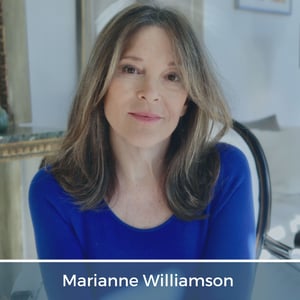
What Happens Now? An Interview with Filmmaker Deeyah Khan
The Marianne Williamson Podcast
Marianne Williamson
4.8 • 1K Ratings
🗓️ 2 March 2026
⏱️ 57 minutes
🧾️ Download transcript
Summary
Williamson speaks with award-winning documentarian Deeyah Kahn about the state of our democracy, what's happening in the world today and where things are headed now.
Subscribe to Marianne's Substack: MarianneWilliamson.Susbtack.com
Subscribe to Marianne's YouTube Channel
Follow Marianne on Instagram
Follow Marianne on Facebook
Follow Marianne on TikTok
Learn more at Marianne.com
Transcript
Click on a timestamp to play from that location
| 0:00.0 | Hi everybody, thank you for being with me today. You know, we have one of my role models on the podcast today and you have, if you know my work, probably heard me speak about her at some point or another. Her name is Dia Khan. Dia was born in Norway to Muslim immigrant parents and for over a decade she has been making documentaries that have won and MA won BAFTA and they go there. They are unflinchingly honest and yet so poignant. She talks to Jehattas, she talks to Neo-Nazis, she talks to white supremacists, she talks to domestic abusers, people who at the beginning, you're just like, I don't even wanna hear this. And by the end, Dia has gotten you to hear them, and you also get the feeling at the end of her documentaries that they heard her to. So I think that what she has done to show our world to us is absolutely stunning. I think of her work as the essence of peacebuilding because she has shown us that there is another way. And as you can imagine, particularly given the state of the world today, I have many questions to ask her and I'm really glad to be able to introduce her to you. Here she is, the icon. Thank you so much. Oh, hey, thank you so much. I have thought about you recently, of course. I mentioned in the introduction this idea that humanity could do things another way. And all of your documentaries have shown us there is another way to be on the planet. There's a way in which we come to understand one another. And we live at a moment where obviously we did not take that option. And we headed in other directions brute force rather than soul force as it were. To such an extent that now we are clearly at a perilous point in our human evolution. Tell us how you feel given the work that you've done about the state of the world today. I'm curious and I know others are as well. Oh, how do I feel? First of all, thank you for having me on. And all those wonderful words in the introduction, you're absolutely a role model for me because you have modeled from the beginning. I think how to show up, how to face life with as much center and presence as possible and as much love and compassion as possible. |
| 2:28.8 | So I really profoundly respect that. So this means a lot to me to be talking to you here today. How I'm feeling is, I think I'm feeling a lot of what everybody's feeling. I think I'm feeling the pace at which everything is happening and the intensity of it all, it feels obviously unsettling, it feels overwhelming, frightening in some ways, but I keep thinking that this moment is so important. I feel like either this is the moment where we just, this is the crash, this is where everything, as we know it, falls apart in a negative way, in a destructive negative way, in a dark way. Or this is the moment where, because everybody's trying to hold on to the past, right? And I'm not sure the past necessarily was that great. So maybe the other point that we are standing at is the possibility of something better, where we try to make up for what we skipped in the past, what we ignored, what we left out, the voices that we didn't hear, the conversations that we didn't have. Maybe this is the moment where we can choose differently, and maybe we can overt this kind of crash course that it feels like we're on. So I do feel hopeful as much as I go between overwhelm and just fear and this intense heartbreak because of the US. |
| 4:10.0 | I mean my children are American. I've lived and worked in America. A lot of my closest friends are in America. So to see what's happening in the US is very, very personal for me. |
| 4:24.2 | It's just not just a spectator sport, in that sense, for me. The world that you describe as falling apart is clearly falling apart. And you also point out, I think, very accurately, that much of the old wasn't all that great. And for those of us who were looking at things through a filter, a recognition that every cause has an effect, recognizing how much injustice and how much suffering and how much inner violence existed just beneath the surface. Even those of us who saw that and knew that this could happen to actually live through it, to see it happening. As you say, it can go one of two ways. It can either be a point of destructiveness that leads, I mean, it could lead to a dark age, or a new dark age, it could lead to dystopia beyond our worst imagining, or it could lead if not immediately then ultimately. And I think you and I agree on that. It will lead if not immediately then ultimately I share that faith with you to a great flowering of possibility for the human race where we are forced to admit and recognize the places where we were on an unsustainable path and we must never be on that path again. Now to me, that's where your documentaries come in because you demonstrate another path. I want to talk about what took you there. I want to talk about what those films mean to you in terms of what they tell us about what is possible but also I want to go somewhere else first. Those of people who have attended my lectures or my classes or whatever over the last few years, probably have heard me mention something that I heard DSA. DSA, you once told me, and correct me if any of this is wrong, that you were at a conference with world leaders, and because of your, you have extraordinary access with all the awards that you've won and the important films that you've made that people know about internationally. You once told me that you asked world leaders what kept them up at night, what scared them the most, what truly made them, you know, gave them the chills to think about. And you expected possibly nuclear catastrophe, biomedical catastrophe, weather catastrophe. And you told me that you were surprised to hear this one thing mentioned more often than not. And that was, what will we do if America goes down? Is that accurate memory on my part? That is accurate. It was when America's exit from Afghanistan happened. And I would call it like I used to go on this sort of, I felt like a groveling tour trying to speak to different leaders and different diplomats and representatives of different countries about pleading with them to take in women's rights activists, to taking some of the women judges, to take in like all these extraordinary people who were at very, very high risk individuals, police women, for example, military women in Afghanistan. And after that conversation, you know, I would ask all of them what kept them up at night, what they were struggling, what they were concerned about. And it wasn't most of them. It was absolutely every single one of them said, if America falls to its knees, if democracy in the US, as we know it, collapses that potential is what keeps me up at night. And I remember at the time going, that's a very big thing to say. And that's a very consistent thing to hear from so many people and you know here we are. So I mean their worst fears are now coming true. And I mentioned that story often. I mentioned that when I was campaigning. In your mind, given that and given where we are today, what and also in your experience of so many world leaders, people internationally, what's the landscape among other democracies, Europeans? I know you grew up in Norway. What's your take? I know a gentleman from Denmark told me recently. He said, you know, until now, we always gave America a pass. Yeah, you gave us Vietnam, but you also gave us Bob Dylan. Yeah, you gave us Iraq, but you also gave us Steve Jobs. So we were always willing to, they'll come back to their senses. He said, we're not there with you anymore. Can you tell me how you read the world reaction to us today? Well, I think America and the presence and the day-to-day workings of most countries have been completely intertwined, whether it's based on security, whether it's based on other geopolitical factors, whether it's economically based, culturally based, you know, I grew up, as you say, I grew up in Norway, then I've spent the rest of my life in England and partly in the US as well. You know, when I was growing up, all of the kind of culture in a way that we were consuming as kids and it's still the fact now was American, you know, so America all of our lives for as long as I can remember, my entire lifetime. And I think a lot of people and leaders in very many countries across Europe, I think they feel betrayed. I think there's a sense of betrayal that this alliance that I think in the synergy that I think people took for granted, that was supposed to be permanent. This was that unmovable relationship between Europe and various countries, European countries, and the US, the fact that they now view the US, many of them as a threat, not as a protector or as an ally or as a collaborator and a friend, but as a potential threat and a potential risk to their well-being, to their economies, to their people, to their, to what they're spreading through, the internet and social media. It's become very quickly now a troubling, concerning, panic-inducing condition. And I think some of it, I'm seeing some of the countries almost kind of scrambling and panicking now to look for other alliances and reconfigure how they operate and how they stand with each other, who they stand with. And in some ways they should have maybe done that a long time ago, sort of placing all of their eggs in the kind of US basket maybe wasn't the wisest thing to do, but they did. So I think now all of them, in quietly or openly, are absolutely looking elsewhere. So I think this is a real shift in terms of alliances. I think this is a real shift in terms of trade, in terms of security, alliances, and loyalties, in terms of the position of the US and the respect that the US had for all of its faults and all of its, you know, hypocrisies and double standards and all of that, it's changed. And I think to get that back, even if the current circumstances were to completely change tomorrow, which they won't, but if they were, that trust that's now gone, I think is going to be really hard to get back. And that fear that it's now instilled in the Europeans, I think, will be very hard to overcome. Well, it's been a process. I think many of those countries said, yeah, you voted for the architect of the Iraq war, and then you voted for him again. Yes, you voted for Donald Trump, and then you voted for him again. And that's what made a lot of us go. We're done. And I think Americans are just waking up to the fact that much of what you just said is a danger to our security. It wasn't just that some of these countries needed the United States. The United States needed these countries. And when you talk about other forces that they're looking to for economic and military security alliances, that's what should scare many Americans. The idea that any of this kind of bullying the world that has been so endemic of the Trump administration has made or can possibly make America safer is the core. No, I think many people are waking up. Yeah, it it's going to make it much much worse. And I think, you know, when the state department was targeted in the way that it's been and when the USAID was dismantled in the way that it was, you know, it was, I remember speaking to, I was still in the US and I remember to speaking to some of my friends who actually did vote for him. And they were like, yeah, this is great, You know, this will save money, this this will be this. And you know, this will make America safer. And I was like, look, it will not. I said, you don't realize that the making America great, everything that is dismantling is actually what was really good about it. You know, America has been one of the first, you know, global powers that has exerted diplomacy and soft and you know soft power all these other ways of having leverage and the ability to influence the world that it isn't doable with only the biggest gun. It just isn't possible. So I agree with you the fact that they have completely demolished some of this this presence around the world, I think absolutely will make America not just less safe, but I think also it'll make it more ignorant politically, because they just won't have their finger on the pulse around the world in the way that they have managed to have. And all this, the globalist this and globalist that and the global collaboration or whatever, I mean, the genius of the US was to help stand up the UN, was to help stand up a multilateral system around the world where cooperation is first and guns are second or military forces second, where dialogue is at the forefront and where the understanding of the prosperity here means prosperity there that we are interlinked and that's not some spiritual principle, that's a practical strategic, economic, military principle that makes complete sense. And of course we've had all the various wars that we've had in the last, however many decades, but relatively speaking, if we glance at history, this has been a very productive and peaceful time for the most part, right? In this post-the second world war. So the fact that they are so quick now to dismantle everything as this world order that somebody else has created. I mean, America was at the forefront, and it's one of the most beautiful things and admirable gestures and steps that the US has taken in the world, creating so much more stability, cooperation and collaboration between nations across severe, severe differences. So it's very disheartening and disappointing to see it means we've surrendered our moral authority. Absolutely. Absolutely. Many years to get our voice back. And before it's not like the world was not like the world was naive about us. |
| 16:05.0 | It's not like the world was not aware of the wars and the militarism. |
| 16:09.6 | But there was always a sense that there were ideals on which we would purport to stand and our best would try to stand. But this has been going on for decades now. When you look at the amount of money given to our military, we were screaming that it was almost a trillion dollars. The president |
| 16:25.6 | dropped now once a 1.5 trillion dollar military budget as you are well aware more than twice the size of all the other countries put together and a diminishment, a consistent diminishment of resources given to the State Department, to diplomacy, to soft power, and so forth. So this has been of the soul of the soul of the soul of the soul of the soul of the soul of the soul of the soul of the soul of the soul of the soul of the soul of the soul of the soul of the soul of the soul of the soul of the soul of the soul of the soul of the soul of the soul of the soul of the soul of the soul of the soul of the soul of the soul of the soul of the soul of the soul of the soul of the soul of, or any other life strategy, because it means alignment with the ways of nature. Anytime you put yourself first at the expense of others, your life is not going to work out, and that's true whether you're a nation or whether you are an individual. Now let me ask you this, a lot of people see something like the decimation, the complete |
| 17:25.0 | demolition of such things as USAID. |
| 17:27.9 | And you know the tragedy here, a lot of people see something like the decimation, the complete |
| 17:25.0 | demolition of such things as USAID. And you know the tragedy here is a lot of people and correctly. So yeah, but the CIA was involved in places they should have been. And I think our point, my point, I assume yours also is yeah, you could have gotten rid of that. You didn't have to burn the whole thing down. That didn't happen. I have hunger starvation hunger, starvation, become blind, etc. Okay. So this is the question I have for you, given your very broad perspective. I think a lot of Americans are deeply curious. What really happened here? If you look at just the tip of the iceberg, what happened here was Elon Musk. He comes in here, USAID is a perfect example. He sends his little computer nerds who know nothing about what these agencies do who have no understanding of the human suffering that they address and he tells them if it looks dumb, get rid of it. So on the surface, this was just a ketamine-high Elon Musk who comes in and does this thing. But there's more and more of a sense, D.L., that there's a bigger project at work here, a bigger agenda, that it's obviously not just demolishing the functionality of USAID, well, USAID period, but the functionality of many of the agencies that, yes, just as USAID help people around the world help people function here in the United States whether it has to do with followers, whether it has to do with any other element children, food, medicine, and so forth. Is it your sense that this is an agenda that is being perpetrated by a group here. We talk about the corporate futilists, the billionaires such as Peter Teel, Elon Musk, and their ilk, the white nationalists. Has the work that you have done and the exposure you've had give you any sense of what really is going on here that all of a sudden in the space of only one year. The functioning United States battered beaten wounded and hypocritical as we sometimes were still stand for the best of human possibility. The whole thing. Just cut down the way it is. What are your thoughts and the thoughts of people that you're in contact with about who and what actually happened here? Well, so there's a couple of things before I talk about that. There is, as I was saying, that there's this huge disappointment in what's happening in the US, and the US stood for a lot of very good things. You know, at the same right next to that opinion, there's also the feeling of very many people, which I also understand, is that this was always the US. What's happening right now is no different than what happened in previous decades. The differences the musk came down. Now, it's like now you're just mainlining the abuse and the exploitation. Now it's just clear. Trump, I think in his first presidency also was like, well, yeah, it's about |
| 20:46.6 | the oil. |
| 20:47.6 | It's about the oil. |
| 20:48.6 | And I think even the person interviewing, he was like, well, yeah, I think what you mean |
| 20:51.3 | is, you know, maybe it's the, yeah, no, it's the oil. |
| 20:53.6 | We want the oil. |
| 20:54.6 | You know, we want the oil. So the Iraq war, we all know how that went and the motivations for that and how that was packaged and sold. |
| 21:02.6 | I mentioned Afghanistan earlier, we're going to go, we're going to save women and we're going to liberate this and that and human rights and whatever. |
| 21:08.6 | And it was never real. motivations for that and how that was packaged and sold. You know, I mentioned Afghanistan earlier, you know, we're going to go, we're going to |
| 21:05.3 | save women and we're going to liberate this and that and human rights and whatever. And, you know, it was never really what, it never is that what it's the, the, the banners that the war wars are sold under are never really proven to be true. So I think that, that kind of hypocrisy and that kind of double speak, I think in some ways, many people now feel |
| 21:25.5 | that that's now been exposed. And in some ways, there's a clarifying feeling in that that now at least we know where we stand. You can deal with this guy because you know the ugliness in a way. He's not pretending anymore. So some people, I think, take this as fine. We finally see what the US is for, for what it's about, what it wants to do in the world, and we can relate to that. We can not relate to it, but we can now try to position and deal with that somehow, rather than it's selling one thing and doing actually something else. And not to go into this whole other thing, but I also do think that one of the things that's hugely underestimated about one of the recent things that's happened is I do think that the Democrats inability to speak about Gaza and the genocide that has happened in the ceasefire that still isn't being respected. I think played a much bigger part in that election than I think anyone would like to give it credit for. Having said that, so what's really going on? I think that the level of exploitation and deregulation and just the kind of predatory behavior that we're now seeing. I think to me makes it very clear that that's the intent to pillage, to pillage and rob and rape the resources of your country and any other country that it can is how it feels. It feels like an abusive drunk conniving manipulative abuser. If I had to give it a kind of form is what it feels like that it's just battering anybody in its way. It's manipulating. It's using force. It's It's wanting to dominate, wanting to be ugly and aggressive. |
| 23:29.4 | And then... It's manipulating, it's using force, it's wanting to dominate, wanting to be ugly and aggressive, and then backing down just enough to build a little bit of kind of relax on the other side and then pounding again. But I do feel that this didn't happen just in a year. I think the conditions were ripe for this. I think this has been a long time coming in many ways. I think that the level of inequality in the US has been rising for a very long time. And you've spoken about this. So it's, I mean, it's one of the things I loved about you and the campaigns that you ran. Is you were very blunt and very clear about the reality and lived experiences of the majority of Americans and how people are and were, and will even more so now live from paycheck to paycheck, if they're looking to have a paycheck, how health care is just a racket in that country, how education is just under supported and prioritized in that country, the fact that the gun laws were what they were, that, you know, in one breath, the kind of some of the people that I would talk to in the militias in the US would talk about, oh, the Muslims, they're so barbaric, they do this and they do that. I remember just looking at one of the guys going, look from the outside, looking in, I could just like you're painting these broad brushes of whatever based on what happened on 9-11 or some specific incident. |
| 24:48.0 | I can also say you're barbaric, you kill your own children. You walk into your own classrooms and just mow down your own children. And then don't stop. Do nothing about it. So I think the conditions have been there a long time, |
... |
Please login to see the full transcript.
Disclaimer: The podcast and artwork embedded on this page are from Marianne Williamson, and are the property of its owner and not affiliated with or endorsed by Tapesearch.
Generated transcripts are the property of Marianne Williamson and are distributed freely under the Fair Use doctrine. Transcripts generated by Tapesearch are not guaranteed to be accurate.
Copyright © Tapesearch 2026.