
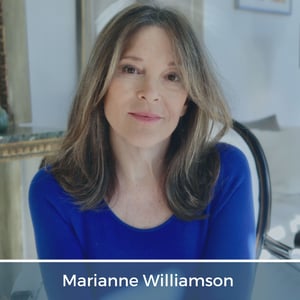
Substack Live with Marianne Williamson and Jeff Burningham
The Marianne Williamson Podcast
Marianne Williamson
4.8 • 1K Ratings
🗓️ 31 May 2026
⏱️ 63 minutes
🧾️ Download transcript
Summary
Author and entrepreneur Jeff Burningham joined Marianne for a Substack Live where they discussed his book THE LAST BOOK WRITTEN BY A HUMAN: Becoming Wise in the Age of AI.
JeffBurningham.com
JeffBurningham.Substack.com
Sign up for Marianne's Substack at MarianneWilliamson.Substack.com
Transcript
Click on a timestamp to play from that location
| 0:00.0 | Five. Okay, everybody. Thank you for being here. I'm excited about this conversation we're |
| 0:05.4 | about to have. I know people are being notified and people will be coming on. And I will start setting up this conversation. Have a wonderful guest tonight. Gentleman named Jeff Burningham. And I got your book, Jeff, in the mail. I had not heard of your work before. I saw this book, last book written by a human, |
| 0:27.2 | becoming wise in the mail. I had not heard of your work before and I saw this book, last book written by a human becoming wise in the age of AI. So I thought, you know, started just looking to it and of course, it became very interesting and I'm very glad to be talking about it. But I also thank everybody. It's particularly interesting that Jeff and I are having this conversation today because as we know, the purpose has just released an encyclical, which is a huge deal about the issue of AI and particularly the moral context within which we need to see it. He said something I've said, I think a lot of people who said it, which is that we need to regulate this the way you regulate nuclear power. This has the power to do very good things. I think the bottom line on that is just that it's here, regardless what you think about it. But I think many people are deeply concerned because it also has the power mean to encivillization as we know it. Let's just get right to it. I think everybody realizes that. Jeff Burnningham's book is so interesting because because we all know Jeff we're living in this time of a real dichotomy. We get, we get, you know, the lab and saying it is a tsunami's coming. It's either going to be a great light or great dark. The days of neutrality are over. And so this is the time of great potential impending peril. But it's also, and this is what you stress so much in the book, |
| 1:45.3 | when I think the book is about, correct me from wrong, is it's also potential for profound light. But it's not just what we need differently, it's who we have to become, right? Is that what you'd say? Absolutely. I mean, AI, if you think about it in one way, and I make the argument in the last book written by a human is simply a cosmic mirror to humanity, a reflection of us because Marianne, think of what it does. It just takes all of recorded data, human history, and then how we interact with it, and then it provides a reflection back to us. And as you know, a reflection can be a powerful thing. It shows our biases, it shows our inadequacies. It can also look at our patterns, our patterns of dysfunction. Hopefully we can see those more clearly. And then we can choose if we want to change. I think it's time for a change. And I think that in AI, you could say the obstacle becomes the way here. Yeah, I read that. It's a certain quality. Yeah, through this reflection, the way becomes more clear, I think, for humanity. I'm gonna push back on that a little in a few minutes because it's nice that you think that I can think that everybody listening can think that but what really matters at a certain point is the Sam Altman think that because he's not just Peter Teal think that's Alex Carp. You're very sophisticated man and you know that. But what's next to that because I think that your setup here is so important. First of all, I want people to understand. Guys, Jeff Burning him, Jeff, your book is, I want to talk about a man of the moment, right? So you grow up, you raise a family within this very traditional Mormon church, right? You're from Utah, Mormon, Mary, four kids at one point, a bishop in the church, goes all the way from that to investor, tech guy, multi-billion dollar companies, then you add civil side and then you add Ioska, then you add your pamphlet governor, it's like, this is interesting. And then you say, I think it's time for me to tell the world how we're going to survive AI. But your book, in essence, is a profound story about a spiritual journey. And very very definitely the spiritual journey that I think speaks to this moment. So I'd love to hear you first tell people about your life, your journey, which is a spiritual journey. And then we're going to have a little conversation about AI because I think that I'm not the only person who would listen to you. And as I said, all that's very nice, |
| 4:25.0 | but you're talking Peter Tiel and et cetera. |
| 4:27.7 | So, let's see what I'll tell us more about. |
| 4:29.2 | Well, Peter Tiel and Sam Altman and all those guys, they're part of us, right, Maryann. So like, we're in this together. So you're absolutely right. Let me tell you a little bit of my, Yeah, I grew up in a very conservative Christian home, |
| 4:44.4 | Mormon, Latter-day Saint, a Beno Bishop, |
| 4:47.4 | and a leader in the church in various regards. |
| 4:49.8 | I saw... I grew up in a very conservative Christian home, Mormon, Latter-day Saint, a Benubiship, and a leader in the church in various regards. I served a mission for two years for the church, which is very common. I'm an entrepreneur, so I've started large companies here in Utah and invested in over 200 technology startups here in the state. I grew very quickly, like you said, I'm a father for. I'm actually a grandfather of one now, I've been 18 month old grandson. Happens fast here in Utah. Yes, that is my heart. I love that. Yeah. It's beautiful. But the pace that I was keeping was not, I could not keep the pace in these startups. I had become, like I think a lot of us, a human doing. And we're not human doings. We're human beings. And this is one of the interesting things that we get to grapple with as that we as humanity get to grapple with in the age of AI, as a machine becomes better and better at doing so much of what we have done, so much of how we defined ourselves as by our doing, what are we left with? And I would argue that we're left with our essence, our being. |
| 6:05.0 | We are human beings after all. |
| 6:08.0 | Yes. |
| 6:09.0 | I think that that conversation has already been mainstreamed. |
| 6:12.5 | Every, probably every person listening, |
| 6:14.5 | heard Wayne Dyer say, we're not a human being, |
| 6:16.9 | doing we're human being. |
| 6:18.6 | I think the way you put it in your book was great. |
| 6:20.3 | You said, the smarter the machine gets, |
| 6:22.4 | the wiser we must get. |
| 6:24.4 | So, go from the baseline of everybody gets the basics. Everybody, but the way you talk about it in your book, there's really, you talk about the periods of disruption, transformation, get right into it because the book gets right into it. So I assume that we know the best people know that this is a time of spiritual growth and spiritual evolution. People know we need to embody it. People know that we need to raise our frequency now, but that's really our only hope actually. Right? Yes. Yes. I'd like to hear some of your own experiences, some of the things that you felt that you saw on Sylasyban, your ayahuasca, where you think psychedelics come in. So just know that the whole we're not doing we're being like people get that. But what do we do in all seriousness about the San Mortman Alex Carp, the very real things that the Pope was discussing? People are concerned about massive job disruption, massive data surveillance, massive manipulation. And what could be obviously the enslavement of the human race. Now you just said something very interesting, and I think that I'm probably speaking for everyone here, saying, I get you conceptually. Could you say something very important? Alex Carr is part of us. Sam Altman is part of us. Peter Till is part of us. Get in there because you do get in there in the book and talk to us about how you see the evolutionary elevation of human frequency. |
| 14:06.5 | Because what I heard you say is if we're more ethical, all that AI will do is mirror us. But once again, it's in the hands of people who might not wish to mirror the better angels of our nature. So at that point, you get what I'm coming from throwing it over to you. Yeah. I mean, life is a heroic journey for each of us. So here we are individually on our own heroic journey. And you mentioned that I ran for governor in the state of Utah. In 2020, I lost during the pandemic. And that was a, the little platform that I had built for myself just disintegrated. And I was free-falling into nothing. I talk about in the book kind of climbing my little mountain of success. We all do this in different forms. And when I got to the top of my mountain, I say there's nothing but a cold, howling wind, just void and more void on top of that. So, man, you may or may not like this answer, but what we have to do instead of looking outside of ourselves, I think the place to begin is to look inside of ourselves. So, I wrote the last book written by a human to be a conversation starter. I mean, this book's been out for almost a year now. It was ahead of its time in a lot of ways. And this is a conversation that needs to be had obviously in boardrooms and government halls and even in religious institutions, but especially around the dinner table. So where we begin is with what we can control. So it's how we interact with the digital world that we're living in, and then what we model for our children. So the real work that we have to do here is to look into the mirror and to decide where we want to go. Will we allow AI to be continued to be pointed at what I call it in the book, the old game of division, greed and hate? Or will we use it as a tool for personal transformation? And eventually the last section of the book is institutional evolution. I think that's what you're talking about here and what you're getting at. Institutions are made up of individuals. We have power within institutions. If we don't, then what are any of us to do? I think that we do hold power. I think that we can speak to the powers that be. I think you've made a career in a life of doing that. It doesn't mean that our voices will be heard. It really, you know, Mary Ann Williams, since voice, Jeff Bernie Ham's voice, whoever else we want to list, we could list a lot of names. It's not really up to us, let's say, how much our voices travel. We get to share what we feel like we should share after our own internal journey. And then it's up to us to obviously act in wisdom and decide where we feel like we should play, whether that's politics, inside politics, outside of politics, et cetera, et cetera, in terms of the transformation of humanity and the evolution of our institutions. That is coming via AI. Either through, I mean, it will probably come, unfortunately, through a lot of pain. It seems like humans need pain in order to look in the mirror and to do the hard internal work, both individually and collectively, that I believe is at the heart of existence. I believe this is at the heart of why we're here and what we are, it's time for us to do that work in earnest. And so that starts individually. And certainly I talk in the book about a political movement, I call it the human political movement, that's an option, right? It's a direction that we could go where we then transform our political system potentially. We look at different ideas. You know, our tribes may be saved us when we were on the savanna, you know, trying to stay alive from lions or whatever the case might be, but now our tribes are destroying us. So I say that we get to sacrifice the specialness and I grew up in some quote unquote special tribes. The Mormon Church is a special tribe. Our political parties are a special tribe. What's much more fundamental I, than our tribes is the unity and the oneness that exists amongst us. So when we can point out, you know, the deficiencies in our political leaders and the CEOs, et cetera, but no matter our differences, Marianne, whenever we We are sitting across from another human being, we are on sacred ground because we always share more in common than we don't. And we've forgotten that in our day. We have made enemies out of people that don't see things the way that we see them. So this is work that needs to be done in the human heart. And when I've talked about the human heart, talking about individual human hearts and our collective human spirit in heart. And I think that AI is here to either accelerate that or yeah, to accelerate a path that will not be good for any of our children or grandchildren. Well, first of all, don't get me wrong. I agree with every word in your book and when you said you might not like this answer don't please don't misunderstand anything I said I totally agree with you the change comes being has to come before doing I saw some graffiti once it said doing is being Kierkegaard being is doing Shopenhauer, do be do be do it's an atra. So funny. I think any of us with a spiritual perspective understand that everything in the world is a reflection of us. And this is a time of a deep evolutionary possibility. I think think people do realize that. I think that one of the things that does make your story |
| 14:29.5 | in America. I think that there are, and you said, and you said in the book, and you said something a couple minutes ago, you got to the top of that mountain, and I knew exactly which mountain you were talking about because I read the book, meaning very successful, financially, in business, et cetera. And you said I got there and there was nothing there. I think that there are people and enough people in America. And I assume in the West, or maybe in the world at this point, you know, this evolutionary trend is not coming |
... |
Transcript will be available on the free plan in 25 days. Upgrade to see the full transcript now.
Disclaimer: The podcast and artwork embedded on this page are from Marianne Williamson, and are the property of its owner and not affiliated with or endorsed by Tapesearch.
Generated transcripts are the property of Marianne Williamson and are distributed freely under the Fair Use doctrine. Transcripts generated by Tapesearch are not guaranteed to be accurate.
Copyright © Tapesearch 2026.