
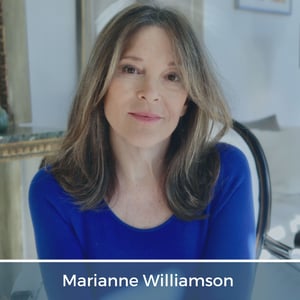
Harvey Kaye on Thomas Paine: "We Have It in Our Power to Begin the World Over Again"
The Marianne Williamson Podcast
Marianne Williamson
4.8 • 1K Ratings
🗓️ 30 January 2026
⏱️ 55 minutes
🧾️ Download transcript
Summary
In an era when cynicism and despair can feel overwhelming, how do we recover the firebrand spirit needed for effective resistance without losing our moral center? Marianne Williamson talks with historian Harvey J. Kaye about Thomas Paine's role in turning rebellion into revolution, the power of education in nonviolent movements, and why history can be both instruction and inspiration. Plus, why this administration wants violence and why a disciplined nonviolent response matters.
Subscribe to Marianne's Substack: MarianneWilliamson.Susbtack.com
Subscribe to Marianne's YouTube Channel
Follow Marianne on Instagram
Follow Marianne on Facebook
Follow Marianne on TikTok
Learn more at Marianne.com
Transcript
Click on a timestamp to play from that location
| 0:00.0 | Hey everyone, thank you for being with us today. We have an important guest to story on Harvey K. He's a friend of mine. Somebody I greatly respect. I read his books. I hope you do too. And I want to tell you a little bit something about him before I bring him on. Harvey is Professor Emeritus of Democracy and Justice at the University of Wisconsin in Green Bay. He's a member of the American Federation of Teachers. He is the award-winning author and editor of 18 books. They include Thomas Payne and the promise of America, the book that I most want to talk to him about today. Also, the fight for the four freedoms and FDR on democracy. He's currently co-authoring a book with Alan Minsky on the case for an economic bill of rights. |
| 0:45.0 | Join with me, please, and give a big welcome in your heart. Harvey K. Harvey, thank you so much for being here. That's a pleasure. I mean, we've exchanged texts almost daily, but I don't think I've seen your face in two years, maybe. Is it possible? Well, I saw your daughter's face. We had lunch together, not too long ago. Right. She was thrilled to be able to do that. Yeah, yeah, I was she said to make sure to say hello when I saw you today |
| 1:08.1 | Listen, I called you earlier the artist's face, we had lunch together not too long ago. Right, she was thrilled to be able to do that. Yep. |
| 1:05.3 | Yeah, I was thrilled to see her. |
| 1:06.3 | She said to me, she was going to say hello when I saw you today. |
| 1:08.3 | Listen, I called you earlier today, of course, to talk about what we were going to talk about in this interview. You and I talk a lot about the politics of an economic bill of rights, the re-emergence of the spirit of FDR and our politics, which of course was very important in work that |
| 1:22.9 | we did together, also that you see among a lot of progressives in America and so forth. |
| 1:27.7 | But particularly given the events of this current moment, it feels to me like the spirit of Thomas Paine that you have talked to me about so much and that you've written about so eloquently is really something that I think would inspire a lot of people. I had known, I think, what most people know about Thomas Payne, oh yeah, he bought this |
| 1:46.7 | pamphlet called Common Sense, he had something to do with the American Revolution, he sort of considered one of the founders even though he wasn't an elected official, and that was pretty much it for me, and I think probably for most people. But reading your book about Thomas Payne and hearing you speak about him, I've come to realize what an important part he played at a moment that is in many ways much |
| 2:07.8 | like the one we're living through now. So imagine that none of us know anything about Thomas' pain and could you tell us other things that you obviously know so much about and also that you realize you realize the importance of this man and what he did in ways that I think would be inspiring to all of us. Okay, I'll just, I won't go into the story, but I will tell everyone that I have been, in quote, it's a fan of Thomas Payne ever since I was 10 years old. Okay, for that. Yeah. Wait, why wouldn't you tell us the story? Because I want to hear this story. Oh, well, I thought maybe I had told you before it, it goes back to 1959, 1960. My grandparents on my father's side were living in Brooklyn, New York. All the family was at one time living in Brooklyn, New York. And they were living opposite the Brooklyn Museum, which is fabulous museum, even to the fact very much to this day. And you know, 10-year-old, I had a younger sister who was four years younger, but we'd have a lot of cousins, occasionally they would show up, but not a lot of cousins. And after a while, it could be boring in an apartment in Brooklyn, New York, or at least I thought at the first. So I would try to get my father, when possible, to go with me across the street to the museum. At 10 years old, they weren't about to let me go by myself. And especially, there were moments like when my grandparents who were born as very, very young when they emigrated from Russia, slash the Ukraine to the United States, they spoke some degree of Yiddish. And it's not unusual usual in families that if the grandparents know foreign language, if they want to disable the capacity of the kids to understand what they're saying, or indeed to send a signal to the kids to leave the room, they talk about foreign language. So my grandparents, if, if, if, either one of them was eager to see me leave the room, they would just start speaking yiddish. My parents could sort of understand, but not really understand it. So it really was simply a signal. And what I would do is, if there was no cousin around, I would wander my grandparents apartment, which, you know, had several rooms, as if it was a museum, as if each room was a gallery of a museum. And there was one place where I always ended my tour. It was in their dining room. I mean, it was a large enough apartment. It actually had its own dining room. And at the end of the long table, there were bookshelves. And those shelves were my grandfather's personal books. He was a trial lawyer, criminal lawyer in New York City. But that's where he kept his personal books. And I would always end up sitting down on the floor, that's where grabbing books in front of me. And after a while I realized I was going back to the same place and pulling the same book off the shelf all the time. And though this is not the original copy that I did. So this is a book I later found in a bookstore, recalling my grandfather's books, this was this book, Thomas Payne, author of the Declaration of Independence. Now, the book was written by a major figure in the free thought, you know, I, I, he might even have been an atheist, but in any case, he, he was a huge, um, follow-up of Payne's ideas and arguments and he was constantly promoting the idea that every state, maybe aversity, should have some kind of monument to Payne. The point is he loved Thomas Payne and he bought into this argument which went back into the 19th century that it really wasn't Jefferson but it was Payne who wrote the Declaration. And let me make it clear, I don't believe it for a moment any longer, but at 10 years of age, if you find a book that contradicts your teachers, you can be sure that you're gonna embrace it, basically. And I did, and as I always told my own students, I never got 100% on quizzes or tests about the American Revolution, because I made the foolish remark that, well, you know, it really was pain who did whatever, you know, author of the Declaration. |
| 6:08.0 | Like there is about who should be here was? |
| 6:10.4 | Yeah, right. So, so anyhow, my grandmother actually passed away around the time I was 11, |
| 6:18.8 | and my grandfather was downsizing the apartment, and he gave me a number of books buying about |
| 6:23.7 | pain, though that book was not included. Probably wanted to keep me from becoming an idiot in school. So, but I did see pain then as this figure that if my grandfather admired him, I should admire him too. And I did try through high school to read pain's works. Some I understood, some I didn't really grasp at all, but it became part of my persona, you might say. And I didn't study, I really was not a student of American history when I was in college or grad school. I was especially a student of Latin American studies. Later I had moved to British studies and my first books were actually in British, not history of a British intellectuals. It was on a series of works that they had produced in a group in particular called the British Marxist Historians. Well, basically around, well, would that be the 1980? Especially, well, this goes back in some ways to when Ronald Reagan was accepting the nomination for president in 1980 at the Republican National Convention. I can't remember the city was held in board. I do remember anyone who was interested in Thomas Payne or for that matter, FDR or for that matter Lincoln will remember that speech if they heard it, or especially if they watched him presented. Reagan who had been an FDR Democrat as a young man, a very serious FDR Democrat, basically never gave up the knowledge he had acquired in his earlier years in Hollywood or even in politics. Anyhow, that night, accepting the nomination, he quoted three figures from American history that were not supposed to be quoted any longer by a conservative Republican. Well, if they were never quoted by a conservative Republican, one of those figures was in fact Thomas Payne. The second one was Abraham Lincoln. And the third one, shockingly, was Franklin Roosevelt. In fact, he was so eager to do it and so proud to do it that he actually pissed off George Will, the leading conservative columnist in America who said, wait a minute. A conservative is not supposed to be quoting Thomas Payne or Franklin Roosevelt. He should be quoting Edmund Burke, the great Anglo-Irish philosopher and member of parliament. So anyhow, I never forgot that. And then around 1980, and I was in England sometimes during the 80s, |
| 8:49.0 | no, this never forgot that. And then around 1980, and I was in England sometimes during the 80s, no, this was around 1990, I guess. Am I kidding myself? Wow, time flies, doesn't it? He, my historians that I had been working with and writing works about, they kept saying to me, you know, you really should be doing American history. You should be writing something that might make a difference over there, okay? I'd already developed something of a political reputation. And Britain is about you should be doing it over there. And I decided it was time, perhaps, to pay more attention to my childhood hero, Thomas Payne. Now, to make the long story short, because it's really a story of academic and trade publishing, but to make the long story short, I ended up writing a young adult biography of Thomas Payne for Oxford University Press. And I mean, I was blessed to write that. I mean, had pictures in it. You know, I had all the things that a 15 to 20-year-old might really like like to see. And to my amazement, because I didn't even know that such a thing existed, I won a New York, I won the New York Public Library Award for the best book for the teen age. That was the title of it. And I was so thrilled by that. I mean, I'm sorry. Is that book still in print? Yeah, Yeah. I'll show everyone in case they're curious to buy it as a next year. Okay, it's called Thomas Payne, Firebrand of the Revolution. And yeah, as I said, it was a blast to write it. And I won the award. So I decided, we were walking my wife and I were walking in the woods, Lauren and I, and I said to her, you know, I don't want to give up Thomas Bain. But there are already good biographies about him. I don't need to mention it, but there were two or three good biographies. But what I decided I'd want to do since I'd already written this young adult biography, is do a book of three parts. The first part would be pain's life and labor. The second part would be the story of how conservatives, and I'm not exaggerating when I say, for 200 years, did everything in their power in this country and in Britain, and all the more aggressively, I think, over here, to suppress Thomas Payne's memory because of his deraticalism, the democratic spirit of it, and also the things that he had to say about, first of all, the imperative, he didn't call it this, the imperative of social democracy. He's really the founding figure of social democracy. But, and then moreover is he wrote when he was back in Europe and it involved in the French |
| 11:29.4 | revolution. He's really the founding figure of social democracy. And then moreover is he wrote, when he was back in Europe and it involved in the French Revolution, he wrote a book, The Age of Reason, which I can imagine this would not be a book. You'd be terribly happy to read, but it was really an attack on organized religion that denied the divine origins of the Bible. Now, everyone who hated him thereafter said he was an atheist. He was never an atheist, ever an atheist. He was a deist. He believed in God, as he even said, he believed in a life in the hereafter. I think that was most of the sounders. |
| 12:05.5 | Exactly. |
| 12:06.5 | In fact, the funny part is when I say that to people, they don't want to believe it. |
| 12:10.1 | Of course, no, no, no, they were Christians, but that was true of the whole crew of them, |
| 12:13.8 | almost all of them. |
| 12:14.8 | Sam Adams was not a deist, but John Adams was, never talked about Washington was. |
| 12:19.7 | And as a side note, the now late Michael Novak, the leading figure in conservative intellectual circles, and really the foremost figure on questions of religion and politics, et cetera, et cetera. When he and I met, we were doing a show together on C-SPAN, he actually was overjoyed to meet me, because I didn't deny that pain was an atheist, and he fully accepted the argument that Washington was a deist as well, which is amazing to him to admit. Anyhow, so I ended up writing this book, however, I didn't write the book that I contracted to write. What happened was when I started working on the book, again, I'll make that part of the story short, I discovered that despite 200 years of efforts to suppress pain's memory in every single generation, the progressive movement or movements of the day, rediscovered and took hold of Thomas Payne as a champion for his arguments that have to do everything, from everything from democracy to equality of men and women, to free thought, to the rights of working men and women. I mean, he constantly spoke in his work to the kinds of things that later these progressive liberal radical movements just could not resist embracing and they kept his memory alive and in fact the more I looked through I realized first of all his writings were never out of print ever in the United States. Okay, it's also the case that some very leading figures were deeply influenced by in the most most impressively so, Abraham Lincoln. The editor of Lincoln's collected works does it well after Lincoln's death, actually made the remark something to the fact that I'm paraphrasing. If you forget the prairie school teacher and they like that, Lincoln picked up a lot of his ideas and even his writing style from Thomas Payne and he gave some credit as well to Jefferson, but it was Payne, he said. And as I was reading all the more into Lincoln when I got to the point in my, oh, I didn't say, I turned my book into that book of three parts, Life and Labor's, the effort to suppress his memory, which, you know, I just got otherwise and thus turned into a book about the struggle overpains memory for 200 years. And the third part was I was going to tell, I was going to bring pain back to life and have a dialogue with him in the book. And I actually got a contract to write that. But the other parts became so big that I figured out why reduce the book to a fantasy conversation. And the book became, to this day, probably the, you know, that to judge it merely by market, but the best seller I've ever had. And it was a pleasure to do it. Well, I'm glad that you did. And I have a few questions to ask you. First of all, I was fascinated by what you said regarding Reagan's acceptance speech. You said for the Republican nomination in 1980. You said he quoted pain and Lincoln and FDR. Do you remember what those quotes were? Oh, absolutely. Well, the quote of Lincoln, I can't say that I remember right off the top of my head right now. The quote of Roosevelt was to take out of place. Okay, this is the key thing. Roosevelt did not believe in the dole, as they say in England, in welfare payments. He believed in enabling people, opportunities, and also enabling them to have jobs and to be in a position to organize themselves in a workplace to secure better wages. So basically, Reagan found in Roosevelt's writings this remark having to do with the dull, something to the effect of giving money away. And he used it, which is totally out of the spirit of Roosevelt. I definitely remember, to me the most important words that the pain may have ever written. In common sense, the second, it was like the third edition, but the second edition that he approved of, he had a line, actually a whole paragraph, but the key line is, we have it in our power to begin the world over again. Right. And I can tell you that liberal Democrats had only started to quote, what I say, liberal Democrats of the highest elite, the likes of President, like Roosevelt. Roosevelt's the one who brought, brought pain back into the liberal democratic discourse back in 1942, in fact. But Democrat, and Democrats thereafter didn didn't hesitate to quote, pain the patriot. Pain in many ways, a liberal. But they never ever, and I looked at everything, quoted pain's lying, we have it in our power to begin the world over again. They did not bring pain the truly most revolutionary figure of his day back into public life intellectually speaking. So, but and here was Reagan doing it. Okay, so there are a couple of things I want to talk about. First of all, I think it's interesting his quoting and as you said yourself, very much out of context, Roosevelt's concept of you know, that we don't want the dull. But of course, and this is for all of us to remember, he didn't want the dull, but what he did want was fundamental economic justice, as you said, or people to be able to have good jobs, for people to have economic opportunity. I have a couple of questions for you. One has to do with your mentioning social democracy, because I think a lot of people don't quite know what that means when we use the phrase social democracy. |
... |
Please login to see the full transcript.
Disclaimer: The podcast and artwork embedded on this page are from Marianne Williamson, and are the property of its owner and not affiliated with or endorsed by Tapesearch.
Generated transcripts are the property of Marianne Williamson and are distributed freely under the Fair Use doctrine. Transcripts generated by Tapesearch are not guaranteed to be accurate.
Copyright © Tapesearch 2026.