
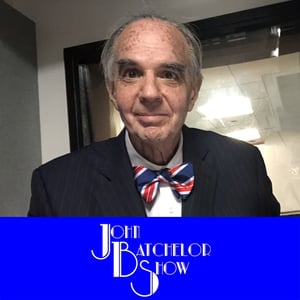
CBS EYE ON THE WORLD WITH JOHN BATCHELOR SHOW SCHEDULE 9-5 GOOD EVENING: The show begins in Las Vegas as the Strip struggles with decline.
The John Batchelor Show
John Batchelor
4.5 • 2.8K Ratings
🗓️ 6 September 2025
⏱️ 11 minutes
🧾️ Download transcript
Summary
SHOW SCHEDULE
9-5
GOOD EVENING: The show begins in Las Vegas as the Strip struggles with decline.
FIRST HOUR
9-915
Jeff Bliss, Las Vegas Tourism Decline and Anaheim Development
Jeff Bliss reports a significant decline in Las Vegas tourism, with a 12% drop in visitors, which he attributes to the city's nickel and diming practices by major corporations like MGM and Caesar's Palace, coupled with the rise of online gambling. Despite increased gaming revenue, the broader city economy, including restaurants and hotels not part of the strip, is suffering. Vegas resorts are now offering discounts and food credits to attract visitors. Nevada's unique lack of a state lottery, forcing residents to cross state lines for games like Powerball, also highlights a peculiar disadvantage. In Anaheim, a proposed skyway/gondola system aims to connect Disneyland, hotels, and sports venues.
915-930
Brandon Weichert, Artificial Intelligence, Quantum Computing, and Economic Impact
Brandon Weichert and John Batchelor discuss artificial intelligence and quantum computing, with Weichert expressing optimism for AI's long-term economic benefits, though he finds a 7% GDP growth projection very optimistic. He believes AI will augment, not replace, human work, leading to positive productivity gains over time, especially in manufacturing and tech sectors. The conversation touches on AI's current competitiveness in generating novel research hypotheses, nearly matching humans in a Science magazine study, but humans still slightly lead in designing experiments. Weichertsees quantum computing as the next breakthrough
930-945
Professor Richard Epstein, Federal Power, National Guard Deployment, and University Funding
Professor Richard Epstein discusses two cases involving the Trump administration's use of federal power. First, he analyzes Judge Charles Brier's ruling that Trump's deployment of National Guard troops for immigration enforcement in Southern California was partially illegal, citing the 1878 Posse Comitatus Act. Epstein distinguishes between protecting federal interests and overstepping into local policing, as with traffic violations or raids far from Los Angeles. He criticizes the political polarization between Trump and Governor Gavin Newsom for hindering cooperation during emergencies. Second, Epstein addresses Judge Allison Burroughs' interim decision against Trump's freezing of Harvard's research funds over anti-Semitism allegations, warning of long-term damage to US medical research.
945-1000
CONTINUED Professor Richard Epstein, Federal Power, National Guard Deployment, and University FundingProfessor Richard Epstein discusses two cases involving the Trump administration's use of federal power. First, he analyzes Judge Charles Brier's ruling that Trump's deployment of National Guard troops for immigration enforcement in Southern California was partially illegal, citing the 1878 Posse Comitatus Act. Epstein distinguishes between protecting federal interests and overstepping into local policing, as with traffic violations or raids far from Los Angeles. He criticizes the political polarization between Trump and Governor Gavin Newsom for hindering cooperation during emergencies. Second, Epstein addresses Judge Allison Burroughs' interim decision against Trump's freezing of Harvard's research funds over anti-Semitism allegations, warning of long-term damage to US medical research.
SECOND HOUR
10-1015
Bradley Bowman, Chinese Military Parade and US Security
Bradley Bowman discusses a recent massive Chinese military parade, noting the presence of Xi Jinping, Vladimir Putin, and Kim Jong-un, with the president of Iran also in attendance. He views the parade as a demonstration of China's decades-long effort to build a military capable of defeating the US in the Pacific, highlighting the erosion of American security and increased likelihood of a Taiwan Strait conflict. Specific concerns include modernized hypersonic YJ seriesanti-ship missiles challenging US naval interception, the DF61 intercontinental ballistic missile aimed at the US, and a low-observable tailless drone for manned fighters.1015-1030
Conrad Black, Canadian Politics, Mr. Carney's Government, and Regional Challenges
Conrad Black discusses the challenges facing Mr. Carney's new Canadian government, particularly the unrest in Alberta. Carney's extreme green views threaten Alberta's oil and ranching economy, leading to a significant separatist movement that could see the province join the United States if its energy exports aren't facilitated. Black notes that Carney has yet to reveal his plans to address this or the historical cultural and political challenges posed by Quebec, a wealthy province with aspirations for independence. Carney has been robust on national security, agreeing with President Trump that Canada needs increased defense spending.1030-1045
Jim McTague, Lancaster County Economy and National Job Market
Jim McTague provides an optimistic view of Lancaster County's economy, contrasting with national job market slowdowns. He notes low unemployment at 3.4% and no personal reports of job losses. The county's economy is buoyed by affluent retirees, who contribute millions to local restaurants and businesses, and a booming tourism sector attracting 10 million visitors annually. McTague highlights the importance of agriculture and the Amish culture as economic backbones. However, housing prices are significantly elevated, posing a challenge for younger, lower-wage workers. Growth is concentrated in suburban townships due to a superior healthcare industry and expanding data centers and pharmaceutical companies attracting professionals.1045-1100
CONTINUED Jim McTague, Lancaster County Economy and National Job Market
Jim McTague provides an optimistic view of Lancaster County's economy, contrasting with national job market slowdowns. He notes low unemployment at 3.4% and no personal reports of job losses. The county's economy is buoyed by affluent retirees, who contribute millions to local restaurants and businesses, and a booming tourism sector attracting 10 million visitors annually. McTague highlights the importance of agriculture and the Amish culture as economic backbones. However, housing prices are significantly elevated, posing a challenge for younger, lower-wage workers. Growth is concentrated in suburban townships due to a superior healthcare industry and expanding data centers and pharmaceutical companies attracting professionals.
THIRD HOUR
1100-1115
Molly Beer, Angelica Schuyler Church and the American Revolution
Molly Beer discusses Angelica Schuyler Church (1755-1814), a prominent figure during the American Revolution. Born to the influential Schuyler family in Albany, Angelica was well-educated, a trait uncommon for women of her time but typical for Dutch families. She eloped with John Carter (later John Barker Church), much to her family's dismay, a decision perhaps driven by love for the cosmopolitan Englishman. Angelica was deeply involved in the revolutionary cause, supporting the French army and maintaining a strong patriotic identity even while living in London after the war. She cultivated extensive connections with key figures like George Washington, Alexander Hamilton, Thomas Jefferson, and Lafayette
.1115-1130
CONTINUED Molly Beer, Angelica Schuyler Church and the American Revolution
1130-1145
CONTINUED Molly Beer, Angelica Schuyler Church and the American Revolution
Molly Beer discusses
1145-1200
CONTINUED Molly Beer, Angelica Schuyler Church and the American Revolution
Molly Beer
.
FOURTH HOUR
12-1215
Henry Sokolski, Plutonium, Nuclear Proliferation, and International Debate
Henry Sokolski discusses the global debate surrounding plutonium, a highly poisonous substance used in nuclear weapons, especially by China, South Korea, and Britain. He explains that plutonium can be extracted from nuclear power reactors and quickly used to make a bomb, similar to the Nagasaki weapon. Sokolski criticizes the US Energy Department for suggesting that new reactor designs like Natrium and Ollo can extract plutonium while leaving enough radionuclides to prevent bomb-making, a claim previously debunked by studies. He highlights proliferation risks, citing South Korea's historical attempts to use civil reprocessing to acquire nuclear weapons.1215-1230
Jack Burnham, Manhattan Project Lessons for AI and US-China Talent Competition
Jack Burnham explains that China views the Manhattan Project as a key lesson in harnessing international talent for national strategic goals, particularly in artificial intelligence. The US successfully recruited theoretical physicists fleeing Nazi Germany, nurturing a scientific reserve for the atomic bomb project. Burnham notes that after World War II, the US continued to prioritize basic science funding, leading to its technological edge. However, he suggests the US is currently struggling with this, as funding issues and regulatory uncertainty are driving American scientists abroad and limiting foreign talent attraction while countries like China, the EU, France, and Canada actively recruit US scientists.1230-1245
Nathaniel Peters, The Nature of Murder and Evil in Andrew Klavan's "The Kingdom of Cain"
Nathaniel Peters reviews Andrew Klavan's "The Kingdom of Cain," which explores murder and evil through fiction and real-life examples. Klavan, a former atheist, was propelled to faith by Klavan, a former atheist, was propelled to faith by pondering evil, suggesting that recognizing objective moral order is necessary to condemn acts like those of the Marquis de Sade. The book examines Leopold and Loeb, who murdered to prove their superiority and live beyond good and evil, but left a crucial clue, highlighting their human fallibility. Klavan also considers Dostoevsky's Raskolnikov, whose rationalized yet pointless murder leads to a breakdown of his self-deception. Klavan argues artistic creation, like Michelangelo's Pietà, can redeem or transform the subject of art.1245-100 AM
CONTINUED Nathaniel Peters, The Nature of Murder and Evil in Andrew Klavan's "The Kingdom of Cain"
Nathaniel Peters reviews Andrew Klavan's "The Kingdom of Cain," which explores murder and evil through fiction and real-life examples. Klavan, a former atheist, was propelled to faith by pondering evil, suggesting that recognizing objective moral order is necessary to condemn acts like those of the Marquis de Sade. The book examines Leopold and Loeb, who murdered to prove their superiority and live beyond good and evil, but left a crucial clue, highlighting their human fallibility. Klavan also considers Dostoevsky's Raskolnikov, whose rationalized yet pointless murder leads to a breakdown of his self-deception. Klavan argues artistic creation, like Michelangelo's Pietà, can redeem or transform the subject of art.
Transcript
Click on a timestamp to play from that location
| 0:00.0 | Building a coffee business, serving the best Americano in town is up to you. |
| 0:04.1 | But winning back time and growing your business, leave that to sum up. |
| 0:07.1 | Take orders and payments anywhere with the new SumUp terminal. |
| 0:09.9 | Turn occasional customers into regulars with a free loyalty program. |
| 0:13.4 | And with the SumUp point of sale system, you'll always know when you're running low on your best-selling blends. |
| 0:17.9 | Visit sumup.co.uk to learn more. |
| 0:23.4 | Good evening. The show begins in Las Vegas. Where are the tourists? Where are the gamblers? |
| 0:31.1 | They're off the strip. There are in other parts of Las Vegas where there are $3 beers and not $35 or $40 beers. |
| 0:42.2 | Jeff Bliss is Pacific Watch and Vegas report, and he tells me that the bean counters back in New York that own these vast casino empires. |
| 0:53.7 | Just press the price. Press the price don't actually go there |
| 0:57.0 | or experience what it is to want to gamble but not have $60 or $70 for a drink that used to be |
| 1:07.0 | three because they wanted people to gamble. The story goes on. |
| 1:15.0 | Plains are empty, streets are sparse around the strip, but off-strip. |
| 1:22.6 | Then Brandon Weikard and I discuss the latest understanding of AI moving quickly. |
| 1:26.8 | This time we talked about Tim Harford's piece in the Financial Times. |
| 1:32.7 | How much will AI add to productivity to GDP growth? |
| 1:37.7 | High estimates are not impossible, 7% per year. |
| 1:41.0 | Low estimates, 0.1% per year. |
| 1:46.9 | Somewhere in between is prosperity for our children and our children's children. |
| 1:57.4 | Every 10 years, you'll double it if it's 7% a year. AI is productive. How so we don't know yet? I'm still working with three different programs, Anthropic, GROC, Super GROC, and Gemini. |
| 2:05.2 | My new companion playmate is Gemini. Feed it in to a, feed in a sound file, and it comes out with |
| 2:14.2 | whatever you want of a summary, 50 words, 75 words, 500 words. |
... |
Please login to see the full transcript.
Disclaimer: The podcast and artwork embedded on this page are from John Batchelor, and are the property of its owner and not affiliated with or endorsed by Tapesearch.
Generated transcripts are the property of John Batchelor and are distributed freely under the Fair Use doctrine. Transcripts generated by Tapesearch are not guaranteed to be accurate.
Copyright © Tapesearch 2026.