

YNP #076: Different Leash Walking Tools (Part 02: Collars and Harnesses)
Your New Puppy: Dog Training and Dog Behavior Lessons to Help You Turn Your New Puppy into a Well-Behaved Dog
Debbie Cilento: Dog Trainer | Dog Behavior Consultant | Owner of Playtime Paws | Belly Rub Specialist
4.8 • 917 Ratings
🗓️ 8 October 2022
⏱️ 14 minutes
🧾️ Download transcript
Summary
Every dog needs a collar and leash. There are many options out there so let’s talk about them.
Each of these tools has it’s advantages and disadvantages and there’s no one perfect solution that works for every dog.
In part one I talked about the different types of leashes.
In this episode (part two) I talk about the most common types of collars and harnesses that are available.
I also share my recommendations and which ones I think you should avoid. By the end you’ll have a better idea of what will work for you and your dog.
Here are the different types of collars and harnesses I talk about:
Flat Collar:
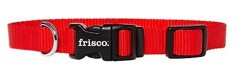
This is the most common type of collar. It usually holds some kind of identification. You may or may not use this one for walks as well as everyday use.
There is a slightly different version that has similar uses which I talk about next.
I recommend the flat collars that have a quick release (which is the type of clip you see in the picture). Most flat collars have this type of clip. What I don’t want you to use the type collar where you have to loosen and tighten the collar to get it on and off. There are many ways for these collars to get caught up and you want to be able to get them off quickly.
Martingale Collar:
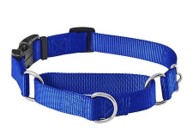
This collar is very similar to the flat collar. The difference is that there is an extra piece that when a leash is attached and they pull the collar pinches together to make it just small enough so they can’t pull out of the collar.
It’s NOT a choke collar (in fact if it chokes your dog then it’s too tight). It’s made for safety reasons so your dog can’t pull back and out leaving you standing there with a leash and collar and no dog!
This is the everyday collar I recommend.
As with a flat collar, you may or may not use this for walks and I recommend using one with the quick release clip.
Harness:
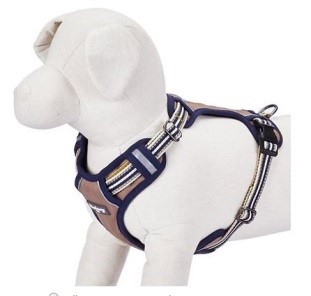
Harnesses are also very recognizable. I favor this tool for everyday walking. For some dogs a harness can encourage pulling and you loose a little control compared to a neck collar. That being said, I’ve seen enough neck injuries to still recommend a harness over a neck collar for walks.
If you have a heavy puller there are some separate tools for that. So let’s talk about them…
Head Collar or Gentle Lead:
This tool is specifically designed to help with leash pulling. When your dog pulls forward the collar pulls their head around taking away their leverage.
It’s very effective.
The biggest drawback is dogs hate it. They don’t like the strap that sits around their nose. Some dogs will get used to it but for the most part they tend to reject it.
Front Clip Harness:
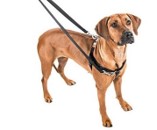
This is the tool I recommend for leash pullers. Essentially it’s a regular harness with a clip in the front as well as the back. You don’t need the double leash like in the picture but some do come designed that way.
It works in a similar way to the head collar. When your dog starts to pull forward they get turned around and lose their leverage. It’s very important to get the fit right for these, otherwise it’s just the harness that spins around, not the dog.
What I don’t recommend:
E-collar, pinch collar, choke collar.
Each of these tools are designed to make your dog uncomfortable to stop a behavior. In my experience these cause more behavior problems than they fix.
Those are the tools I talk about in part two. Head over to Episode #75 for part one where I talk about the different types of leashes.
In this episode I talk about:
- The most common types of collars and harnesses.
- Which tools I recommend and why.
- My recommendations for young puppies.
- Which collars I don’t recommend and why.
Press play and enjoy!
Other resources mentioned and related to this episode:
YNP #075: Different Leash Walking Tools (Part 01: Leashes)
Playtime Paws Academy: A brand new program for dog and humans no matter where you are in your training journey.
Transcript
Click on a timestamp to play from that location
| 0:00.0 | You are listening to your new puppies podcast. Starting you and your dog off on the right paw. Here's your |
| 0:16.8 | host Debbie Salento. Hello and welcome to episode 76 of your new puppies podcast I'm Debbie and this is |
| 0:36.1 | part two of a two-part series where I'm talking about the different leash |
| 0:40.3 | walking tools part one which was episode 75, was all about leashes. And now we need something |
| 0:47.9 | to attach the leash to. So here I'm going to talk about collars and harnesses. |
| 0:54.0 | So same thing as with the leashes. |
| 0:56.0 | I'll talk about the different types, the pros, the cons, |
| 0:59.0 | what my go-tos are, some comments specifically about puppies, and then I'll go into the ones I don't use |
| 1:06.5 | and don't recommend. So the most common one is just the typical flat collar which is just the collar that we put on our dog we clip it maybe their tags |
| 1:17.9 | hang from it maybe their name and your phone number is etched into the actual |
| 1:22.0 | collar and they kind of wear it every day |
| 1:24.5 | it's their identification maybe you're clipping a leash to it to take them out for a |
| 1:29.0 | walk but just about every dog out there has that type of collar. |
| 1:35.0 | A second type, which is very similar to the flat collar and has all the same uses, is called |
| 1:41.2 | the Martin Gale collar. Now, it looks just likeingale collar. |
| 1:43.0 | Now, it looks just like a flat collar, |
| 1:45.0 | but there's an extra like piece, |
| 1:48.0 | an extra loop to it, |
| 1:50.0 | where if you clip the leash to it |
| 1:52.0 | and they start to pull it actually |
| 1:55.1 | pinches the collar making it smaller. Now a lot of times these are compared to a |
| 2:01.2 | choke collar and that is not the intention that is not how they are used. |
... |
Please login to see the full transcript.
Disclaimer: The podcast and artwork embedded on this page are from Debbie Cilento: Dog Trainer | Dog Behavior Consultant | Owner of Playtime Paws | Belly Rub Specialist, and are the property of its owner and not affiliated with or endorsed by Tapesearch.
Generated transcripts are the property of Debbie Cilento: Dog Trainer | Dog Behavior Consultant | Owner of Playtime Paws | Belly Rub Specialist and are distributed freely under the Fair Use doctrine. Transcripts generated by Tapesearch are not guaranteed to be accurate.
Copyright © Tapesearch 2026.