
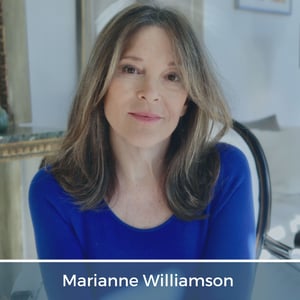
WE CAN ALL STILL MAKE A DIFFERENCE - An Interview with Sam Daley Harris
The Marianne Williamson Podcast
Marianne Williamson
4.8 • 1K Ratings
🗓️ 26 August 2025
⏱️ 31 minutes
🧾️ Download transcript
Summary
I've been a fan of Sam Daley Harris for many years. His thinking and activism has motivated and inspired my own efforts in the non-profit world.
An organization he founded called RESULTS is a citizen lobby dedicated to creating the political will to end poverty and hunger. His work has literally saved people's lives. He founded and now leads Civic Courage, providing all of us the opportunity to make a difference on the lives of people we will never even know.
Sam's book Reclaiming Our Democracy is a testament to what's possible when citizens are engaged in the democratic process. Working through Civic Courage, Daley Harris and his volunteers have led successful efforts to block some of the draconian budget cuts in the Trump agenda, forming a bulwark against their cruelest effects.
He is an important leader for such a time as this.
Subscribe to Marianne's Substack: MarianneWilliamson.Susbtack.com
Subscribe to Marianne's YouTube Channel
Follow Marianne on Instagram
Follow Marianne on Facebook
Follow Marianne on TikTok
Learn more at Marianne.com
Transcript
Click on a timestamp to play from that location
| 0:00.0 | Hey, everybody. Some of you probably know that in 1998, I published a book called Healing the Soul of America. And I was really fascinated by the idea that we should have a pro-democracy movement in this country. I felt that I had done some citizen activism. I had lobbied in Congress. I had seen the difference that an individual could make. And I thought, this is something that could really excite everybody. Is it excites me if people were actually involved? And instead, the American population became kind of a spectator class. We just observed it while the political class did what it did. And we know, of course, where that got us. Now, during that time, when I was so excited about actual citizen involvement and lobbying efforts on a state level and on a federal level, I had a hero and that hero was my guest today. And that's a gentleman named Sam Daily Harris. He has been a leader and innovator in the field of citizen advocacy for a very long time and has a book that's really become a kind of classic reclaiming our democracy, which of course is a big conversation now and hopefully we will have it. But I want you to know a little bit more about him before I bring him on. Sam is the founder of Civic Courage, which trains nonprofit organizations to deliver transformational advocacy, that's his concept that I want to talk to him about, transformational advocacy so that their members can create champions in Congress and the media for their cause. Sam is also the founder of Results, an organization I've personally been involved with, and International Citizens lobby dedicated to creating the political will to end hunger and poverty. He's the author of the book I just told you about. You can find out more about him at reclaimingourdemocracy.com. Also, it's civiccurage.org. And I want to welcome you. Sam Dehlihares, good to see you, my friend. Yes, great to be with you. Sam, I don't think it's hyperpropriately to say you've saved lives. You have worked for decades and have been down in the weeds in Congress. You have gotten lost change. You've gotten appropriations changed. There are people who have been fed because of your efforts. There are people who become citizen lobbyists because of your efforts. Myself included, your work is certainly deep in my understanding. I assume you're one of the most heartbroken people in America right now. But at the same time you are, and I think this has been part of your power, ever the optimist pointing out to things we can do to make a difference. But in telling people what they can do to make a difference today, we can't pretend what's going on is not going on. I have seen an arc and I want to hear what your experience has been. When I first started doing citizen activism, my own organizations, your organizations, going into Senator's offices, going into Congressman's offices, often I felt when I was there to support some bill that had to do with more money to feed children or more money to feed the poor, whatever, that I got as much of a positive openness from Republican congressman and senators as I got from Democrats. Once you actually got there, it was a pretty nonpartisan type of thing. I've seen things really change. I want to know what your experience has been, and I think given, and I understand almost the conundrum you have, because you see close, if anybody understands what's happening, you do, and at the same time, you're continuing to hold space for what's possible. What have you seen? What do you see now and where do you think we need to go? Not just to, like you put here reclaiming our democracy at a time when we arguably still have one. Over to you my friend, tell us what you're thinking is this day. Well you said there's so much just now. Let me just pick on a few of the things that you said. One of the things you said was about, what seems it's so many wannabe spectators in our democracy and just sit on the sidelines and watch. And I got my first view of that piece in 1978 and 1979. It's a longer story, but I'd gotten involved in ending world hunger and red calls for the political will and hunger. I asked 7,000 high school students, what's the name of your member of Congress? And fewer than 3% could answer correctly. They're in their 60s now. So I've been aware of the sitting on the sidelines piece for a long time. Yeah, and that's a large part of how we got here. Yes, absolutely. And you and I, you and I were among those saying, uh, uh, yeah. So another thing was you talked about the saving of lives results, the anti-poverty lobby. Uh, started lobbying on child survival issues globally in 1984. And at that time, UNICEF, the UN Children's Fund, was reporting 40,000 child deaths a day from preventable things, malnutrition coupled with measles and things like that. And over the last 41 years, the global child death rate has fallen by 66% from 40,000 to 13,000, 125 a day still exists. Okay, but let me ask you something right there. Absolutely. In many areas, we were headed in the right direction. Now what the Trump administration has done, it has started pulling back, it has gotten Republicans in Congress to support them in pulling back withholding resources from the exact programs and agencies that caused that increase of good. Aren't you concerned now? Or isn't that child poverty rate going to go right back up? Absolutely, devastated. I'm going to to give a little quote, but show you the other side of it. David Brooks, New York Times, said last in July, he said, the cuts to USAID have brought a kind of rage. I haven't experienced before the agency for international development. So it's been devastating and researchers have predicted that 14 million children will die over the next five years because of these cuts. Okay, hold on. I want everybody to be really clear about what Sam just said. Over the next five years, 14 million children. A traditional? Pardon? Children who would not have died. Yeah, 14 million children who would not have died with the old programs. Yes. We'll die or predicted to die over the next five years because it cuts to USAID. And so let me just finish this with glimmer of hope in July to the 23rd, the House Appropriations Committee, not the Democrats, no, the House Appropriations Committee. Basically rejected President Trump's 26 budget for maternal and child health, and I'll of you the exact numbers and talk about what that was. This year, maternal and child health globally is funded at $915 million. And for next year, President Trump's budget proposed, that President Trump proposed, $85 million, over a 90% cut. The House Appropriations Committee approved 915 million the exact number of this current year. So there's this glimmer of hope in that one I'm going to tell you some others later, but in that one action by the House now goes to the Senate Appropriations Committee for their action. And I I want to finish this piece up by this year, 128 members of the House, led by two Republicans and two Democrats, signed a letter to the top appropriators urging robust funding for maternal and child health programs around the world. And so again, it's like the way I always say it is... |
| 8:05.6 | Protests... for maternal and child health programs around the world. And so again, it's like the way I always say it is, |
| 8:29.6 | protesting is critically important. |
| 8:32.1 | We need the protests, |
| 8:34.6 | but we also need people going inside. |
| 8:38.6 | And so my work with transformational advocacy |
| 8:42.6 | is about the going inside part. And, you know, I, I, I, so go ahead. So what I'm hearing you say, and I, I think it's as important as people, that people understand that you recognize the depth of the problem as it is that people understand what you're saying about doing what we can. If I understand you correctly, your point is that there are still individual congresspeople and senators who we can reach through lobbying. Yes. Is that what you're saying? I think that's a really important piece everybody. So going through everything, we're going through the authoritarian government, the unbelievable withhold of resources to the people most in need both in this country and around the world. Even within that, what Sam is saying is we can still talk to individual congressmen, individual senators, and actually make a difference through constituent calls and lobbying efforts so forth. What about Sam, the peace of the media? I think that's really important right now. So much of the work that you do is teaching people write a letter to the Congressperson, write a letter to the media, to the letters to the editor. Tell us about that piece and how that plays in. Yeah, and I actually want to proceed with this story. I was talking to the head of organizing maybe seven years ago for a very big group. Everyone watching or listening know this group He said to me he was ahead of organizing We can't let our volunteers write letters to the editor or op-eds Because they'll get it wrong and misrepresent the organization. It's like protecting their brand One of the groups I Climate Lobby, in 2019, the year before COVID, their volunteers had 4,300 letters, op-eds, and editorials published. One group was saying they'll get it wrong and misrepresent the organization. Citizens Climate Lobby was saying, well, what do we have to do to help them get it right? And give to them and as a result they had 4,300 letters up it's and |
| 10:47.5 | editorials they get the training and |
| 10:50.4 | On how to do it and maybe I could share this one other thing. I've been on this book tour on zoom and in person |
| 10:58.4 | last week I did my 113th |
| 11:01.4 | in person or zoom talk in the last |
| 11:04.2 | 19 months and I always say, if you wanna find an organization that's working to deliver transformational advocacy, which I'll describe a bit in a moment, look for three things. One, recruitment and community building. The organization brings people in not to build in e-blast lists, but to form local chapters so you're not working alone. And the community building might be a whole of organization monthly webinar with guest speakers, Q&A, inspiration. So recruitment and community building, too, what you were asking about training. How do you write a letter to the editor? How do you get the meeting with the elected? |
| 11:46.0 | How do you plan for the meeting? What do you ask for the meeting to? Training. Three. Breakthroughs. The organization encourages its members to move out of their comfort zone and do things they never thought they could do and frankly build confidence as a result. So this transformation, not transactional, |
| 11:42.8 | sign the petition transaction complete. |
| 11:46.7 | But build confidence as a result. So this transformation, not transactional, sign the petition transaction complete, but transformational advocacy where your trained, encouraged and succeed at doing things as an advocate, you never thought you could do like meat with the member of Congress and bring them on board to your issue. And when you do those things, you see yourself differently. That's the transformation. So there are two things actually that I want to share from my own experience. One is, most of us don't realize the incredible power that you can wield by making constituent calls. I think the House Switch Board is what, 2224-3121? That's right. And you can write, whether you have, if there's a particular piece of legislation that you care about a lot, let's say today, say something like the SAV Act, making sure they don't pass the SAV Act, which would make it harder for married women who change their names, and they got married to vote. |
| 13:07.0 | All these voter suppression, I mean, there are so many things going on right now that theoretically you would want your Congressperson, you would want your senator to hear from you. If it's something that you believe in strongly, you might say, well, my senator doesn't hear from me. He doesn't need to hear from me. She is a Democrat. I know they agree or my Congressperson doesn't need to hear from me. They do need to Democrat. I know they agree. Or my Congressperson doesn't need to hear from me. |
| 13:25.0 | They do need to hear from you, because they have a lot of choices. |
| 13:29.6 | This one I might vote for, but this one I'm going to be vocal about. And you want them to know, no, I want you to more than vote for it. I want you to be vocal about it. So those constituent calls you just call up the office. You say this is such a calling. |
| 13:22.8 | This is my address. |
| 13:23.8 | I want to know that you're actually constituent. |
| 13:25.7 | And you say I just want the congressman or the senator |
| 13:28.2 | or whoever to know that I feel very strongly about this. And also, don't think that if it's a Republican, you know, everybody has their own conscience. And a lot of these people, you don't know what people might be thinking of the background, saying in the background, particularly today. They're also feeling the feeling the pressure let them feel it from you So even if it's a Republican and you think well, they probably wouldn't be for this you still call the office They need to hear from you too. Is everything on just that correct Sam? Yes, yes Absolutely, and if I could just put it in the context of a thing I call the champion scale my member of Congress is supposed There's no reason to no no no you want to move opposed to neutral Oh, My member of Congress is supposed, there's no reason to, no, no, no, you wanna move opposed to neutral. Oh, my member of Congress is a supporter. There's no, there are supporters. There's no reason, no, no, no. You wanna move your supporter to being an advocate, and a leader eventually a champion. Exactly. The other thing is, I wanna tell a story. I was talking to a fellow on Zoom the other day, and he's in Utah, and he was saying to me, in September, they will have their annual hike with their now Republican Senator. He took Mitt Romney's seat. He was their representative, John Curtis, Republican of Utah. He said, in early September September it'll be a three-hour hike with our Republican Senator and there'll be about 30 of us on the hike. Can anybody go who's a Utah citizen? Well this is one, and let me tell you how it started. The then congressman 2017 said, I'm going to have a town hall meeting hike. And it's going to be an eight hour hike. And eight people showed up six from citizens climate lobby. The next year they had such a turnout, he promised them their own hike each year. So the now he's senator, it's that's Ike with the senator, not with the representative. And he said, on that first hike, someone said, |
... |
Please login to see the full transcript.
Disclaimer: The podcast and artwork embedded on this page are from Marianne Williamson, and are the property of its owner and not affiliated with or endorsed by Tapesearch.
Generated transcripts are the property of Marianne Williamson and are distributed freely under the Fair Use doctrine. Transcripts generated by Tapesearch are not guaranteed to be accurate.
Copyright © Tapesearch 2026.