
The Meaning and Importance of Independent Media with Jordan Chariton
The Marianne Williamson Podcast
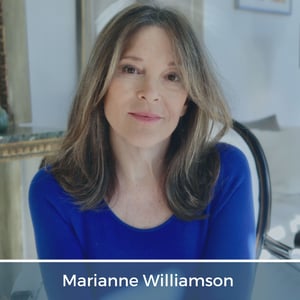
Marianne Williamson
4.8 • 1K Ratings
🗓️ 20 January 2022
⏱️ 40 minutes
🧾️ Download transcript
Summary
When I was growing up, fair news reporting was not only appreciated; it was codified into law. A single company was not allowed to own a town’s TV station, radio station and newspaper, so much did we value diversification of opinion. There was a Fairness Doctrine that required balanced reporting. I remember when I was a child, my father explaining that the sales department in a newspaper building was on a different floor than the news department, that the two staffs were never supposed to communicate about what they were doing, and in some buildings the elevators wouldn’t even go to both floors.
Then all that when away.
The Fairness Doctrine was repealed in 1987. The 1996 Telecommunications Act gave huge conglomerates almost unlimited power to dominate news markets; the consolidation of corporate media power can be traced directly to that piece of legislation. At the time the legislation was passed, for instance, there were approximately 55 media companies while today there are 5. Local newspapers lost funding, then readership, then relevance in the life of the average American.
Fairness and independent reporting gave way to the demands of the market, as profit margins for huge corporations took precedence over balanced reporting and even truth itself. News became as much about entertainment as information, geared more toward getting people’s attention than creating informed citizens. Political programming based more on adrenaline-fueled opposition than intelligent debate became a sales technique (read Matt Taibbi’s Hate Inc.), leading to the dumbing down of American discourse.
A reporter or editor telling too much truth ran the risk of angering the powers that be. Once the news became just another capitalist enterprise, a series of articles that might have gotten a newspaper reporter a Pulitzer Prize in years past now became as likely to get the reporter fired. This is why huge corporate monopolies having so much power in our lives is so destructive to society. Just think about it: A reporter wants to write about the factory downriver that is polluting the town’s water - but the company that owns the factory also owns the newspaper! One phone call saying “Kill the story,” and it’s done.
Anything that didn’t sell became less important than that which did. Things that we as citizens most need to know about are often the things we’re least informed about, as mainstream media bases its priorities more on stockholder value than on citizen edification. One of the most tragic consequences of this decline in responsible reporting has been the diminishment of resources allowed to foreign correspondents. When 9/11 happened, far too many Americans seemed completely unaware that anyone out there hated us! But people were curious; they wanted to know what events had led to the disaster. I remember, in the days right after the tragedy, how the news was filled with meaningful, intelligent conversation about foreign policy - correspondents, scholars and political experts were going deep with the truth - and people were eating it up. I also remember the day, a week or so later, when someone clearly put the kabash on all that and Americans were told to just go back to shopping.
But there has been a pushback to this overtaking of the news industry by an economic bottom line. It’s called Independent Media. My podcast interview this week is with one of the most important voices in independent media today, Jordan Chariton of Status Coup. From covering the Flint water crisis to last year’s re-emergence of a strong labor movement to Standing Rock to the BLM protests, Chariton has been on the front lines of some of the most important news stories of our time - stories too often given short shrift by the mainstream media, or even ignored completely.
Jordan’s story is an important look into the state of the American news media today, and not all of it is pretty. But the only way we will change direction in this or any other area is if all of us become more informed about what’s happening. In the meantime, great independent media - a lot of it on substack! - continues to arise. It’s an important force at this critical time and it needs our full support.
Listen on Spotify and Apple Podcasts
One more thing: If you want a good look at the news from an independent media perspective, I highly recommend Breaking Points with Krystal and Saagar. In my opinion it’s a regular dose of the news as the news should be reported.
This is a public episode. If you'd like to discuss this with other subscribers or get access to bonus episodes, visit www.transformarticles.com/subscribe
Transcript
Click on a timestamp to play from that location
| 0:00.0 | Hi, welcome to the Mary Ann Williamson podcast. |
| 0:03.0 | I have someone very special to introduce you to my guest, Jordan Sheraton. |
| 0:07.0 | Before we have our conversation, I want to say a few things. |
| 0:11.0 | I know this is kind of hard to believe, but when I was growing up, we did not hate the media. |
| 0:17.0 | We actually trusted the media in this country, and we did believe, and for some good reasons, |
| 0:22.2 | that we had basically fair reporting. There was a fairness doctrine. We knew that there were |
| 0:28.3 | people who were not just in it for the money. News was not about an economic bottom line. It was |
| 0:34.1 | actually about informing and educating the public. I'm not romanticizing anything here. I'm not |
| 0:39.7 | saying it was perfect. Obviously, as you can imagine, racial issues, criminal justice issues, even then, |
| 0:44.9 | etc. There were many things that should have been discussed that I'm sure were not. But what started to |
| 0:49.9 | happen in the 1980s took things in a far worse direction. First of all, the elimination of the |
| 0:56.0 | fairness doctrine so that a news reporting agency no longer had the legal responsibility to |
| 1:02.4 | present both sides of an argument. And then in 1996, Bill Clinton signed the Telecommunications |
| 1:08.9 | Act that led to the corporate conglomeratization of the news media. |
| 1:14.1 | That's why we call it now mainstream media. |
| 1:18.0 | You know, when I was a kid, the same company could not own the newspaper and the television station and the radio station |
| 1:25.4 | because the diversity of opinion was actually valued, |
| 1:30.0 | institutionally valued. In fact, there were news organizations and television stations |
| 1:35.3 | where people who were in news and people who were in sales. They were not on the same floor |
| 1:41.9 | of the building and the two floors. |
| 1:46.8 | There was no way that the elevator went to both stops. |
| 1:50.6 | All that burst open with the Telecommunications Act. Now there are a few companies that own most of the mainstream news, and they are in it for |
... |
Please login to see the full transcript.
Disclaimer: The podcast and artwork embedded on this page are from Marianne Williamson, and are the property of its owner and not affiliated with or endorsed by Tapesearch.
Generated transcripts are the property of Marianne Williamson and are distributed freely under the Fair Use doctrine. Transcripts generated by Tapesearch are not guaranteed to be accurate.
Copyright © Tapesearch 2026.