
meta_pixel
Tapesearch Logo
Log in
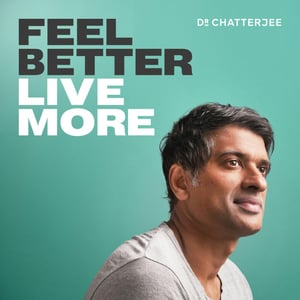
Feel Better, Live More with Dr Rangan Chatterjee

The Healing Power Of Music: How Your Favourite Songs Boost Your Mood, Mind & Mobility with Dr Daniel Levitin #623

Feel Better, Live More with Dr Rangan Chatterjee

Dr Rangan Chatterjee

Alternative Health, Medicine, Health & Fitness, Mental Health

4.711.7K Ratings

🗓️ 11 February 2026

⏱️ 92 minutes

🧾️ Download transcript

Summary

Music is medicine. It has the power to heal us. And today’s guest knows it’s something we can self-prescribe, for free, whenever we want to benefit. Dr Daniel Levitin is a neuroscientist, cognitive psychologist and bestselling author. He’s also a former record producer and an accomplished musician who’s brought all those skills together in his latest book, Music As Medicine: How We Can Harness Its Therapeutic Power. As soon as I heard about it, I had to ask Dan onto the podcast to share his wisdom. As a lifelong musician and music fan, I know certain tracks change how I feel. But talking to Dan has opened my mind to just how profound an effect music has on the brain. It doesn’t just shift our mood, it can affect our entire physiology. Dan has spent decades studying this, advising the US Government and working with the National Institutes of Health, to the point where his research is now influencing global health policy. We’ve all experienced the health-giving power of music, perhaps without realising. Now with that knowledge, and Dan’s insights, we can start to put it to therapeutic use. Here’s what fascinates me the most: music doesn’t just hit one part of your brain. Different types activate different regions, in much the same way as certain medications work. And Dan shares some astounding examples of this – from the people with Parkinson’s who relearn to walk, to the marathon runners who don’t feel pain, to the Alzheimer’s patients who can’t recognise loved ones, but can recall how to play an instrument perfectly. The brain regions that process music are deeper, older and more protected. It’s why music communicates emotion in ways that words can’t always match. Throughout our conversation, Dan makes this case that music is our birthright. And it can flood us with feelgood, bonding hormones. So it’s a tool we can turn to for overcoming trauma, processing difficult feelings, or connecting with others. But he doesn’t just want us to listen. Playing an instrument, singing and songwriting all do more than you might expect – and you don’t need to be an expert. The next time I’m strumming my guitar, I won’t just think of it as a hobby. I’ll know I’m doing something profoundly important for my health. And you can too. Whether it’s learning an instrument, having a family singalong in the car, or simply switching on the radio, I’m not sure there’s a simpler, more effective way to feel better.   Support the podcast and enjoy Ad-Free episodes. Try FREE for 7 days on Apple Podcasts https://apple.co/feelbetterlivemore. For other podcast platforms go to https://fblm.supercast.com.   Thanks to our sponsors: https://vivobarefoot.com/livemore https://onepeloton.co.uk https://thewayapp.com/livemore https://drinkag1.com/livemore   Show notes https://drchatterjee.com/623   DISCLAIMER: The content in the podcast and on this webpage is not intended to be a substitute for professional medical advice, diagnosis, or treatment. Always seek the advice of your doctor or qualified healthcare provider. Never disregard professional medical advice or delay in seeking it because of something you have heard on the podcast or on my website.

Transcript

Click on a timestamp to play from that location

0:00.0

In Parkinson's, inevitably, many patients lose the ability to walk because that timing circuit has been degraded,

0:08.7

the part that tells them to put one foot in front of the other with a certain timing.

0:14.0

So music that has the same tempo as the walking speed, the gate of a Parkinson's patient,

0:20.5

activates regions of the brain that are spared,

0:23.4

and within a few seconds,

0:25.2

the brain synchronizes to the beat of the music.

0:28.7

And a Parkinson's patient listening to that

0:33.1

can suddenly start to walk.

0:35.3

Hey guys, how you doing?

0:37.1

Hope you're having a good week so far.

0:39.1

My name is Dr. Rongan Chatterjee, and this is my podcast.

0:43.5

Feel Better, Live More.

0:47.8

Today's conversation is a meeting of two key areas in my life, music and medicine. Music has always been hugely meaningful to me.

0:58.6

I've sung and played multiple instruments since I was a young boy, and honestly, some of my

1:04.4

happiest moments have been performing on stage or simply losing myself in music. Now, even if you don't play yourself, and after hearing this episode, that might change.

1:16.3

Most of us know intuitively that music just does something to us.

1:21.5

The right track at the right time can soothe you, energize you, or transport you back to another time.

1:29.3

But here's where it gets even more interesting.

1:32.4

In all my years as a clinician,

1:35.5

music was never really discussed as a therapeutic tool.

1:39.8

Drugs, nutrition, exercise, sure, but never music. Yet the more I've learned about and experienced

1:47.0

its effects, the more I've come to realize that we could be missing out on a powerful and beautiful

...

Please login to see the full transcript.

Disclaimer: The podcast and artwork embedded on this page are from Dr Rangan Chatterjee, and are the property of its owner and not affiliated with or endorsed by Tapesearch.

Generated transcripts are the property of Dr Rangan Chatterjee and are distributed freely under the Fair Use doctrine. Transcripts generated by Tapesearch are not guaranteed to be accurate.

Copyright © Tapesearch 2026.