
The Beginnings of Belief
Living with the Gods
BBC
4.7 • 616 Ratings
🗓️ 23 October 2017
⏱️ 15 minutes
🧾️ Download transcript
Summary
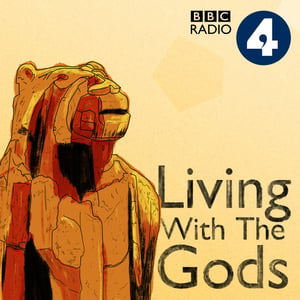
Neil MacGregor, former Director of the British Museum, begins this series about the role and expression of shared beliefs with the Lion Man, a small ivory sculpture which is about 40 000 years old. The figure has a human body and the head of a lion - it is a being that cannot exist in nature. While we shall never know what the Lion Man meant to the community in which it was created, we do know that it mattered enough for the group to allow someone to spend about 400 hours carving it.
The programme visits the cave in southern Germany where fragments of ivory were discovered in 1939. These fragments were gradually pieced together by archaeologists decades later to re-assemble the figure. Some smoothing on the torso suggests that the Lion Man was passed from person to person in the cave.
Neil MacGregor begins the series with this object because, in his words, 'what the archaeologists did as they pieced together the Lion Man is what societies have always done: work with fragmentary evidence to build a picture of the world. You could say that it's when a group agrees on how the fragments of the cosmic puzzle fit together that you truly have a community - one that endures, encompassing the living, the dead and the yet unborn. What this whole series is about is the role that such systems of belief - and perhaps even more the rituals that express those beliefs - have played in the creation, and sometimes in the destruction, of societies. Are we humans distinguished not just by a capacity to think, but by our need to believe - in a context where the search is not so much for my place in the world, but for our place in the cosmos - where believing is almost synonymous with belonging?'
Producer Paul Kobrak
The series is produced in partnership with the British Museum, with the assistance of Dr Christopher Harding, University of Edinburgh.
Photograph: (c) Museum Ulm, photo: Oleg Kuchar, Ulm.
Transcript
Click on a timestamp to play from that location
| 0:00.0 | The head is looking at us, listening to us. This isn't a human being wearing a mask. This is a creature, a being that doesn't exist in nature. |
| 0:13.6 | Hello, I'm Neil McGregor. For the whole of human history, believing and belonging have gone together. In this series of podcasts, |
| 0:23.5 | I'm looking at objects and at places to see how those shared beliefs have helped build |
| 0:29.0 | communities and how they can also divide them. The series is called Living with the Gods, |
| 0:35.2 | and it's about faith and about society, |
| 0:40.9 | but it's essentially about how we live with each other. |
| 0:46.9 | And we start in this, the first episode, with the beginnings of belief. |
| 0:48.8 | This is the BBC. What an amazing place. |
| 0:58.8 | On the 25th of August 1939, two men were digging here at the back of this cave in southwest Germany. |
| 1:06.8 | War was about to break out, and both men, the anatomist Robert Vetzel and the geologist Otto Fultzing, had just received their call-up papers. This was the last day of the dig. As they were preparing to pack away their tools, they made a discovery. Forty meters in, right at the back of the cave, they found tiny fragments of mammoth ivory, which looked as |
| 1:28.8 | though they'd been worked by human hands. There was no time to examine them, no time to begin to work |
| 1:33.9 | out what they actually were. The fragments were packed away, and the two men left for the war. |
| 1:40.6 | It's easy to imagine and to share the impatience and frustration that Wetzel and Fultzing must have felt as they left the Staudel cave. |
| 1:49.4 | If only the fragments could be fitted together, then they and we might see some larger pattern that would make sense of the bits. |
| 1:57.8 | From the earliest societies making repetitive marks on their pottery, all human beings seem to be hardwired for pattern. |
| 2:05.8 | It brings us satisfaction, pleasure, reassurance. |
| 2:09.9 | And we don't just create pattern in the things we make. |
| 2:12.9 | We seek it out. |
| 2:14.8 | We assume that from the smallest fragment right up to life on the largest scale, |
| 2:19.9 | somewhere in or behind the things and events of the world lies pattern, |
| 2:25.2 | pattern that could be turned, perhaps, into a coherent understanding, |
| 2:29.6 | into a narrative of our place in the universe. And that search for a grand narrative is what this series is about. |
... |
Please login to see the full transcript.
Disclaimer: The podcast and artwork embedded on this page are from BBC, and are the property of its owner and not affiliated with or endorsed by Tapesearch.
Generated transcripts are the property of BBC and are distributed freely under the Fair Use doctrine. Transcripts generated by Tapesearch are not guaranteed to be accurate.
Copyright © Tapesearch 2026.