
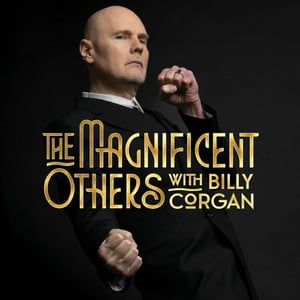
Simon Kirke | The Magnificent Others with Billy Corgan
The Magnificent Others with Billy Corgan
Billy Corgan
4.6 • 731 Ratings
🗓️ 19 November 2025
⏱️ 79 minutes
🧾️ Download transcript
Summary
Billy Corgan sits down with Rock & Roll Hall of Famer Simon Kirke (Free, Bad Company) for a sharp, funny, and revealing dive into 50 years of rock majesty. Simon traces his journey from growing up in poverty to the lightning-bolt moment drums grabbed him, the fateful coin flip that led him to Paul Kossoff and the creation of “All Right Now,” and then to forming Bad Company with Paul Rodgers and Mick Ralphs. Together, they dive into the grooves of Stax vs. Motown, the genius of Al Jackson Jr., Ringo Starr, and Charlie Watts, and the art of serving the song rather than showing off chops. Along the way, Simon shares stories about Jimmy Page, John Bonham, Steve Marriott, and Queen. It’s a masterclass in rock history and rhythm.
Subscribe to the Magnificent Others YouTube channel: https://www.youtube.com/@BillyCorganTMO?sub_confirmation=1
Learn more about your ad choices. Visit podcastchoices.com/adchoices
See Privacy Policy at https://art19.com/privacy and California Privacy Notice at https://art19.com/privacy#do-not-sell-my-info.
Transcript
Click on a timestamp to play from that location
| 2:45.1 | So we got a TV, a black and white TV. And the very first thing that I saw when the thing, you turn it on and that little white dot opened up. Was this thing called, a program called All That Jazz? Okay. Featured Big Band. Yeah. All in black and white. So I'm riveted. by the t t t t t t t t t t t t-b-b-b-b-b-b-b-b-b-b-b-b-b-b-b-b-b-b-b-b-b-b-b-b-b-b-b-b-b-b-b-b-b-b-b-b stage to the sound of our own footsteps. A lot of space in that bag. A lot of space, a lot of hatch. We swung a lot of hatch. Congratulations Rock and Roll Hall of Fame. Well deserved. Thank you. Mr Simon Kirk. Really cool, man. Thank you for being here. What's the best drummer joke you ever heard? Oh, it's kind of long, but you know, it's worth it. We have time. It's worth it. So there's a drummer sitting in the rehearsal room waiting for the others in the band. And it goes on and no one's arrived. He's sort of playing, practicing. And after about 35 minutes, it's just, and he throws down his sticks. He said, I'm fed up with being a drummer waiting for the others so he rushes down to the mall and goes into the the music store and he goes up to the count he says I want I want to be a guitarist like that bloke from food fighters I want a custom gold a lesbale gold chop I want diamond encroasted picks and the best leather strap and the best strings. And the guy at the count says, you're a drummer, aren't you? He says, why? Is it because I'm doing this on the counting? He says, no, no. This is the music store's next door. This is a Dunkin' Donuts. Da-da! Well, we'll overdub the symbol craft. All right. In your illustrious musical life, I need to start here. Tell me about Mr. Lean. Oh my Lord. Mr. Lean. Wow. What a great question. Mr. Name was a bus driver in my high school when I was brought up on the border of Wales. And our school was about six miles from where I lived in the country and this bus driver. After about a year, I was about 14 and as I was getting off the bus, he said, oh, I want a word with you. I thought, oh, my darn, can't be smoking in the back or whatever. He says, I hear you play drums. I said, well, I do, yeah. And he said, well, I have, this is before disco, but he had a stack of 45s, a couple of turntables, and he used to go around all the village halls playing, you know, the songs of the day. And he said, I think with a good idea, If you brought your little drum kit and played alongside, and I was like, whoa, whoa, I'll have to ask my parents. And they agreed as long as it didn't affect my homework. And I did that for about two and a half years, Billy. And that's where I've got what I consider to be a pretty good sense of time. Because in one minute you'd be playing, can't buy me love by the Beatles, then baby love by the Supremes and then waltz with Jim Reeves, he'll have to go and then a forlita which is you know some kind of weird tuba pumping umpa, umpa. So I did that for two hours a night for nearly two years. It seems, I mean maybe maybe it's a stretch, but you tell me, but it seems like it's so in the foundational route of your playing, you know, because the great, and I mean, this is the ultimate compliment, the great pocket drummers, they have such a love of rhythm. They don't necessarily have a love of the drums. They have a love of rhythm. And it's shown up in their playing. That's a good distinction. Well, I think it's important because people get lost on what drummers are good at. Most of the popular records historically are played by guys who are really great rhythm players. They may not be the most flashy chop guys, but they've got the back beat that makes the kids want to dance to sort of paraphrase. Well, that brings me to the three biggest influences in my career were Al Jackson Jr. that is the number one from the stacks band, Booker T and the MGs. Of course, Ringo, who I had the pleasure with touring alongside in the All Star Band and Charlie Watts, who was not flashy at all. He says, I'm not good enough to be flashed. Didn't care about anything. And he didn't. He played that jazz grip like Stuart, like... Then the weird, always lifting. And the weird mechanical, but he had this beautiful backbeat and he just, those three guys, he had down a rhythmic foundation and unlike the distinction between a rhythm and actual, you know, I had a question about Al Jackson's. So you know, but it's fine because stacks in the American canon is in a way underappreciated because Mot all the glossy, glossy love. But musicians are very aware of how important stacks is. And I think it's interesting because a lot of guys from your generation, they were attracted to Motown, obviously the Beatles were huge on Motown. But a lot of the guys who end up playing like heavy blues |
| 5:47.9 | They tended to be more stacks guys. Can you can you speak on that a bit? Well, I think the difference between Motown and stacks |
| 5:55.6 | they said |
| 5:57.0 | Motown had a huge roster |
| 6:00.2 | Of artists and they were a little more flamboyant. I mean, they had that wonderful rhythm section. James Jameson on bass, Benny Benjamin. But they had a much bigger roster. They used strings, they used flutes, whereas stacks was a bit more muscular. You know, with that wonderful Algiers and they had maybe a handful of Otis, Sam and Dave, Wilson Pickier. So they never really made the inroads, certainly into England and Europe, that Motown did. I see. So was it like if you were a kid listening around time, Stax was a little bit more of a secret? Stax, when I first heard Otis Reading, it was Doc of the Bay, and it was the week when he died, right? He already died, right? And Steve Kropper said the toughest thing it was for him was to mix Doc of the Bay, the week after Ode's had passed. But I was just finishing high school, I was 18, so it would be 1967, 60, and I heard a certain amount of sound. I thought, oh, that's nice. And I I only heard that sort of side-stick. It didn't really until I started branching out into the snare and the full thing. Oh, that's great. But then after that, there was a bit of a lot until midnight hour came in. Wilson pick it. And I heard that backbeat for the first time and went, whoa, but at the same time, Motown was coming up with Marvin Gaye and the Suprins, Smokey Robinson, the middle calls and they started kind of overtaking. They were more pop. Right. I guess that's it. They were more pop than stacks. But every time, every time before I went on to play on stage, I put on the best of all this reading, and Sam and Dale, lovely. Yeah. It's interesting because my father was a musician, never really had any success, but one of the bands that he had for a while, the drummer was one of Wilson Pickett's touring drummers, a Southern drummer. And so when I was five years old, I go down, listen, I'm playing the basement. And this guy had that heavy foot backbeat thing. So I was always conscious of that music because my father loved that music. So connecting the dots with you on Al Jackson, it made a lot of sense because not a lot of guys know how to play that. I don't even, it's even like |
| 8:25.5 | there's the English version of the shuffle, but there's the American version of the shuffle. So you know what I'm talking about, right? Yeah, yeah, yeah, very good. Well, mix three, because the English version of the shuffle to me is, I think it was named the drummer for your IHEAP. Oh, and Lee Kursley. It's more of a rock-leafed. It's not Yeah, I can't get enough. |
| 8:46.3 | But your version is a little bit more. |
| 8:49.2 | Yeah. Oh, and Lee Kursley, it's more of a rock-leam. It's not like quarter notes. Yeah, but I can't get enough. |
| 8:46.4 | But your version is a little bit more... |
| 8:49.5 | Yeah, right. |
| 8:50.6 | Sunny Freeman was BB King's drummer. |
| 8:52.7 | Yeah. And me and Mick Fleet was a good friend of mine. |
| 8:55.3 | I agree that Sunny was the king of the shuffle. |
| 8:57.5 | And with Sunny, everything was... |
| 9:01.5 | Including the left hand. |
| 9:03.0 | And the bass drum. |
| 9:04.7 | Not quarter notes on the bass. There's that groove though. The whole thing, you know. There's that groove though. So that's, it's interesting to me how English musicians interpreted American music and American musicians interpreted English music. Well, you gave us Wilson Pickett and we gave you Benny Hill. Is that a fair trade, maybe? Benny Hill, his own genius though. He is his own genius, yeah. I'm curious because I was doing my poke around on your life. What did your parents do? They were, my mom was sort of stay at home housewife, who had an amazing recal collection. I'm gonna go too far into it. But tell me, she was the same stuff. And she was a bit of a mystery, my mom, because number one, she was illegitimate, which back in the 20s, I mean the 1920s was huge. So she grew up with this kind of stigma and I didn't know until she passed away and my older brother, you know, mum was a really good pianist. She could have been good me. She apparently played real beautiful. And she had this amazing record collection, which she amassed over her teenage years and 20s. Which she had to give up when she moved to the country, where we lived very primitively. We had no electricity, no running water. You know, we... It was great. So what did your dad do? |
| 10:26.3 | Dad was a bus driver. Okay. Yeah, he was a bit of a dark horse, my dad, but... Yeah, and he, a bit of a Philistine, he didn't like music. He wrote poetry, and I found a book of his poems years ago, which kind of moved me to tears. Because he was a bit of a closet, you know, a public lawyer. |
| 10:45.8 | Obviously, my dad, you wrote this? |
| 10:47.8 | Yeah. which kind of moved me to tears. Because he was a bit of a closet, you know, poet laureate, obviously, nice. |
| 10:46.7 | Dad, you wrote this? |
| 10:50.2 | So because you were talking about growing up in this, |
... |
Please login to see the full transcript.
Disclaimer: The podcast and artwork embedded on this page are from Billy Corgan, and are the property of its owner and not affiliated with or endorsed by Tapesearch.
Generated transcripts are the property of Billy Corgan and are distributed freely under the Fair Use doctrine. Transcripts generated by Tapesearch are not guaranteed to be accurate.
Copyright © Tapesearch 2026.