

Remembering the Spanish Flu and WW1, Episode 310
Join Us in France Travel Podcast
Annie Sargent
4.8 • 1.1K Ratings
🗓️ 8 November 2020
⏱️ 72 minutes
🧾️ Download transcript
Summary
This episode features our frequent and very popular guest Elyse Rivin. If you enjoy her episodes, please consider supporting her on Patreon.
On today's episode of the podcast Annie Sargent brings you a conversation with Elyse Rivin. As we celebrate then end of WW1 it is also important to remember that the Spanish Flu killed even more people than the war that had just ended. We also talk about how the Spanish Flu changed Europe forever especially how Europeans understand the need to extend health care to everyone.
I also want to do a quick review of a book about WW1 that I absolutely loved called All Blood Runs Red by Henry Scott Harris about Eugene Jacques Bullard the African American born in Georgia who enlisted in the French Foreign Legion and served with great honor in both WW1 and WW2. An extraordinary person and a well crafted book that brings WW1 and this person to life for me.
I will also read you a bit of The Plague by Camus right before the end music. If you're interested in learning about virology today, Annie recommends you add This Week in Virology to your podcast line-up.
Remembering the Spanish Flu
Unfortunately talking about the Spanish Flu is the right way to celebrate WW1 in 2020 because we're in the middle of our own pandemic right now.
It is called the Spanish Flu, but it had little to do with Spain. This flu didn't start in Spain. They had no part in spreading it any more than any other country. What happened is that since they weren't involved in WW1 Spanish newspapers were not the victim of censorship. They spoke about the pandemic freely in Spain and so they got associated with it for no reason.
It is more likely that the Spanish Flu started with a farmer in the US who then went to serve on a US army base. As American soldiers were shipped out to help end WW1 they spread the virus all over the world. The first place these soldiers landed was in Bordeaux and it spread from there in France.
The Spanish Flu was a very effective virus and spread quickly. Viruses affect humans with zero care for their nationality. That's why it's unfair to call it a Spanish flu or an American flu or a Chinese flu. Humans are subject to viruses and that's what matters.
The first wave of Spanish flu (May 1918) was not particularly deadly, the second wave was awful (the fall of 2018) and the third a bit less virulent. But by then the flu had spread all over the world, which is the definition of the word pandemic. The Spanish flu killed about 4% of the people it infected, and it was mostly younger people who go sick with it.
In the US there were pro mask cities and anti mask cities and, predictably, the cities like San Francisco where masks were seen negatively had more deaths.
The Plague by Camus
Every time there is a pandemic there is a great temptation from political leaders not to scare the public and brush it under the rug. Albert Camus was writing about a fictional plague but he brought that fact into his famous book. Annie reads this part of the book at the end of the episode.
The local press, so lavish of news about the rats, now had
nothing to say. For rats died in the street; men in their
homes. And newspapers are concerned only with the street.
Meanwhile, government and municipal officials were put-
ting their heads together. So long as each individual doc-
tor had come across only two or three cases, no one had
thought of taking action. But it was merely a matter of add-
ing up the figures and, once this had been done, the total was
startling. In a very few days the number of cases had risen
by leaps and bounds, and it became evident to all observers
of this strange malady that a real epidemic had set in. This
was the state of affairs when Castel, one of Rieux’s colleagues
and a much older man than he, came to see him.“Naturally,” he said to Rieux, “you know what it is.”
“I’m waiting for the result of the post-mortems.”
“Well, 1 know. And I don’t need any post-mortems. I was
in China for a good part of my career, and I saw some cases
in Paris twenty years ago. Only no one dared to call them by
their name on that occasion. TTie usual taboo, of course; the
public mustn’t be alarmed, that wouldn’t do at all. And then,
as one of my colleagues said, ‘It’s unthinkable. Everyone
knows it’s ceased to appear in western Europe.’ Yes, every- '
one knew that — except the dead men. Come now, Rieux,
you know as well as I do what it is.”Rieux pondered. He was looking out of the window of
his surgery, at the tall cliff that closed the half-circle of the
bay on the far horizon. Though blue, the sky had a dull
sheen that was softening as the light declined.“Yes, Castel,” he replied. “It’s hardly credible. But every-
thing points to its being plague.”Castel got up and began walking toward the door.
More episodes about French History
Email | Facebook | Instagram | Pinterest | Twitter
Support the Show
Tip Your Guide Extras Patreon Audio Tours Merchandise
If you enjoyed this episode, you should also listen to related episode(s):
- WW1 Memorial Sites in France, Episode 211
- Chateau-Thierry and the Battle of Belleau Wood, Episode 256
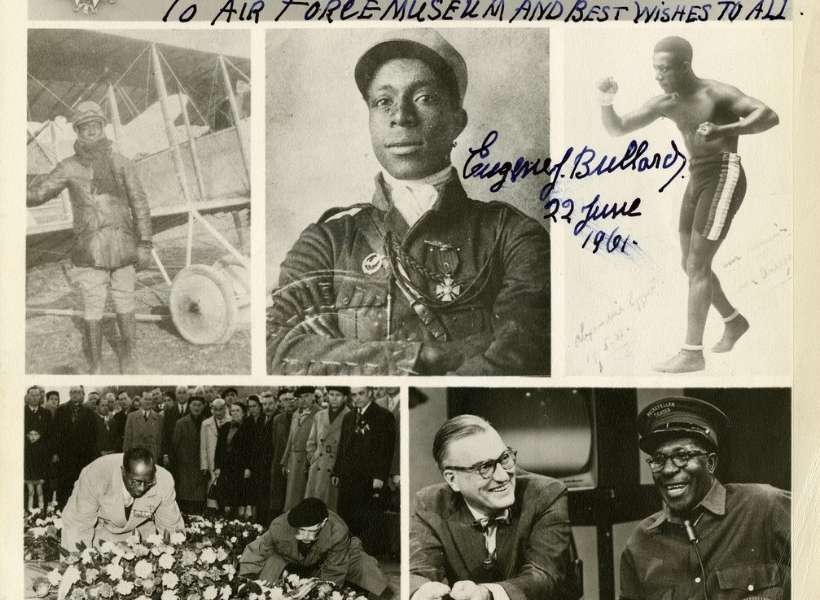 This week Annie recommends a book about Eugene Jacques Bullard, the French-American WW1 hero born in Georgia.
 Category: French History
Transcript
Click on a timestamp to play from that location
| 0:00.0 | This is join us in France episode 310. |
| 0:04.3 | Monjo, I'm Annie Sergeant, and today I bring you a conversation with Elise |
| 0:09.2 | about the Spanish flu. |
| 0:11.9 | As we celebrate the end of World War I this Sunday, it is also important to remember |
| 0:16.7 | that the Spanish flu killed even more people just as the war ended. We also talk about how this flu changed Europe forever, |
| 0:26.2 | especially how we see the need to extend health care to everyone. |
| 0:30.5 | I also want to do a quick review of a book about World War I that I absolutely loved. |
| 0:36.0 | It's called All Blood Runs Red and it's by Henry Scott Harris about Eugene Jacques Bullard, the African American born in Georgia who |
| 0:46.6 | enlisted in the French Foreign Legion and served with great honor in World War I |
| 0:52.3 | and also helped out in World War II, an extraordinary |
| 0:55.8 | person and a well-crafted book that brought this person to life for me. |
| 1:01.8 | And also I will read you a tiny bit of the plague by Camus right before the end music. It's going to be a busy episode. |
| 1:09.2 | I'm going to be releasing my cookbook by next episode. So by the time episode 311 is out the 15th of November, |
| 1:19.6 | the cookbook will be out. I need to work my tail off to get it to happen. But it's going to be good. I'm excited and I hope you are too. |
| 1:30.4 | Thank you patrons for giving me a precious gift. The time to produce this podcast. |
| 1:36.0 | Your monthly gift makes it all possible and in these times of great uncertainty |
| 1:41.0 | and you know a bit of chaos yeah I can't tell you how much it |
| 1:46.6 | means to me there will be a shout out to new patrons and more info about how to join all my wonderful patrons after the interview. |
| 1:55.5 | Check out my audio self-guided tours on join us in France.com forward slash audio tours. |
| 2:01.9 | As I record this, I have four of them for Paris and I will |
| 2:05.2 | release more as time goes by because I love the freedom and depth that these |
| 2:09.0 | tours provide and I know we can't travel right now but the time will come and people listen to these |
... |
Please login to see the full transcript.
Disclaimer: The podcast and artwork embedded on this page are from Annie Sargent, and are the property of its owner and not affiliated with or endorsed by Tapesearch.
Generated transcripts are the property of Annie Sargent and are distributed freely under the Fair Use doctrine. Transcripts generated by Tapesearch are not guaranteed to be accurate.
Copyright © Tapesearch 2026.