
Poverty Pimpin’ Politicians & Other News You Can Use
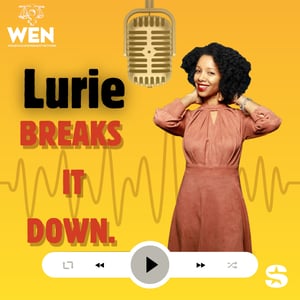
Lurie Breaks It Down
Women's Empowerment Network
5.0 • 617 Ratings
🗓️ 27 October 2025
⏱️ 31 minutes
🧾️ Download transcript
Summary
Transcript
Click on a timestamp to play from that location
| 0:00.0 | Welcome to another episode of Lurie Breaks It Down, a podcast where we dig deeply to connect the dots on the issues that shape our world. |
| 0:20.0 | I'm Lurie Daniel Favors, author, activist, attorney, and the host of the Lurie Daniel Favors show on Sirius XM's Urban View, Channel 126. If you like what you're about to hear, go ahead and give us five stars and then tell everybody that you know. And if you don't like it, just, child, keep it to yourself and pray our strength. Okay? Thank you so much. |
| 0:37.6 | Also, don't forget to check out my YouTube page, Lurie Daniel Favor's Media, where you should subscribe, like, and share, because then you'll get notified when I post videos from my show, which I do just about every single day and when I go live with my YouTube audience. All right, folks, today is October the 27th. It is a Monday, so a day ending in Y means we got a lot to cover. |
| 0:56.2 | When I was a little kid, there was this dish my mom used to make us for breakfast. It was called cornmeal porridge. This is a Jamaican, Caribbean breakfast food. It's kind of like the American version or analog of this, I guess, would be cream of wheat, except cornmeal porridge is delicious, especially when my mom will put this nice, thick swirl of sweetened condensed milk on top. And, ooh, my lord, it was just, it was amazing. I absolutely loved this dish. I was almost an adult before I found out that my Jamaican grandfather absolutely hated cornmeal porridge. For me, it had always been one of the foods that sort of connected me to the Caribbean and to my heritage vis-a-vis my mom. |
| 1:28.0 | Y'all may recall my dad is Black American from New York, Brooklyn by way of Harlem, actually |
| 1:32.9 | originally by way of South Carolina on that side of the family. And my mom's side of the family |
| 1:36.4 | is Black Jamaican. And so for me, having the ability to connect with both cultures has always |
| 1:40.5 | been something that I really appreciated. And cornmeal porridge as a food, a food in my |
| 1:45.5 | mind, which was a cultural food, I'd always loved this dish. My grandfather could never understand |
| 1:50.8 | why I loved cornmeal porridge because for him, cornmeal porridge was poor people food. He had a very |
| 1:56.1 | negative association with cornmeal porridge that connected that dish to times of struggle. Now, |
| 2:00.3 | this was a man born, I think he was in 19, in the late 1920s. For him, this was a food that was a sign of economic distress and not even the ancestor child could spice it up enough with sufficient flavor to make him like it. You all may recall that I have mentioned in the past that there was a period in our life when I was a kid where we were very, very extremely poor. We were never not really poor in my memory of things. My mom says she doesn't remember it quite that way. But, you know, when you're a kid, you're going through it, those memories sear in your brain in ways that perhaps they don't for the adults in your life. But there was a period of time when we lived in a homeless shelter. And one day, had gone down for breakfast into the lunchroom. And I remember, oh my God, I will never forget this. My brother had a fly in his oatmeal. And I was already so traumatized by the fact that we were living in a homeless shelter. I had two pairs of jeans. And like I was like I was clearly aware. You know how people say, I didn't even know we was poor. No, baby, I knew we was poor. By the time we had moved into the homeless shelter, I was like, okay, this, this is poverty. Okay, this is poverty. And after that moment where my brother had this fly in his oatmeal, I was so disgusted. I was so traumatized. I think it might have been decades before I ate oatmeal again, |
| 3:10.1 | well into adulthood, certainly. |
| 3:12.0 | Food memories and trauma can be funny that way. |
| 3:14.5 | Speaking of food memories, how many of you remember this phrase? |
| 3:17.4 | Hamburger helper, helped her hamburger, help her, |
| 3:21.2 | make a great meal. |
| 3:22.7 | You might remember that jingle, and if you do, you're definitely a part of |
| 3:25.8 | Gen X or older. But if you remember that jingle, this was a song for a product known as Hamburger |
| 3:31.3 | Helper, which you can still get on the shelves today. And Hamburger Helper is a product line of |
| 3:35.7 | edible chemical concoctions that were basically aimed at helping people who were too poor to be able to |
| 3:40.7 | afford a |
... |
Please login to see the full transcript.
Disclaimer: The podcast and artwork embedded on this page are from Women's Empowerment Network, and are the property of its owner and not affiliated with or endorsed by Tapesearch.
Generated transcripts are the property of Women's Empowerment Network and are distributed freely under the Fair Use doctrine. Transcripts generated by Tapesearch are not guaranteed to be accurate.
Copyright © Tapesearch 2026.