
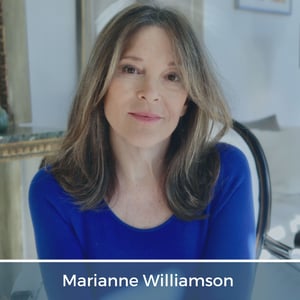
"It's Time To Engage in Some Radical Thinking" says Trump Whistleblower Miles Taylor
The Marianne Williamson Podcast
Marianne Williamson
4.8 • 1K Ratings
🗓️ 11 September 2025
⏱️ 40 minutes
🧾️ Download transcript
Summary
On September 5, 2018, an anonymous Op Ed appeared in the New York Times entitled I am Part of the Resistance Inside the Trump Administration. Obviously that caused a stir, followed by the publication of a book by the same author called A Warning. Someone was yelling from the inside: Get away from this man as fast as you can. You get the drift.
Ultimately the Anonymous author revealed himself to be Miles Taylor, a former chief of staff at the US. Department of Homeland Security. Having worked in the Bush administration as well, Taylor knew how things were supposed to work in the White House - and how they were not supposed to work. He followed up A Warning with another bestseller, Blowback, in which he described what would happen in a worst case scenario during a second Trump term. Most of them have already occurred.
In today's interview, Taylor told me it's now "time to engage in some radical thinking." He said we need a massive movement of non-violent resistance unlike anything America has ever seen.
I've admired Taylor's writing, his courage, and his continued call to the American people to wake up before it's too late. If Paul Revere were alive today, he'd be called Miles Taylor.
Subscribe to Miles Taylor's Substack: https://www.MilesTaylor.Substack.com
Support Miles' legal fund: https://endpresidentialrevenge.org/
Subscribe to Marianne's Substack: MarianneWilliamson.Susbtack.com
Subscribe to Marianne's YouTube Channel
Follow Marianne on Instagram
Follow Marianne on Facebook
Follow Marianne on TikTok
Learn more at Marianne.com
Transcript
Click on a timestamp to play from that location
| 0:00.0 | Hey, everybody. Thank you for being with us today. I have a really special guest. Somebody who has been speaking publicly for a while about some very important things and whose voice matters a lot right now. I'm sure a lot of you know who he is, Miles Taylor. He wrote an article that was an op-ed, an anonymous op-ed in the New York Times during the Trump presidency, saying, hey, I'm part of the resistance, but I'm inside. It was inside the administration. And he made it clear that politically he was on the right. He was inside the administration, but he was seeing things that he thought we really needed to know about. Taylor is a former chief of staff at the U.S. Department of Homeland Security. While there, he published the bombshell anonymous essay in the New York Times to which I just referred, where he blew the whistle on presidential misconduct. He's also the author of the best seller of warning, a really good book. It reads like a novel. It's a very, very good book. He's also the author of the New York Times best selling book, Blowback, and his host of the I Heart Radio podcast, The Whistle Blowers. Miles, welcome and thank you so much for being here. We forgot to add into the bio. I have a dog named Martini. He's really the, you know, he's the, the spinal cord in the family, you know, he's the moral, he's the moral center. Well, if you're going to say your dog's name, you better say your wife's name, because I'm not sure she'd be happy otherwise. Say the wife's name. Hannah is the actual spinal cord of the family. She's the one that bucks me up if I'm ever getting in clinicians to do the wrong thing. Yeah, you make that clear in your book. and I think that your personal vulnerability that you show in the book is a part of the story that I believe makes you more deeply informative than just people who are laying out certain facts. But let's go back to those certain facts. So you were a part of the Trump administration the first time, and I think it's very significant that you were part of Department of Homeland Security What unfolded Which you really told us about in your op-ed piece and then in a warning is that this was an inept president a Malovulent president a Narcissistic president someone who didn't know what he was doing, then you publish Blowback. In Blowback, you say, having been there and seen him at his worst, I'll tell you what's going to happen in a worst case scenario. You hear those sirens right now that they're coming to arrest Maryanne for even talking. They're like You should not put this guy on your podcast I have more dangerous contacts than you pay but anyway You say in this book Worst case scenario based on what I've already experienced This this and this could happen You and I are talking now at a time when this, this, and this, worst-case scenario is happening. Would you agree with my assessment? Yeah, almost all of it has come true. And when I wrote that second book, Blowback, which was under my name, you know, I wrote a warning anonymously, but I wanted to talk about the details I couldn't talk about in an anonymous book. And so in blowback, I tried to paint what I felt like at the time was the most comprehensive portrait possible of what a second Trump administration would look like. And as part of that, I think I spoke to more ex-Trump officials than anyone who wrote a book about the Trump era. I think I talked to north of 100 people who were former colleagues or cabinet secretaries or folks in different roles in the first Trump administration to ask them a very simple question. What did he want to do in the area that you worked in the first Trump administration, that he was unable to do, and how would he implement those ideas in a second administration? I of course tell my own personal story throughout that, but I try to paint that picture, and Mary, I'll be honest with you, I thought, you know, maybe in a second Trump administration, half of those things would come to fruition in the first year. But the overwhelming majority of things that I predicted in that book have come true in the first seven months of the Trump administration, surprising even me at the Breakeneck pace of that revenge presidency. And in the bulk of the things people told me about for this book, that the president wanted to do in their departments or agencies were things that were immoral or unethical or illegal or unconstitutional. And we've seen that done with alacrity in this second administration. Yeah, it is beyond our worst nightmare. And we're only this many months in. I think that there have been some psychological stages. First, people just integrating that information, right? I think there was a period where people were just paralyzed. You know, you and I spoke a little bit before you came on, and I know I'm not outing you because you talk about it in the book. I thought the way you spoke of your own personal vulnerability, I think the way you talked about the role of alcohol. But not only you, you made it clear, I thought it was a very good way that you described |
| 5:44.3 | the incredible personal stress and trauma that not just you, but so many people in the administration under which you served. We're experiencing these were good people. They were there to serve their country and they were realizing, you know, it unfolded in front of people's eyes how bad this was. So you talk about that. You talk about the personal stress and the personal anxiety not only for you but for others. I think that that is very relevant to what's happening to so many people in America today. Basically you were trying to suppress the pain. You were trying to, you know, medicate it, basically self-medicate with alcohol. And I think that where we are right now, one of the things you do mention towards the end of the book, I think, is, we could defend ourselves against bad policies, but we can't defend ourselves against bad men. You know, when you have this moral hollowing out, you quoted a former Republican congressman who pointed out it wasn't just Stalin, it was all the little Stalin's around him. Whatever hope we have, I would think, has to do with us and that we don't become a culture of aqua essence. Are you hopeful that somehow we're going to become the people that we need to be to turn this around and if so, how do you see it happening? Well, I think there is a there's a there's a culture of denial right now in our country and I'm glad that you pointed out actually Mary-Anne that I talk about struggling with alcoholism in the book and this isn't something that I struggled with while I was in my job in the national security community. It all came after. And this is relevant to your question, and I'll explain why in a second. But when I quit the administration and protest, I was harboring this very big secret that I was this anonymous critic from inside the Trump administration. And it was something that frustrated me on multiple levels. One, you know, keeping any secrets tough, keeping a secret that you know is going to blow up your life when it becomes known is also really tough. But then there was the fact that I felt incredibly let down by all the people I had worked for in Washington. In another time, I had the Golden Boy Dugi house or career in Republican politics. I got to do all the cool shit, right? The coolest jobs in the Pentagon and the White House and on Capitol Hill and, you know, I'm in the lead up to Trump becoming president. I'm helping right Paul Ryan's national security strategy. You know to me he's the figure head of the Republican Party. There's no way Trump's going to win. And then I watch him win. And I watch all of these people I looked up to in Republican politics. Just completely cave and bow at the altar of Trumpism. People who by the way in private were so strident in their denunciations of him and yet so glowing and effusive in their praise in public. And I mean just simply put it really that disgusted me. I come from a small town in Indiana pretty black and white morality about what's right and what's wrong. And it was just so obvious that there were all these people who would get together on the house floor for votes or for drinks and say, this guy's a psychopath and he's dangerous, and then they would go out and law him. That was baffling to me. And it was so much worse inside the Trump administration, as you had this so-called axis of adults, a term I helped coin, coin that were trying to keep him in check inside the administration, which was good. |
| 9:29.6 | And yet... is you had this so-called axis of adults, a term I helped coin, that were trying to keep him in check inside the administration, which was good, and yet many of them, even once they were fired or quit, didn't want to go talk about it. And my feeling at the time was, who the hell is Miles Taylor? Who cares what I have to say about it? But someone had to say something from in that administration. and so fast forward, after I quit the administration, I'm harboring this secret. I know that I have to come forward before the 2020 election in my own name. And I'd planted a marker to make sure that I followed through on it because I wasn't sure if I was going to have the stones to actually come forward. And so I said, look, I'll take the mask off before the 2020 election. So that I couldn't walk back on it. But that stress compounded. And like a lot of people during the pandemic, I found myself drinking more and more. I was on Xanax at the time and mixing those things. If you saw me on the news after I started speaking out against Trump, if you saw me on the news and lead up to the 2020 election, there was a good chance that I was buzzed at best and maybe drunk at worst. I think more of us saw more than you think. Marianne's like, he looked pretty drunk on Anderson Cooper that one night. I wouldn't say that, but not drunk, but you could, one can only amount to what you had to be going through going through. Well, the stress was, well, it was extraordinary stress. And I bring this up. Not so anyone has sympathy, but because I think that's what a lot of people are going through in this country right now. We're in a culture of denial that is so similar to what I experienced when I was in denial about self-medicating. You know, I was bearing the stress under drinks and drinks and convincing myself, hey, you can handle it, you're fine, you're fine, you're fine. That unwillingness to admit that I had a problem led to all kinds of other compounding problems in my life. And we are seeing that in our country. And, you know, I'll tell you it was I think my publisher was a little skeptical when I came to them with this book blowback. They said, wait a second, you know, you were this anonymous author and you want to write a book about how anonymity is actually the biggest danger to this country. And I said, yes, because I realized that in keeping the mask on, I wasn't being myself. I wasn't being honest and truthful about how bad the threats were, whether that was metaphorically as the anonymous author or keeping the drinking to myself. And it was only when I came forward with those two things. It was only when I unmasked myself politically and only when I admitted to my partner at the time that I thought I had a problem that I finally actually felt freed. Genuinely, I felt freer than I've ever felt in my entire life. And there hasn't been a day since then that I've looked back. I have zero regrets about coming forward and all of those things. And I think we as a country are in that sort of middle stage of that process. We're sort of in denial about our problem. We are watching our slide into authoritarianism as a country. And I'm glad you mentioned Hungary. There's a country that's as well we've been through it before we can admit it. We've never been through it anymore before. And so we've got a country that's in total denial. The longer we stay in denial, the more we enable this to happen, the more dangerous it gets, and then it's too late. And so we really do have to take our masks off. We really do have to, as individuals, go talk about what this is and to call it what it is, Marianne, which you alluded to, which is authoritarianism. We can say that without sounding hyperbolic. He's born in the military, so technically, if you're going to really be textbook about it, we've entered into totalitarianism at this point. But I want to talk to you about a couple of things, and obviously you've learned the concept you're sick is your secrets, right? |
| 13:26.3 | And we know where that comes from. |
| 13:29.4 | You did coin that phrase, the access of adults. |
| 13:31.6 | There were going to be these adults, which to be honest, thank goodness there were those |
| 13:35.1 | access of adults in the first administration because look at that compared to the, I think |
| 13:40.1 | you called them fifth graders, somebody calls them fifth graders in your book that are running |
| 13:43.3 | things now. |
| 13:44.3 | I think that was a general. |
| 13:46.1 | Yeah, I mean, and someone on the left of the political spectrum to look at John Bolton and realize he was the organ to Mundo. It was extraordinary. Yeah, it's right there. Yeah, it's right there. Okay, but it wasn't enough to be adult. You mentioned a couple of minutes ago, you come from a small town in Indiana and there |
| 14:03.8 | was good and bad, right and wrong. |
| 14:06.7 | And that was really, and that is what I think caused so much of the stress for people that they were working for the administration where they saw things that they knew were not good. But then there's this third thing, and that's what you just mentioned, that you've been shocked by how many people you talked to after. And also, and I know some of those people who, who, in the background, will say he's the biggest, in the world. You mentioned somebody who said, I think he's on math. This was a Republican Congress moment. He's taking math or something like that. And you've been shocked by how they will not display the courage necessary. Now, you, you make a comment at one point in Blowback, you say, Washington is filled with people who think that the enemy is external, which to me is the same way as saying, all the traditional politics does is deal with symptoms. How do you see it happening that we turn this around without something coming from really some other place, the same kind of place that got you sober. Well, I'm glad. I would agree with you, Mary, and about where we are at as a country in that process. Maybe it's a stage or two past denial and we need the mirror held up. And there's something that I say in the book, which is that, you know, when you come up in politics and you know this very well, |
| 15:26.2 | everything is about us versus them. And it's not just politics. I mean, I think that one of the hardest things that we reckon with in life |
| 15:34.4 | is realizing that the biggest struggles are not us versus them. It's us versus us. |
| 15:39.1 | You know, anyone listening right now knows probably the hardest thing they've ever been through |
| 15:44.3 | has been something internally that they had to reckon with. It's no different with our country. And you're right, in order to address this moment we are in, we have to reckon with how we got here, which was by choice. 73 million Americans said, we're going to do this again, despite all the warnings. There's no way to fix it without saying, we did this, our neighbors did this to all of us. Even if you didn't vote for Donald Trump, well, clearly you didn't do enough to keep your neighbor from voting for Donald Trump. We did this. And now that we're in it, we can either undo it or go a very different direction. |
| 16:26.3 | And I think this is a moment that lends itself to the need for more radical conversations. Now let me tell you what I don't mean by that because on the political right, a radical conversation is we need a civil war in this country. And I have no doubt that if Joe Biden had sent armed troops into Republican states and Republican cities, that we would have a popular discourse about a second civil war right now. There would be militias on the streets in those cities going and fighting against American troops. It would be ugly like nothing you'd ever imagined. But of course, Joe Biden didn't do that. And he never would have, and we never would have gotten to that point of them deploying troops into Republican cities. Now that it's happening in democratic cities, which is the president's own terminology, he's deliberately sending troops into cities that lean left to consolidate his power to make a point. We can't go down the path of armed resistance because we know what happens. But that doesn't mean we can't engage in radical thinking. We have to engage in radical thinking right now. And that is either a mass mobilization, a nonviolent movement, the likes of which we've never seen in this country. I'm talking about a level even beyond the civil rights movement. That's the kind of thing we need to see to turn the tide, but also a discussion about what comes after that. Because we clearly need to rewrite our civic compact. And what do I mean by that? Let me be more specific. The United States Constitution clearly is insufficient at this moment. We need to revisit that document. We need to consider amendments to that document or we need to consider rejiggering our polity so that we can either live peacefully together or peacefully separate. I'm not here advocating for succession. I'm not here advocating for throwing the Constitution out. I'm saying we are in a moment as pivotal as the one our founders were in, where they said, we need to consider something drastic. Either some kind of separation or a new document, we're in one of those moments right now. And we have to be able to talk openly about how do we amend our Constitution? How do we reform our politics so that we don't have people living among us who feel an existential threat from the other side so much so that they would talk about loading their rifles and going after their neighbors? That's the seriousness of the moment we're in. And until we have that kind of conversation, we're going to be trying to treat a gunshot wound with a bandaid. And that's how I feel like the response is right now, is the patient is bleeding out on the table and we're sticking band aids on the thing. It's not going to solve our problem. Yeah, I mean, all the people who said that we had to have guns, you have to have guns in case the government becomes tyrannous, now the government has become tyrannous and they're on the side of the tyrants in many cases. I run it, isn't it? Uh-huh. All right, so I want to go back to what you said about radical thinking. And you said we need a radical movement that is even bigger than the civil rights movement. So let's talk about that. There are already people on the streets in many, many cities. This is where, and I'm sure you've thought about this, the fact that Pete Heggseth is apparently drawing up plans that the president, I'm sure, has directed him to draw up for military response to peaceful protest. Well, what we would call peaceful protest. So when you say I want to follow, I want you to follow through a little bit of that. When you talk, we keep saying we need radical thinking. I agree. I think a lot of people would agree. Certainly there's critical mass who are not in denial. Okay, check radical thinking. I'm ready. I think that we would both agree. Well, it's going to have to, you're going to have to be courageous. There's a courage element here. That's why I admire you, actually. And others that you mentioned in your book and that we all know who are speaking up. You said a mass movement. Tell me about this movement. What does it look like and what does it do? Well, I think we don't quite have the numbers yet. And here's why. I think before Donald Trump came into office, we had the numbers to go resist something like this. But I think the social fear is so, so high right now because his revenge campaign has been very successful. Whether it's, whether pieces of it against the law firms or the universities or businesses have been struck down by the courts is irrelevant to what I'm about to say. The fact that the president has shown himself willing to abuse executive power to destroy anyone's life or any institution has been sufficient to scare people from doing the things publicly to resist this administration they would otherwise do. And I'll be even more specific about it. Some of my former colleagues who were very vocal in the 2020 election and in the lead up to the 2024 election have gone completely silent. Now these are people who risked a lot to come out against Donald Trump, but have since self-sensored because they are worried about the punishment. They are worried about being in handcuffs. They're worried about their families being attacked. And so I fear that that intimidation is working. And if it's happening to people who've already been brave enough to go out there publicly and fight against this man, certainly ordinary Americans are scared by what it might mean to come forward. Now, that said, we know what the recipe is to get people to dissent. And that is strengthen numbers. The more people you get out there, the more you lower the price of dissent, the easier it gets for the next person and the next person join. There's a formula for that. There's a way to do that. And it starts off with the people you already referenced, Maryann, a lot of us being out there talking about this, even though it's scary, lowering that price, expanding the ranks. But we have to go beyond just protests. And I'm glad you mentioned strikes. I don't think we're there yet. I don't think we have the numbers yet. |
| 22:45.0 | I'd love to have the country do that tomorrow. |
| 22:47.0 | But I want to give you an example. |
| 22:48.0 | And I think you probably know more about this than I do. I think it was in the mid-70s. I think it was 1975 in Iceland. This is a country I love. It's where me and my wife got engaged. and it's a country that's meant a lot to me. |
| 23:03.4 | In 1975, there was a mass walkout of women in Iceland, |
... |
Please login to see the full transcript.
Disclaimer: The podcast and artwork embedded on this page are from Marianne Williamson, and are the property of its owner and not affiliated with or endorsed by Tapesearch.
Generated transcripts are the property of Marianne Williamson and are distributed freely under the Fair Use doctrine. Transcripts generated by Tapesearch are not guaranteed to be accurate.
Copyright © Tapesearch 2026.