
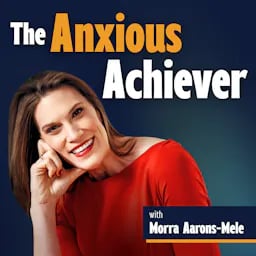
Imposter Syndrome, Work, and Mental Health
The Anxious Achiever
Morra Aarons-Mele
4.7 • 599 Ratings
🗓️ 27 April 2022
⏱️ 26 minutes
🧾️ Download transcript
Summary
Transcript
Click on a timestamp to play from that location
| 0:00.0 | LinkedIn Presents. |
| 0:01.0 | I'm Maura Arons-Mili, and this is The Anxious Achiever. |
| 0:13.0 | We look at stories from business leaders who've dealt with anxiety, depression, or other mental health challenges, how they fell down, how they pick themselves up, |
| 0:22.6 | and how they hope work will change in the future. |
| 0:33.0 | This week, psychologist Lisa Orbae-Austin joins me to share what her research has shown about how to get rid of imposter syndrome. Yep, I said it. You can actually eradicate this thing, Austin says. To me, it starts with a question. Who are you working so hard for? Are you working so hard to prove something to people in your past? To prove to your peers, you're one of them? Are you working so hard to prove something to people in your past? To prove to your peers, |
| 0:55.8 | you're one of them? Are you working so hard because it's all you know how to do? So many of us can |
| 1:01.8 | relate to imposter feelings, the idea that you feel like a fraud, that you're faking it, |
| 1:07.1 | and that any minute now, people will be able to see the real you. It's a concept that dates back |
| 1:12.6 | to the 1970s when two psychologists began thinking about the idea. And it occurs frequently |
| 1:18.6 | among high achievers who can't believe or internalize their success, no matter what level they reach. |
| 1:25.5 | And of course, this can cause anxiety or even depression. |
| 1:29.0 | And so I wanted to speak to someone who could explain the relationship between mental health, |
| 1:34.0 | imposter syndrome, and how we do or don't succeed at work. Lisa Orbe Austin is an executive coach |
| 1:40.2 | and psychologist, and she's an expert on imposter syndrome. Here's my conversation with her. |
| 1:52.4 | It's funny. I mean, you talk about imposter syndrome a lot. Yes, I do. Almost obsessively so. |
| 2:00.5 | What are some of the misconceptions that you find people have about it? |
| 2:04.1 | Yeah, I mean, I think sometimes people think it's all about self-doubt. So it's solely self-doubt. If you doubt yourself and you have imposter's syndrome. And there's a far more involved way that we look at imposter syndrome and it's not just about self-doubt. So I do think that's a misconception. You often hear people say that only women have imposter syndrome or stop pathologizing |
| 2:23.6 | women with imposter syndrome. We know that not to be true from the research that there's, |
| 2:27.9 | you know, plenty of data to show it's inconclusive that women actually experience it more often. |
| 2:32.6 | And many of the data has shown recently that that actually men experience it as often. There's no significant difference. It just shows up |
| 2:39.1 | a little differently. So you hear that. You hear a lot lately around oppression causes imposter |
| 2:44.0 | syndrome. There's no data to suggest that whatsoever. Not that it doesn't sort of exacerbate or |
... |
Please login to see the full transcript.
Disclaimer: The podcast and artwork embedded on this page are from Morra Aarons-Mele, and are the property of its owner and not affiliated with or endorsed by Tapesearch.
Generated transcripts are the property of Morra Aarons-Mele and are distributed freely under the Fair Use doctrine. Transcripts generated by Tapesearch are not guaranteed to be accurate.
Copyright © Tapesearch 2026.