
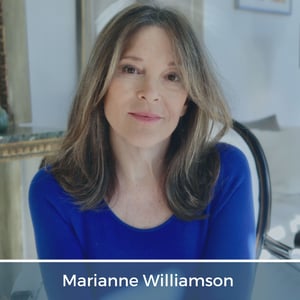
GILDED RAGE: Elon Musk and the Radicalization of Silicon Valley | Interview with Jacob Silverman
The Marianne Williamson Podcast
Marianne Williamson
4.8 • 1K Ratings
🗓️ 9 December 2025
⏱️ 48 minutes
🧾️ Download transcript
Summary
Who are the techno billionaires who have decided to put their money behind the destruction of democracy as we know it, to be replaced by a corporate authoritarian state? Who are they, what is their vision, and what are they doing to effectuate it?
Learn more about Jacob: JacobSilverman.com
More about Gilded Rage: Linktr.ee/gildedrage
Subscribe to Marianne's Substack: MarianneWilliamson.Susbtack.com
Subscribe to Marianne's YouTube Channel
Follow Marianne on Instagram
Follow Marianne on Facebook
Follow Marianne on TikTok
Learn more at Marianne.com
Transcript
Click on a timestamp to play from that location
| 0:00.0 | Hi, I think one of the things happening right now for a lot of people is the effort to more fully understand How we got to this moment in American history? What is the larger goal of some of the people who are so busy demolishing our democratic institutions? I think some things are becoming clear in terms of white supremacy becoming clear in terms of Christian nationalism And that third piece has to do with these tech billionaires who are so much |
| 0:25.1 | a part of this who have been radicalized over the last few years. |
| 0:29.0 | Who are they? |
| 0:30.0 | What's their plan? |
| 0:31.0 | What are they doing? |
| 0:32.0 | And what is the vision of America that they're seeking to affectuate? |
| 0:35.9 | It's important because they're putting billions of dollars behind that effort. |
| 0:39.9 | So my guest today has a lot of the information that if you want to know exactly who they |
| 0:44.2 | are and what they're doing, this is the book for you to read. |
| 0:47.7 | It's called Gilded Rage. |
| 0:49.9 | Elon Musk and the Radicalization of Silicon Valley. |
| 0:53.4 | My guest is Jacob Silverman. |
| 0:55.5 | I found the book fascinating and I've been really eager to speak with him. |
| 0:59.4 | Jacob Silverman, I'm so glad that you're here. |
| 1:02.0 | Thank you so, so much. |
| 1:03.0 | Well, thank you. |
| 1:04.0 | I appreciate the introduction. I'm really glad to be here. First of all, I want to tell people a little bit about you. Silverman is an independent New York-based journalist, author of three books, including New York Times bestseller, easy money, and terms of service. He has spent years reporting on political corruption, illicit finance, crypto, and corporate fraud and the rise of MAGA-aligned tech oligarchs. Now don't let any of that sort of like scary away and make you think, oh, that's technical and crypto and all that that I don't understand. Remember, an integrative approach today means we have to go into the vertical as well as the horizontal. We have to have deep understanding of what's happening. So when you think for instance what can I do? You know what you can do? You can read really good books like this one. The book that we're talking about today is a book called Gilded Rage. This is a kind of thing where in today's world book clubs are a form of political and social activism because they're a way that we have a deeper understanding of what's going on. So let's get right to a Jacob because you really, you lay it all out here. I was saying to Jacob before we started everyone that one and I'm going to tell you it's a good book, but the word good is kind of funny here. It is a very good book. And at the same time, after Terry, there was a point reading this book, Jacob, where I actually thought it might be physically ill. Yeah, you might need to take it in doses. Yeah. There are so many places in this book, everyone, where you just, you know, yellow line, pink line, whatever you're doing. But this one I thought was a really good introduction to the conversation we're having here. This is Jacob's words in Gilded Rage. One had repeatedly expressed his wish to be a dictator and to do away with elections. He talked about using the military to dispose of his enemies. He was surrounded by who's who of constitutional subversives and right-wing radicals, the intellectual and bureaucratic foot soldiers of a political project that would attempt to consolidate power in a president immune from legal judgment, purge the government of millions of disloyal workers, use the military to deport 20 million individuals, and create a database of pregnant people to track violations of a national abortion ban. Among other potential crimes and civic outages, they also wanted to invade Mexico to fight drug cartels. This is the deal, because most of what I just said, you're like, yeah, I kind of knew that. But this is what this book is about and what Jacob's going to explain. Some of text-richest leaders decided they were on board with this political program. They would devote their fortunes, their corporate networks, and their formidable influence to making it happen. Okay, Jacob. One of the things that makes the book so good is that you tell it like the story, the ongoing story that it is. I think what's happening with people is the dots aren't even connecting. We see facts, you know, I'm sure you saw the article about David Sacks for instance in The New York Times this last Sunday. But if I hadn't read your book, I wouldn't understand where SACS fits in with Lonestell, with Peter Till, with Elon Musk, with the whole gang, with Mark Andreessen. So a lot of this, I'd like to just sort of throw over to you what happened. How did these people become part of this right-wing, radicalized group? How did it happen? Who are they? And what are their plans for our future? Sure. Well, I appreciate what you said because I really did try to write almost a handbook or something that does connect these dots and lays out for the common reader or the common American certainly who are these people and it's not just Musk of course but he is the most kind of powerful and richest person the head of this group but some the PayPal Mafia, but now it's kind of expanded to include a younger generation of people. I want to give people equipment for understanding what these few dozen men, pretty much all white men, billionaires and multi-billionaires want and what their intentions are and how they never been very democratic with a small D. Some of them were Democratic party donors at some points, but they never really believed in democracy. Some of them, like Peter Tioquat explicitly has said, democracy is not an important value for him. You know, these are diet and the wool capitalist, but they're also, I think, increasingly across the board people who became more right wing in in the last five years or you know more embracing of something like authoritarianism or fascism and and trump became the vehicle i think that they saw to achieve that they could uh... basically maximize their return on investment by throwing in their lot fully with him and what we see now is this incredible fusion of corporate power from the tech industry, especially with the office of the president itself. So the book is an attempt to kind of chart some of those major personalities and ideas that help bring us there and also to say how things did change a lot beginning with the COVID years especially. Yeah. You still have something just now about Peter Till being a diet in the wool capitalist. I think it's important, probably for a lot of people who would be listening. It is not inherent in my mind that someone who would even consider themselves a diet in the wool capitalist is inherently anti-democratic. I mean, there is such thing some people would argue. Certainly it's at least a legitimate conversation, conscious capitalism, ethical CEOs, proper guardrails and so forth. But these people are into a kind of capitalist corporate authoritarianism. They've crossed the line to them any regulation, challenges them in an unacceptable way. They basically would like to take the levers of power and use them to really reinvent American society when you agree with that. Yeah, I think they don't tolerate any critiques which we see in people like Mark and Dreson who blocks everyone on Twitter but he's a billionaire venture capitalist. But they also, I think a simple way of putting is they just don't wish to be governed. So, sometimes they pursue what they call exit through these libertarian projects of creating new city states, but also the other method is by controlling the levers of power and that they really were able to do with the 2024 election cycle. And they are not interested in submitting to kind of any of the rules or regulations that the rest of us have to and they consider that almost against their designated role in society that they are this elite neo-Aerostocracy and they have a right to rule. Well, in that section that I read that you describe how basically Donald Trump is just a tool. |
| 8:04.0 | Donald Trump is just someone that they can use, which is also very disturbing because no one should be naive enough to think the getting rid of Donald Trump, uh, electrally for instance, is going to end this. Their power is so enormous. One of the things that I think so powerful about the book and what makes it everybody why I think like a book club, I really, um, you will say enjoy reading this you will be compelled reading this I mean it's a pagejourner in its own way and so that's why can you start a little bit at the beginning and tell us because I think what's so interesting is how you really go into some of the personalities of the people who were as you already mentioned in some cases maybe democrats I know I remember the time and we thought Elon Musk was cool. Remember, we thought those guys were kind of cool. You know, no, no, no, the tests are over. So you really go into the personalities, Musk, Peter, Teal, who brings this whole Christian, skewed Christian view into it. Mark and Drieson, I think is fascinating. So I really, can you give us a little bit of the the story, how this started, who they are, and then of course we need to get into what they're doing. Yeah, so the book basically covers the time span of post-911 to now, but the last 10 years are really important in the shifts we've seen in the wider culture, in the culture and politics of Silicon Valley, and of course at the highest levels of government with Trump. And I talk about some pretty dramatic shifts in individuals. I mean, must himself during Trump's first administration, when Trump pulled out of the Paris Peace Accords, or the Paris climate treaty, excuse me, he must resign from a couple of presidential advisory committees he was on related to climate. I mean, this is the kind of thing that's more symbolic. Yeah, this is the kind of thing that's more symbolic, but hey, you could not, obviously he did a complete 180 since then, and this is someone who, you know, also eight years later was doing everything he could to elect Trump, but also had become basically a climate change to nihilists. There are other examples of that I mentioned. Sergey Bryn, one of the co-founders of Google, again, a company that really styled itself as an ethical actor. Don't do evil. Was there an unofficial but official motto? And Sergey Bryn protested the first Trump Muslim band. He showed at san francisco airport he said i am i was a refugee because he was a jew from soviet russia at who had come to the u.s. uh... through a refugee program or asylum program and but by the time that trump was reelected uh... uh... surge brin was attending meetings with trump and and saturday and the dellan others uh... on AI,ela and others on AI. And I think for some of these people what you see is more of a political and ideological transformation of someone like Musk, which is partly psychological. We can talk about how his daughter coming out of his trans definitely affected him and his politics. And some I think maybe more like Sergey Brin or some of these other tech figures at Apple or Microsoft or Google are more opportunistic. But there's still kind of a disregard for politics or for what happens to the bulk of us and as I had to just simply make as much money as possible. So I think those two things, the sort of opportunistic greedy side and then the more ideological but also greedy side can kind of run concurrently together. And that's what we're seeing dominate the tech leadership. And with Trump, they don't necessarily like him very much. I think they do share some of his reactionary grievances. Trump is pretty transphobic. That's something that he and Muscole along with. And they share the same kind of disrespect for a lot of institutions or traditional markers of the American establishment or prestige that they don't have much respect for. And but again, I think that just makes Trump kind of a useful vehicle for them right now. And maybe if he goes away, someone else will serve that place. I'm sure that you saw the video that came out recently of a bunch of the tech billionaires, many of them people that you mentioned in your book sitting around a table at the White House, doing that same kind of dear leader nonsense that we've seen from some cabinet officials that was really kind of heartbreaking. They were all there, right? Zuckerberg was there, Eric Schmidt was there. One of the things that you talk about with Eric Schmidt that I think is particularly frightening is that he has discovered, and it's found it very exciting, the military industrial complex. So everybody, if you thought that we were in trouble, the military industrial complex, it's now the military techno industrial complex. In fact, Biden actually used that expression of technical industrial. So they have discovered the billions to be made there. And I think that, you know, all of that, Eric talks about how we got to fight China. Well, let's not get ourselves at the Chinese influence in Latin America isn't part of what this whole Venezuelan drama is about. So let me go back a little bit. You talked about ideology, and you talked about just sheer profit. I want to go back to almost the psychological significance of the fact that once somebody has, first of all, once somebody has a billion, but these guys that you're talking about, they have tens of billions, some of them hundreds of billions. There's nothing that could happen could in any way affect the lifestyle of them, their children, their grandchildren, or their great-grandchildren. This is sociopath. This is sociopathic at this point. This makes no sense. I have an old friend who was, I don't know how much money he has, but who's kind of famous that he had a billion. And many years ago I said to him, I said, you know, something happens to you guys around $750 million. And he said, what do you mean? I said, I don't know. But until around $750 million, I think you think the laws of civilization apply to you. And I think something happens in you guys. It seems to me it's about $750 million. You know, I've been serious but you know what is the reaction wise? He kind of thought for a minute and then he smiled and he went, yeah I think that's about the number. Something happens to people. So when when Louis Brandeiser, Louis Brandeiser said you can have large amounts of money concentrated in the hands of a few. |
| 14:25.6 | And he was thinking, co-brothers money. |
| 14:27.2 | He wasn't, nobody could even imagine the enormity of this. |
| 14:30.3 | This is like imagining the enormity of the sun. |
| 14:33.2 | He said, you can have that or you can have democracy. |
... |
Please login to see the full transcript.
Disclaimer: The podcast and artwork embedded on this page are from Marianne Williamson, and are the property of its owner and not affiliated with or endorsed by Tapesearch.
Generated transcripts are the property of Marianne Williamson and are distributed freely under the Fair Use doctrine. Transcripts generated by Tapesearch are not guaranteed to be accurate.
Copyright © Tapesearch 2026.