
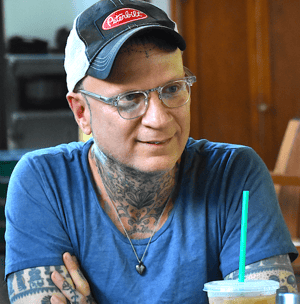
George Haas and Josh Korda on the Roots of the False Self and a Return to Authenticity
Dharmapunx NYC
josh korda
4.8 • 938 Ratings
🗓️ 13 August 2014
⏱️ 61 minutes
🧾️ Download transcript
Summary
Transcript
Click on a timestamp to play from that location
| 0:00.0 | Its talk is on a general theme of inauthenticity and authenticity. |
| 0:09.6 | I'm going to be speaking from a perspective of two of my favorite 20th century psychologists, Donald |
| 0:19.6 | Winnicott, Heinz Kohut, and I'm also then going to be bringing in some Buddhist perspectives and how we |
| 0:27.7 | address the issues that I've introduced and then we'll see where George takes it from there. |
| 0:39.0 | Okay, so from the earliest infancy, a core instinct we have is connection. |
| 0:47.0 | We seek connection with our caretakers. |
| 1:00.0 | We're communicating not through words in the first years of our lives, but through emotional expressions, gestures, body movements, prize. |
| 1:10.0 | We're seeking a bunch of different needs are asking to be met. We're seeking first and |
| 1:21.9 | foremost security, the sense that somebody is there to protect us |
| 1:27.6 | to keep us warm to feed us |
| 1:31.8 | We're all born and from one perspective very prematurely it takes a very long time for a human being to be self-sustaining in any meaningful definition of that phrase. |
| 1:51.0 | So we're seeking security without which we would perish. |
| 1:58.2 | We're seeking emotional tolerance, |
| 2:02.0 | which means someone who tolerates the way we express our needs, |
| 2:06.0 | through cries, through gestures, facial expressions, movements. |
| 2:14.2 | We're seeking nearing, which means someone not only can read our emotions, |
| 2:19.6 | but signal them back in a way that lets us know they understand how we feel. |
| 2:26.4 | They know that we're frightened or scared or hungry or overwhelmed or whatever we're feeling and that they, the caretaker can help us find some stability. |
| 2:50.0 | We're also seeking, eventually these needs become more refined and we're seeking things like role models, people who show us that we can accomplish and do things |
| 2:55.8 | in the world. |
| 2:56.8 | And a sense of affiliation, which means feeling that we're part of a family or a group of people not just something that is |
| 3:06.2 | being taken care of but someone who has something of value. |
... |
Please login to see the full transcript.
Disclaimer: The podcast and artwork embedded on this page are from josh korda, and are the property of its owner and not affiliated with or endorsed by Tapesearch.
Generated transcripts are the property of josh korda and are distributed freely under the Fair Use doctrine. Transcripts generated by Tapesearch are not guaranteed to be accurate.
Copyright © Tapesearch 2026.