
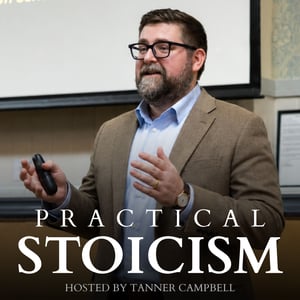
Difficult People and Moral Progress
Practical Stoicism
Tanner Campbell
4.7 • 723 Ratings
🗓️ 5 January 2026
⏱️ 21 minutes
🧾️ Download transcript
Summary
This podcast is supported entirely by you, the listener. Without your patronage, none of this is possible.
Become a patron of my work for as little as $0.50/week here: https://stoicismpod.com/members
--
In this episode I reset Practical Stoicism back to its foundations and begin a new chapter for the show by returning to the classical texts themselves. I explain why this version of the podcast will move deliberately across the Stoic corpus rather than reading a single work straight through, drawing from Marcus Aurelius, Seneca, Epictetus, Musonius Rufus, and, where possible, the early Greek Stoics like Zeno of Citium, Chrysippus, and Cleanthes.
From there, I focus on Meditations 2.1, one of the most concise and powerful passages in Meditations, using George Long’s translation. I explain why Marcus is so often misunderstood, why he should be read as a deeply committed practitioner rather than a philosophical instructor, and why Meditations was never meant to teach Stoicism to anyone but Marcus himself.
We then unpack what Marcus is really doing in this meditation: preparing himself to meet difficult people, refusing to moralize or dehumanize them, and grounding his response in the Stoic claim that ignorance of good and evil (virtue and vice) is the root of wrongdoing. I explain why, in Stoicism, there is only one good and one evil, how this reframes resentment and anger, and why Marcus sees hostility toward others as fundamentally anti-social and contrary to Nature.
The episode closes by showing how Stoicism combines sympathy, personal responsibility, and moral resolve, and why caring for others is not optional if one is genuinely pursuing virtue. This is not a philosophy of withdrawal or toughness for its own sake, but a demanding ethical system aimed at producing better human beings.
Key takeaways from this episode include:
-
Why Meditations is a private practice document, not a Stoic instruction manual, and how misunderstanding this leads to shallow readings
-
How Meditations 2.1 reveals the Stoic view that vice is ignorance, not malice, and why this matters for how we treat others
-
Why Stoicism is fundamentally pro-social, and why turning away from others undermines the pursuit of virtue itself
If you'd like to provide feedback on this episode, or have question, you may do so as a member. Email sent by non-members will not be answered (though they may be read). This isn't punitive, I just cannot keep up. Limiting access to members reduces my workload. You're always invited to leave a comment on Spotify, member or not.
Thanks for listening and have a great day!
Podcast artwork by Original Randy: https://www.originalrandy.com
Learn more about your ad choices. Visit megaphone.fm/adchoices
Transcript
Click on a timestamp to play from that location
| 0:00.0 | Welcome Prokaptan to Practical Stoicism, 2026. It feels good to be doing this hard reset and getting back to basics. |
| 0:08.1 | Feels good to shake off the baggage of acquisitions and partnerships and get back to what practical stoicism was supposed to be all about from the get-go, |
| 0:15.1 | helping you to understand the philosophy through the exploration and interpretation of its classical text so that you can apply it in your own lives the way you see fit. |
| 0:24.5 | In previous iterations of practical stoicism, we worked through meditations. |
| 0:28.5 | One book at a time, one meditation at a time, but not this time. |
| 0:31.8 | This time we're going to bounce around a bit. |
| 0:33.8 | Marcus Aurelius, of course, in fact, we'll begin with one of his meditations today, but also |
| 0:38.6 | Seneca, Wussonius Rufus, Epictetus, and where I can manage to find and cobble together little |
| 0:44.1 | bits and pieces, Xenocrycipus, and Cleanthes. As we explore these texts together, you'll learn |
| 0:49.9 | what Stoicism is truly all about. And then, as is my hope, you'll become an incrementally |
| 0:55.8 | better version of yourself after each and every episode you listen to. Two quick reminders. |
| 1:01.6 | Before we start, old episodes can be found by searching your podcast player for practical |
| 1:06.4 | stoicism archives. That's archives, plural. And secondly, this podcast is presented to you |
| 1:13.0 | free of third-party ads and is, as of January 2026, my full-time and only employment. So help me |
| 1:21.1 | thrive so that I can help you do the same. Pledge your support for my work by going to |
| 1:25.7 | Stoicismpod.com forward slash members. |
| 1:28.7 | You can do that for as little as a dollar a week. |
| 1:31.7 | And believe me, every little bit matters and every little bit adds up. |
| 1:35.6 | Stoicismpod.com forward slash members. |
| 1:39.2 | All right, let's dive in. |
| 1:40.9 | Okay. Let's dive in. |
| 2:04.6 | Meditations 2.1 is one of the most beautiful in all of Marcus' meditations, and, without a doubt, my most favorite. It sums up so much about Stoicism in such few words that meditations could have begun and ended solely with it. |
... |
Please login to see the full transcript.
Disclaimer: The podcast and artwork embedded on this page are from Tanner Campbell, and are the property of its owner and not affiliated with or endorsed by Tapesearch.
Generated transcripts are the property of Tanner Campbell and are distributed freely under the Fair Use doctrine. Transcripts generated by Tapesearch are not guaranteed to be accurate.
Copyright © Tapesearch 2026.