
Catastrophe Apathy: Why understanding the climate crisis isn’t enough
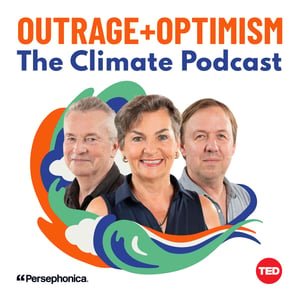
Outrage + Optimism: The Climate Podcast
Persephonica
4.7 • 1.1K Ratings
🗓️ 26 February 2026
⏱️ 36 minutes
🧾️ Download transcript
Summary
Climate concern is not the problem. Most people have it. What's missing is everything that turns concern into action - and understanding that gap turns out to be a lot more complicated than it looks.
This week, Christiana Figueres, Tom Rivett-Carnac and Paul Dickinson sit down with Lorraine Whitmarsh, Professor of Environmental Psychology and Director of the Centre for Climate Change and Social Transformations at the University of Bath.
Together they dig into the psychology behind catastrophe apathy: why understanding an existential threat doesn't always lead to action, and what the research says actually moves people.
Lorraine shares real-world evidence - including renewable energy tariffs that shifted 90% of customers onto green power simply by making it the default - and explains why trusted everyday messengers, from hairdressers to taxi drivers, employers to community figures, often have more influence than expert voices in reshaping what feels normal.
The conversation also revisits an uncomfortable history: how the personal carbon footprint, popularised by BP in the early 2000s, reframed climate responsibility around individual choices rather than systemic change. A framing so powerful that even environmental organisations adopted it. Who benefited most from that shift is a question the movement is still grappling with.
If systemic change requires public consent, and public consent requires political will, and political will requires behaviour change - how do you break the climate Catch-22?
With thanks to the University of Bath.
Learn More:
🧠 Explore Lorraine Whitmarsh's research at the Centre for Climate Change and Social Transformations, University of Bath
🔌 Read about the Swiss renewable energy default study — the experiment that moved 90% of customers to green energy by changing a default setting
🗳️ Learn more about citizens' assemblies on climate and deliberative democracy in practice
🌍 Read the IPCC's work on demand-side solutions and behavioural change in its Sixth Assessment Report
🎤 Leave us your voice notes and questions for upcoming episodes on SpeakPipe
Join the conversation:
Instagram @outrageoptimism LinkedIn @outrageoptimism
Or get in touch with us via this form.
Producer: Ben Weaver-Hincks
Edited by Miles Martignoni
Planning: Caitlin Hanrahan
Exec Producer: Ellie Clifford
This is a Persephonica production for Global Optimism and is part of the Acast Creator Network.
Hosted on Acast. See acast.com/privacy for more information.
Transcript
Click on a timestamp to play from that location
| 0:00.0 | Hello and welcome to outrage and optimism. |
| 0:04.4 | I'm Tom Rufiq. |
| 0:05.3 | I'm Christiana Pirae here this. |
| 0:07.0 | And I'm Paul Dickinson. |
| 0:08.0 | Today we ask how can people be persuaded to take action to make a difference in the climate crisis? |
| 0:13.0 | Thanks for being here. |
| 0:18.2 | All right, we're going to get to an amazing conversation you two have just had with Lorraine Whitmarsh, who is an environmental psychologist here at the University of Bath and Director of the Centre for Climate Change and Social Transformation. |
| 0:32.4 | I have to say it was a great discussion because what I thought the three of you did was really delve into what are the real |
| 0:38.5 | barriers between getting the public engaged? And I thought she had some great insights. But I have to |
| 0:42.8 | say, it did make me think a little bit of the story of the carbon footprint. Did you find |
| 0:47.5 | yourself thinking about that as you were talking to her? The sinister story, because there's probably |
| 0:51.9 | a hundred stories of the carbon footprint, but there's one that's very famous, which I think you're going to share with us, Tom. |
| 0:57.1 | It was in the early 2000s, and older listeners like me may remember that at one point, |
| 1:02.3 | the company formerly known as British Petroleum changed itself to call itself beyond petroleum, |
| 1:07.2 | which I liked, which you liked, right, under the leadership of John Brown. |
| 1:10.9 | And at that time, they also did something else, which is to popularise the idea of a personal |
| 1:15.9 | carbon footprint. Now, this is based on life cycle assessment analysis that have been around |
| 1:20.1 | for decades, but they really put real advertising budget behind the idea that every individual |
| 1:25.5 | can take responsibility for their own, quote--unquote carbon footprint and take action to reduce that. |
| 1:32.4 | Now, this was seen at the time as a real breakthrough, but looking back now, 25 years later... |
| 1:37.7 | And was then adopted by every single environmental organization that put their own carbon calculator. |
| 1:43.6 | People thought it was brilliant. |
... |
Please login to see the full transcript.
Disclaimer: The podcast and artwork embedded on this page are from Persephonica, and are the property of its owner and not affiliated with or endorsed by Tapesearch.
Generated transcripts are the property of Persephonica and are distributed freely under the Fair Use doctrine. Transcripts generated by Tapesearch are not guaranteed to be accurate.
Copyright © Tapesearch 2026.