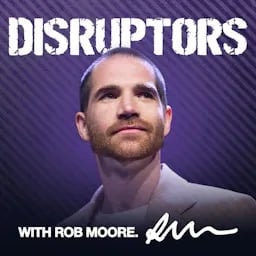
Welcome to The Disruptors podcast.
In this episode Rob explains in detail all aspects of managing finance; these can be applied to both your personal and professional life. Rob takes you through his nine ways to manage money that will leave you more enlightened and confident. It will help you prepare, progress, and achieve your ambitions.
KEY TAKEAWAYS
(0.57) One of the first rules of managing cash Rob impresses on us is to look after our Capital. He discusses how we all get lumps of money i.e. sell something, salaries, and dividends, then spend it. He says money attracts money and if you erode capital then you have nothing left to draw income from. He explores all the different situations that can arise if we do not either understand or appreciate how important it is to preserve capital at all costs.
(03.32) Rob moves onto his second rule of managing cash which is, Capital produces income. He reasons with us if we use capital to invest in assets that produce income, instead of using it on depreciating liabilities, or where we would get a negative return because of inflation, then the assets would allow us to use the income to buy depreciating liabilities. Rob gives us a good example of a standard Mercedes costing £300 per month on a 2/3 year lease and reminds us it might be £35,000 which would depreciate to £20,000 in around 3 years. However if we bought an HMO by using the same capital and raising the money for the rest, it would bring in £500 per month income. Then, instead of using your capital for the £300 per month you would be left with the difference between the income and your asset.
(06.03) The third rule Rob passes onto to us is that we cannot be unrealistic about the returns on managing cash. Rob tells us we can get good return on investment, and we can get infinite return on investment. If we put money into property which increases in value then we extracted all our cash back that is an infinite return on investment. When it comes to actual capital we deploy lumps of money, people expect 20% 30% 100% a day, a month, it’s unrealistic and naive. We should expect 5% that is pretty normal too. Rob goes on to explain this in more detail regarding I.S.A.’s, leverage, and the rate of return.
(07.18) Rule number 4 is to understand what burn rate is. Most people have no idea of what cash burn rate is. Rob describes to us it is the amount of time your capital erodes, and in business it is usually measured in months. How many months burn rate is how much capital we have, if we made no sales. It’s important to know what would be the total overheads and fixed variables, he asks us how many months worth of capital we would have if we made no sales. Rob gives us another example by telling us if our fixed variables were £50,000 and we had £150.000 in the bank our burn rate would 3 months. Rob expands on this theme further so we can appreciate how important having capital that will cover our burn rate.
(09.32) Getting to 0 days. Rob continues giving us another option of looking at getting rid of debt and going into the black. He understands it can be demoralizing trying to get to zero but a target can be a bench mark in our journey; it’s a flag you put in the ground. Rob has people asking him what sort of a target they should set themselves he tells them start at 0 month first then 1 month, 3 months 6 months and 1 year, he says once we have targets set it is going to get us more motivated and focused. Again he gives us examples of how to measure our business needs.
(011.07) Cash Flow Cycle. Rob guides us through the cash flow cycle telling us it is essentially the amount of debt or credit days we are in selling our products and services his example is supposing he buys 100 zoom HI’s they sell at £100, he buys them for £50 he says he then has to spend 5 grand. The cash flow cycle is how many days it takes to get that capital back; he is creating a debt by paying for it in advance and if it takes 60 days to sell all of them, that means a 60 day cash flow cycle, 60 days of exposure debt in the business held in stock. Rob continues by going more into depth giving us a great deal of information that tackles the cash flow cycle.
(014.41) Spreading and deploying your Capital. Rob informs us it is really important not to have our capital all in one place. As he explains if we had all our capital in one investment and something happened to that investment i.e. regulation, crash, recession, our capital is going to erode. Rob also describes how his financial team is always getting emails and so on, trying to get money saying they are Mark or Rob, so if they had all their money in the same bank, theft could clear them out. When you have cash spread it around into savings accounts and current accounts.
(016.16) Drawing vs retained earnings. Rob reveals to us both drawing and retaining earnings describing how profits and dividends can be drawn and what he thinks is best about income and profit.
BEST MOMENTS
Rob tells us about Dell UK how their revolutionary idea, for example building be-spoke computers meant they had the customers money up front for say 14 days. If you think of that with a million pound company the interest on the held money is extremely high.
Rob uses Bill Gates of Microsoft in his burn rate example and tells us how Bill Gates liked to have 12 months burn rate, meaning they could manage without any sales for a year.
Rob tells us in his managing cash rule “your capital is preserved in an asset against inflation and you spending it”
[Business, mindset, entrepreneur, disruptors]
VALUABLE RESOURCES
https://robmoore.com/
bit.ly/Robsupporter
https://robmoore.com/podbooks
rob.team
ABOUT THE HOST
Rob Moore is an author of 9 business books, 5 UK bestsellers, holds 3 world records for public speaking, entrepreneur, property investor, and property educator. Author of the global bestseller “Life Leverage” Host of UK’s No.1 business podcast “Disruptors”
“If you don't risk anything, you risk everything”
CONTACT METHOD
Rob’s official website: https://robmoore.com/
Facebook: https://www.facebook.com/robmooreprogressive/?ref=br_rs
LinkedIn: https://uk.linkedin.com/in/robmoore1979
disruptive, disruptors, entreprenuer, business, social media, marketing, money, growth, scale, scale up, risk, property: http://www.robmoore.com