
#9 Juan Ponce de Leon and the (Official) Discovery of Florida
The History of the Americans
Jack Henneman
4.9 • 632 Ratings
🗓️ 19 February 2021
⏱️ 33 minutes
🧾️ Download transcript
Summary
We now hasten to the first European exploration of the lands now constituting the United States, and that means the first sanctioned expedition to Florida in 1513 by Juan Ponce de Leon, and the legend of the Fountain of Youth. Florida would turn out to be enormously challenging, so it will still be more than fifty years before the first successful permanent settlement at St. Augustine.
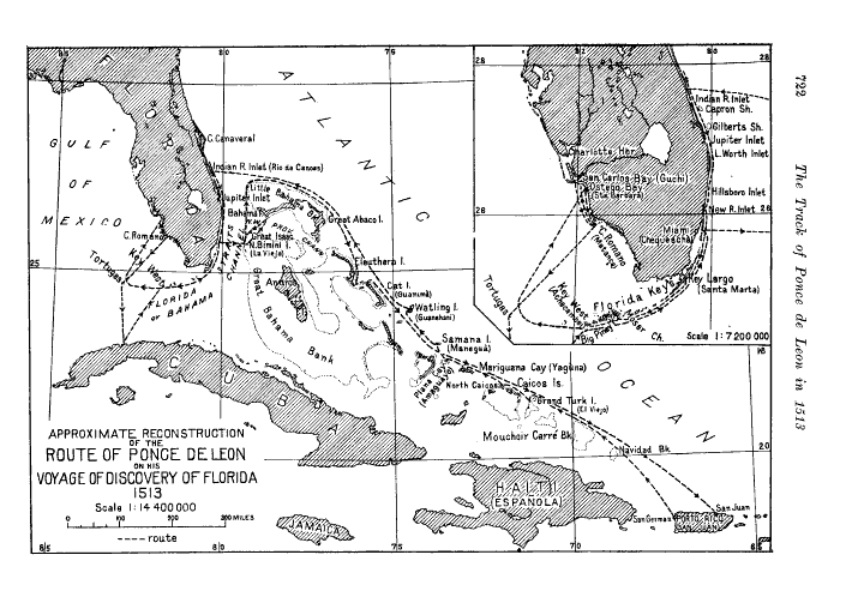
As discussed in the episode, there is some debate over Ponce’s route, so the various maps available online differ in important respects. Here’s one from 1913, which is as professional and on target as any that I found.
Selected references for this episode
Samuel Turner, “Juan Ponce de Leon and the Discovery of Florida Reconsidered”
John McGrath, “Sixteenth-Century Florida in the European Imagination”
T. Frederick Davis, “Ponce de Leon’s First Voyage and Discovery of Florida”
Transcript
Click on a timestamp to play from that location
| 0:00.0 | Welcome to the History of the Americans podcast, episode number nine, one, Ponce de |
| 0:12.7 | Leone, and the official discovery of Florida. I'm your host, Jack Heneman, and I've recorded |
| 0:18.3 | today's episode on February 17, 2021 2021 in blacked-out and very cold, |
| 0:26.3 | Austin, Texas. You'll be thrilled to know, however, that I was able to locate some power |
| 0:32.9 | at my wife's therapy office where I have decamped for the purpose of recording this episode |
| 0:39.4 | for release on Friday, February 19th. |
| 0:43.2 | If you're tuning in for the first time, we are telling the history of the people who inhabited |
| 0:49.0 | and inhabit the lands now constituting the United States. |
| 0:54.4 | To set up that history, we devoted two episodes to the Indians before 1492, and five to the story of Christopher Columbus through his first voyage. |
| 1:04.8 | The last episode was a very high altitude introduction to the Colombian exchange, the extraordinary transfer of diseases, |
| 1:12.7 | plants, people, animals, insects, and technology and culture between the two hemispheres |
| 1:18.1 | after 1492. It is therefore high time. We turn to the European exploration of North America. |
| 1:29.7 | And by the self-imposed boundaries of this podcast, that era began with Juan Ponce de Leon and his discovery of Florida in 1513. |
| 1:38.1 | Now, if you are anglophilic or merely a John Cabot fanboy, you might rise in high dudgeon over skipping over of his |
| 1:48.4 | discovery of Newfoundland in 1497 at the behest of English king Henry the 7th. |
| 1:55.3 | Well, Newfoundland is in Canada, not the United States. No offense, but outside of our subject area, |
| 2:02.5 | just as almost all of the discoveries of Columbus's second, third, and fourth voyages also are. |
| 2:08.5 | So by what feeble reasoning then do we justify studying Columbus's first voyage and not Cabot? |
| 2:15.1 | I need you to ask. There are at least two reasons. First, but for Columbus, |
| 2:20.8 | there would not have been a European exploration of North America, at least when it happened. |
| 2:27.4 | And if the Arabs of the Chinese had beaten the Europeans to the discovery in the usual air quotes, |
| 2:33.6 | there might never have been. Indeed, |
... |
Please login to see the full transcript.
Disclaimer: The podcast and artwork embedded on this page are from Jack Henneman, and are the property of its owner and not affiliated with or endorsed by Tapesearch.
Generated transcripts are the property of Jack Henneman and are distributed freely under the Fair Use doctrine. Transcripts generated by Tapesearch are not guaranteed to be accurate.
Copyright © Tapesearch 2026.