
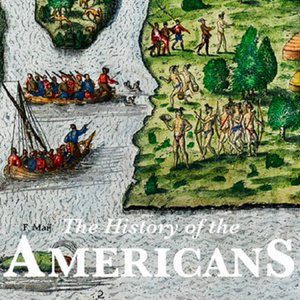
#8 Introduction to the Columbian Exchange
The History of the Americans
Jack Henneman
4.9 • 632 Ratings
🗓️ 12 February 2021
⏱️ 34 minutes
🧾️ Download transcript
Summary
[Note: A revised version of this episode dropped on October 12, 2024. Link.]
Introduction to the Columbian Exchange introduces listeners to the extraordinary consequences of the interhemispheric transmission of diseases, food crops, populations, cultures, and technologies in the years after Columbus’s famous First Voyage. That transmission is now known as the “Columbian Exchange,” a term invented in 1972 by the famous biological historian Alfred W. Crosby Jr. of the University of Texas at Austin. The episode focuses on the impact of diseases and crops that moved from one hemisphere to the other following 1492. It is replete with interesting factoids!
Selected references for this episode
Alfred W. Crosby, Jr., The Columbian Exchange: Biological and Cultural Consequences of 1492, 30th Anniversary Edition
Charles C. Mann, 1493: Uncovering the New World Columbus Created
Noble David Cook, Born to Die: Disease and New World Conquest, 1492-1650
Nathan Nunn and Nancy Qian, “The Columbian Exchange: A History of Disease, Food, and Ideas”
Benjamin M. Schmidt, “The History BA Since the Great Recession”
University of Zurich, “Syphilis May Have Spread Through Europe Before Columbus”
Columbian Exchange (Wikipedia)
Transcript
Click on a timestamp to play from that location
| 0:00.0 | Welcome to the History of the Americans podcast number eight. |
| 0:10.3 | I'm your host, Jack Heneman, and this episode is an introduction to the Colombian Exchange |
| 0:15.5 | recorded on February 10th, 2021 in New Orleans. Before we get to the fun part, I want to thank all our new |
| 0:25.4 | listeners. Well, maybe that is the fun part. We've had more than 600 downloads since inception, |
| 0:30.9 | which far exceeds my expectations. I figured if I had a thousand in the first few months, it would be amazing. |
| 0:39.4 | I hope is that there is an audience for telling history without grinding an axe, |
| 0:44.6 | or at least without forcing a connection between events in the past and today's politics. |
| 0:51.2 | The percentage of undergraduates majoring in history has fallen by about 75% since 1970, |
| 0:58.2 | and it has collapsed since 2007. |
| 1:02.4 | It cannot help but wonder if the decline in part is because the teaching of history in some places by some people |
| 1:10.0 | has become so tediously political |
| 1:12.9 | rather than fun and interesting. So I'll try and keep it fun and interesting. |
| 1:19.3 | This episode is an introduction to the Colombian Exchange, and it should appeal especially to listeners |
| 1:25.3 | who love factoids. In 1492, the entire human population of the |
| 1:31.8 | planet was in the vicinity of 450 to 600 million people, the gap perhaps explained in part |
| 1:39.3 | by the controversy over the pre-Columbian population of the Western Hemisphere. |
| 1:45.0 | We do know that by 1500 the population of Europe had not grown on a net basis since 1300. |
| 1:53.0 | There was plenty of hunger in most places outside of the Western Hemisphere, |
| 1:58.0 | and every reason to believe that humans in the eastern hemisphere had reached something |
| 2:02.1 | of a limit in their capacity to grow or capture calories faster than their need to consume them. |
| 2:10.8 | Now I'm going to break my promise and roll out some math. |
| 2:15.8 | On the very cool website, Our World in Data.org, one can find a graph of |
... |
Please login to see the full transcript.
Disclaimer: The podcast and artwork embedded on this page are from Jack Henneman, and are the property of its owner and not affiliated with or endorsed by Tapesearch.
Generated transcripts are the property of Jack Henneman and are distributed freely under the Fair Use doctrine. Transcripts generated by Tapesearch are not guaranteed to be accurate.
Copyright © Tapesearch 2026.