
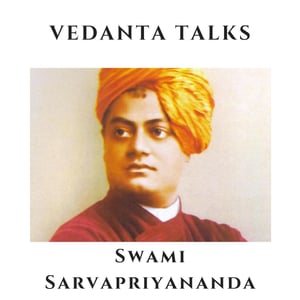
61. Bhagavad Gita | Chapter 5 Verse 2-4 | Swami Sarvapriyananda
Vedanta Talks - Swami Sarvapriyananda
Vedanta Society of New York
4.8 • 714 Ratings
🗓️ 10 February 2021
⏱️ 63 minutes
🧾️ Download transcript
Summary
Transcript
Click on a timestamp to play from that location
| 0:00.0 | O, |
| 0:02.0 | Vasudeva, Suttam, Devam, Kamsha-chanurramar Madhanam, |
| 0:08.0 | Devaki Paramanandam, Krishna, Vandhya Jagad Kurum. |
| 0:15.0 | We are studying the Bhagavad Gita. |
| 0:19.0 | We are on chapter 5, which is called sannyasa yoga, |
| 0:26.6 | the yoga of sannyasa, renunciation. And Arjuna asked a question that you have taught me renunciation |
| 0:35.6 | of action and the performance of action, |
| 0:38.3 | which is good, which is better, which one will lead me to the highest goal, that is Moksha, |
| 0:44.3 | Enlightenment and Freedom. |
| 0:47.3 | Tell me one with certainty. |
| 0:50.3 | Now we saw last time in the discussion of this question, that this question can be interpreted in two ways. |
| 0:59.5 | In one way, it does not make much sense. |
| 1:01.2 | Because if you were talking about the performance of karma yoga or gana yoga, doing your action without selfish motive, doing duty for duty's sake, or as worship |
| 1:16.0 | of God for the purification of the mind, and ghani yoga for getting knowledge, for getting |
| 1:24.0 | enlightenment. Well, then both are necessary. There's no option there. One has to purify |
| 1:29.3 | oneself and make one make the mind ready for enlightenment. And for enlightenment, one has to pursue |
| 1:36.3 | this Vedantic inquiry. So in that sense, there is no choice. But there is a choice in the sense of what kind of life |
| 1:46.6 | should I lead to achieve enlightenment? I want enlightenment. I want God realization. I want the final |
| 1:52.6 | freedom. But before me, there are different approaches. We have been told that one can attain |
| 1:58.9 | it while remaining a householder in the midst of action, in the midst of worldly relationships, and yet become enlightened. |
| 2:05.6 | Or one can leave all of that and become an all-renouncing monk completely dedicated to Vedantic inquiry and meditation without any relationships with the world. no positions, no relationships, no obligations or duties. |
| 2:21.3 | That is also possible. So which one? These two are possible. |
... |
Please login to see the full transcript.
Disclaimer: The podcast and artwork embedded on this page are from Vedanta Society of New York, and are the property of its owner and not affiliated with or endorsed by Tapesearch.
Generated transcripts are the property of Vedanta Society of New York and are distributed freely under the Fair Use doctrine. Transcripts generated by Tapesearch are not guaranteed to be accurate.
Copyright © Tapesearch 2026.