

222-The Year Without a Summer
Futility Closet
Greg Ross
4.8 • 748 Ratings
🗓️ 29 October 2018
⏱️ 32 minutes
🧾️ Download transcript
Summary
The eruption of Mount Tambora in 1815 was a disaster for the Dutch East Indies, but its astonishing consequences were felt around the world, blocking the sun and bringing cold, famine, and disease to millions of people from China to the United States. In this week's episode of the Futility Closet podcast we'll review the volcano's devastating effects and surprising legacy.
We'll also appreciate an inverted aircraft and puzzle over a resourceful barber.
Intro:
The Veterinary Record addressed an overlooked species in 1972.
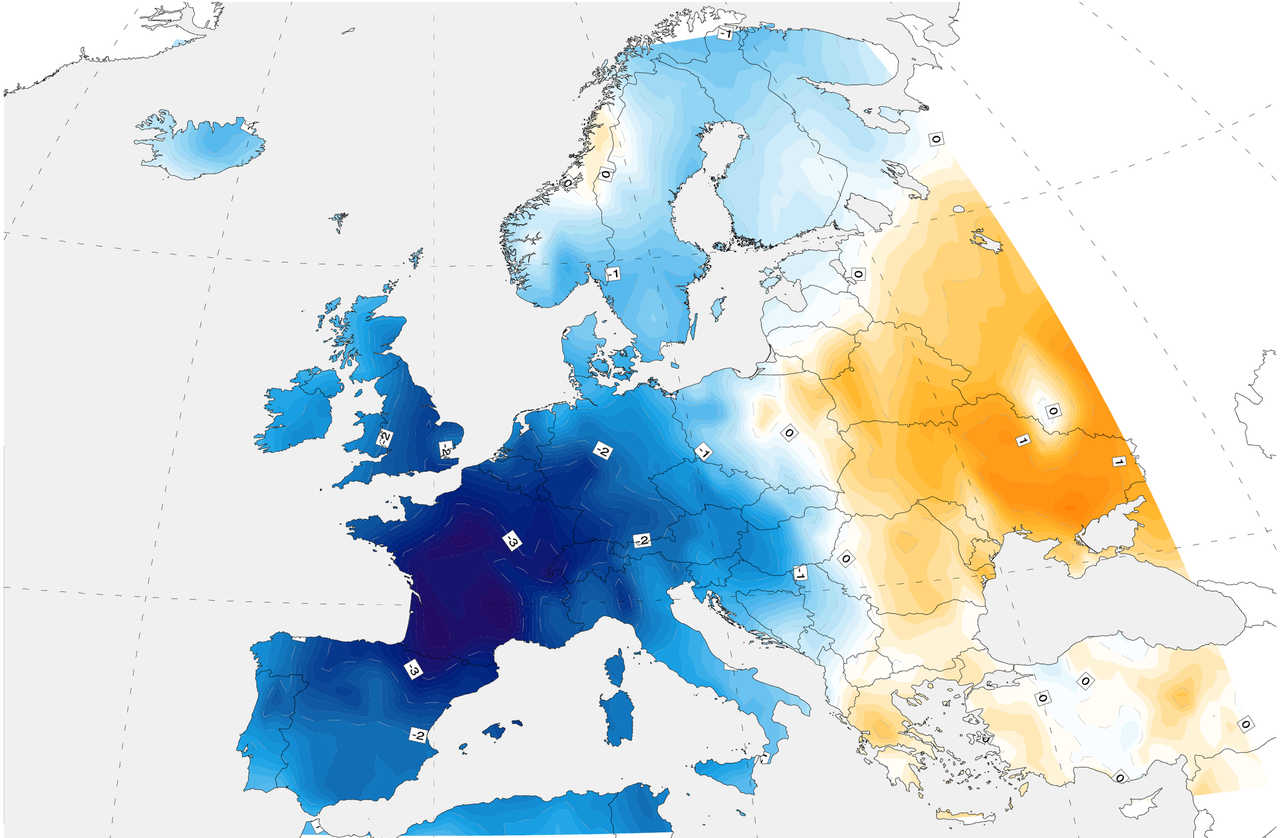
Map: The 1816 summer temperature anomaly (°C) with respect to 1971-2000 climatology (data source).
Sources for our feature on the Tambora eruption:
Gillen D'Arcy Wood, Tambora, 2014.
William K. Klingaman and Nicholas P. Klingaman, The Year Without a Summer, 2013.
Angus M. Gunn, Encyclopedia of Disasters, 2008.
Jelle Zeilinga de Boer and Donald Theodore Sanders, Volcanoes in Human History, 2012.
Jihong Cole-Dai et al. "Cold Decade (AD 1810–1819) Caused by Tambora (1815) and Another (1809) Stratospheric Volcanic Eruption," Geophysical Research Letters 36:22 (November 2009).
Clive Oppenheimer, "Climatic, Environmental and Human Consequences of the Largest Known Historic Eruption: Tambora Volcano (Indonesia) 1815," Progress in Physical Geography 27:2 (2003), 230-259.
Bernice de Jong Boers, "Mount Tambora in 1815: A Volcanic Eruption in Indonesia and Its Aftermath," Indonesia 60 (October 1995), 37-60.
Chaochao Gao et al., "Climatic Aftermath of the 1815 Tambora Eruption in China," Journal of Meteorological Research 31:1 (February 2017), 28-38.
Richard B. Stothers, "The Great Tambora Eruption in 1815 and its Aftermath," Science, New Series 224:4654 (June 15, 1984), 1191-1198.
Shuji Cao, Yushang Li, and Bin Yang, "Mt. Tambora, Climatic Changes, and China's Decline in the Nineteenth Century," Journal of World History 23:3 (September 2012), 587-607.
Gillen D'Arcy Wood, "The Volcano Lover: Climate, Colonialism, and the Slave Trade in Raffles's History of Java (1817)," Journal for Early Modern Cultural Studies 8:2 (Fall/Winter 2008), 33-55.
Lucy Veale and Georgina H. Endfield, "Situating 1816, the 'Year Without Summer', in the UK," Geographical Journal 182:4 (December 2016), 318-330.
Christos S. Zerefos, et al., "Atmospheric Effects of Volcanic Eruptions as Seen by Famous Artists and Depicted in Their Paintings," Atmospheric Chemistry and Physics 7:15 (2007), 4027-4042.
C.S. Zerefos, et al., "Further Evidence of Important Environmental Information Content in Red-to-Green Ratios as Depicted in Paintings by Great Masters," Atmospheric Chemistry and Physics 14:6 (2014), 2987-3015.
Sarah Zielinski, "How Paintings of Sunsets Immortalize Past Volcanic Eruptions," Smithsonian.com, March 25, 2014.
Alan MacEachern, "The Big Chill," Canada's History 96:4 (August September 2016), 52-55.
Richard Cavendish, "The Eruption of Mount Tambora," History Today 65:4 (April 2015), 8.
Robert Evans, "Blast From the Past," Smithsonian 33:4 (July 2002), 52-57.
Michael Greshko, "201 Years Ago, This Volcano Caused a Climate Catastrophe," National Geographic, April 8, 2016.
William J. Broad, "A Volcanic Eruption That Reverberates 200 Years Later," New York Times, Aug. 24, 2015.
John Noble Wilford, "Under an 1815 Volcano Eruption, Remains of a 'Lost Kingdom,'" New York Times, Feb. 28, 2006.
Listener mail:
"Trudeau to Apologize Nov. 7 for 1939 Decision to Turn Away Jewish Refugees Fleeing Nazis," CBC News, Sept. 6, 2018.
"Trudeau to Offer Formal Apology in Commons for Fate of Jewish Refugee Ship MS St. Louis," CBC News, May 8, 2018.
David Harry, "Box-Top Bonanza: Portland Land Bank May Get Park Land for $6,400," Forecaster, Aug. 14, 2018.
"Owney: Tales From the Rails," Smithsonian National Postal Museum, March 6, 2018.
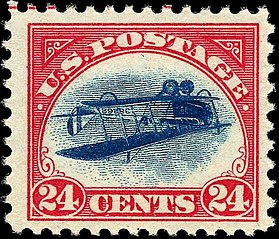
James Barron, "An Inverted Jenny Surfaces. The Flawed Stamp Had Not Been Seen Since 1918," New York Times, Sept. 6, 2018.
Daniel Fernandez, "How the Inverted Jenny, a 24-Cent Stamp, Came to Be Worth a Fortune," Smithsonian.com, May 15, 2018.
This week's lateral thinking puzzle was contributed by listener Frank Kroeger, inspired by Johann Peter Hebel's story "Der Barbierjunge von Segringen."
You can listen using the player above, download this episode directly, or subscribe on Google Podcasts, on Apple Podcasts, or via the RSS feed at https://futilitycloset.libsyn.com/rss.
Please consider becoming a patron of Futility Closet -- you can choose the amount you want to pledge, and we've set up some rewards to help thank you for your support. You can also make a one-time donation on the Support Us page of the Futility Closet website.
Many thanks to Doug Ross for the music in this episode.
If you have any questions or comments you can reach us at podcast@futilitycloset.com. Thanks for listening!
Transcript
Click on a timestamp to play from that location
| 0:00.0 | Welcome to the Futility Closet Podcast, forgotten stories from the pages of history. |
| 0:14.1 | Visit us online to sample more than 10,000 quirky curiosities from Teddy Bear Medicine to a tower for goats. |
| 0:23.4 | This is episode 222. I'm Greg Ross. |
| 0:30.6 | And I'm Sharon Ross. The eruption of Mount Tambora in 1815 was a disaster for the Dutch East Indies, |
| 0:36.0 | but its astonishing consequences were felt around the world, blocking the sun and bringing cold, |
| 0:38.3 | famine and disease to millions of people from China to the United States. In today's show, we'll review the volcano's devastating effects |
| 0:43.6 | and surprising legacy. We'll also appreciate an inverted aircraft and puzzle over a resourceful |
| 0:50.5 | barber. |
| 1:01.4 | The most destructive explosion on earth in the past 10,000 years, took place in April 1815, |
| 1:06.2 | when Mount Tambora erupted in the eastern part of Indonesia, what was then the Dutch East Indies. |
| 1:12.2 | The environmental historian Bernice de Jung Boers called it flatly a catastrophe without equal in recorded history. |
| 1:18.6 | Geologists call it ultraplinian, which means greater than the eruption of Mount Vesuvius that killed Pliny the elder in 79 AD. |
| 1:19.6 | There's a word for that. |
| 1:21.2 | That's great that there's a word for that. |
| 1:25.6 | The mountain lost a quarter of its height, sending 50 cubic kilometers of dense rock into the sky, |
| 1:28.2 | 10 times more than Mount Pinatubo in 1991, |
| 1:33.1 | and 100 times more than Mount St. Helens in 1980. An eyewitness, Lieutenant Owen Phillips, |
| 1:37.9 | wrote about 7 p.m. on the 10th April, three distinct columns of flame burst forth near the top of the Tamboro Mountain, and after ascending separately to a very great height, their tops |
| 1:41.9 | united in the air in a troubled and confused manner. |
| 1:45.2 | The sound was heard a thousand miles away. |
| 1:47.5 | Darkness descended for two days over a radius of 600 kilometers, and the ash cloud expanded to cover a region equal to the continental United States. |
| 1:55.1 | Debris blanketed all of Southeast Asia for a week. |
... |
Please login to see the full transcript.
Disclaimer: The podcast and artwork embedded on this page are from Greg Ross, and are the property of its owner and not affiliated with or endorsed by Tapesearch.
Generated transcripts are the property of Greg Ross and are distributed freely under the Fair Use doctrine. Transcripts generated by Tapesearch are not guaranteed to be accurate.
Copyright © Tapesearch 2026.