
159. How to Feed the World without Devouring the Planet
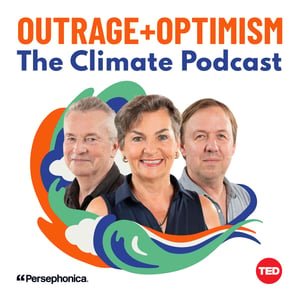
Outrage + Optimism: The Climate Podcast
Persephonica
4.7 • 1.1K Ratings
🗓️ 16 June 2022
⏱️ 64 minutes
🧾️ Download transcript
Summary
Regenesis: Feeding the World without Devouring the Planet is the title of George Monbiot’s new book and an essential challenge that we explore in this Future of Food episode, with the help of George and three other guests committed to transforming our food system. As the current global food crisis continues to push more and more people to the brink of starvation, join us as we take a deep dive into the root causes of the crisis. Surface with a diverse and exciting range of solutions that could ensure we have a ‘glocal’ diverse food system, and a paradigm shift in the way we produce protein that regenerates our planet and feeds our population.
Our four contributors to this episode are: George Monbiot, celebrated author, activist and environmentalist; Dr Laura Pereira, Associate Professor at the Global Change Institute at the University of Witwatersrand in Johannesburg, South Africa and a researcher at the Stockholm Resilience Centre at Stockholm University in Sweden; Dr Ruchika Singh, Director of Sustainable Landscapes and Restoration at the WRI or World Resources Institute in India; and Josh Tetrick, Co-Founder and CEO of Eat Just Inc. You can find their short biographies and links to their work and media platforms below.
All of our guests were incredible, but a special acknowledgement goes to Ruchika who recorded her interview during the middle of a heat wave in India. It should bring home to us all how climate change is already severely affecting particular regions right now.
A huge thanks as ever to The Ikea Foundation for supporting us with the making of this episode. Please check out their wonderful work using the links below:
Website | Facebook | LinkedIn | YouTube | Instagram |
—
Christiana + Tom’s book ‘The Future We Choose’ is available now!
Subscribe to our Climate Action Newsletter!
—
Mentioned links from the episode:
George’s mentions:
Solar Foods the precision fermentation company mentioned by George Monbiot who are making food from thin air. Definitely one to watch!
The Land Institute - Perennial Crops - the initiative mentioned by George Monbiot
Tolhurst Organic - The Oxfordshire Farmer doing incredible things with soil mentioned by George Monbiot
Laura’s Mentions
Scaling Out, Scaling Up, Scaling Deep by Michelle Moore. You can read up to 100 articles per month for free on this site if you register.
Ruchika’s Mentions
The Land Accelerator | World Resources Institute
—
Thank you to our guests this week:
George Monbiot, Author, Environmentalist and Activist (photo credit Guy Reece)
George Monbiot is an author, Guardian columnist and environmental activist. His best-selling books include Feral: Rewilding the land, sea and human life, Heat: how to stop the planet burning, and Out of the Wreckage: a new politics for an age of crisis. George cowrote the concept album Breaking the Spell of Loneliness with musician Ewan McLennan, and has made a number of viral videos. One of them, adapted from his 2013 TED Talk, How Wolves Change Rivers, has been viewed on YouTube over 40m times. Another, on Natural Climate Solutions, that he co-presented with Greta Thunberg, has been watched over 60m times. George’s latest book, Regenesis: Feeding the World without Devouring the Planet, was published in May 2022.
Website | Twitter | YouTube | TikTok
Dr Laura Pereira, Associate Professor at the Global Change Institute at the University of Witwatersrand in Johannesburg, South Africa and a researcher at the Stockholm Resilience Centre at Stockholm University in Sweden
Dr Laura Pereira is a member of the Seeds of Good Anthropocenes project and leads two current projects, the first is a Formas funded project entitled “Seeding transformative futures for people and nature in Africa ” and the other is an H2020 project in collaboration with EAT called “Foodtrails”. She also works with Guillermo Ortuño Crespo on a small project to realise transformative scenarios for the high seas using the Nature Futures Framework.
Pereira co-ordinates the SRC’s module of the Bosch Stiftung Transformational Leadership Post-doc Academy. She is also actively involved in MSc student supervision and gives a lecture on sustainability transformations as part of the MSc course.
Pereira holds a DPhil in Geography and Environmental Science from the University of Oxford. She completed her BSc (Hons) majoring in Zoology, Ecology and Law at the University of the Witwatersrand and read for an MSc in Nature, Society and Environmental Policy at St Hilda’s College, Oxford.
Twitter
Dr Ruchika Singh, Director - Sustainable Landscapes and Restoration, WRI India
Dr. Ruchika Singh leads the Sustainable Landscapes and Restoration programme in India. Till January 2019, Ruchika anchored the restoration opportunity assessments for the Landscape Restoration programme at WRI India. Ruchika brings over eighteen years of extensive experience of conducting evidence-based research, programme management, assessments and evaluations related to various aspects of forest, water, tenure, resource rights, landscape management and governance issues, taking into consideration social inclusion and gender, from an interdisciplinary lens.
Ruchika also contributes to Cities4Forests, an initiative focused on helping cities better conserve, manage, and restore inner forests (such as city trees and urban parks), nearby forests (such as green corridors and watersheds) and faraway forests (such as tropical and boreal forests). Ruchika works closely with Kochi (India) to help them maximize benefits from trees and forests for water, air quality, biodiversity, climate, livelihoods and more.
WRI India
LinkedIn | Twitter | Facebook | Instagram
Josh Tetrick, co-founder and CEO, Eat Just, Inc.
Josh Tetrick is CEO & co-founder of Eat Just, Inc., a food technology company with a mission to build a healthier, safer and more sustainable food system in our lifetimes. The company's expertise, from functionalizing plant proteins to culturing animal cells, is powered by a world-class team of scientists and chefs spanning more than a dozen research disciplines. Eat Just created America’s fastest-growing egg brand, which is made entirely of plants, and the world’s first-to-market meat made from animal cells instead of slaughtered livestock. Prior to founding Eat Just, Tetrick led a United Nations business initiative in Kenya and worked for both former President Clinton and Liberian President Ellen Johnson Sirleaf. As Fulbright Scholar, Tetrick taught schoolchildren in Nigeria and South Africa and is a graduate of Cornell University and the University of Michigan Law School. Tetrick has been named one of Fast Company’s “Most Creative People in Business,” Inc.’s “35 Under 35” and Fortune’s “40 Under 40.” Eat Just has been recognized as one of Fast Company’s “Most Innovative Companies,” Entrepreneur’s “100 Brilliant Companies,” CNBC’s “Disruptor 50” and a World Economic Forum Technology Pioneer.
GOOD Meat
Facebook | Twitter | LinkedIn | Instagram
JUST Egg
Facebook | Twitter | LinkedIn | Instagram
—
Big thanks to the talented team at Airaphon who helped edit and mixed this show for us this week. Check them out:
Twitter | Instagram | LinkedIn | Website
—
Keep up with Christiana Figueres online
Tom Rivett-Carnac
Instagram | Twitter | LinkedIn
Paul Dickinson
—
Follow @OutrageOptimism on social media and send us a message!
Facebook | Twitter | Instagram | LinkedIn
Don't forget to hit SUBSCRIBE so you don't miss another episode of Outrage + Optimism!
Hosted on Acast. See acast.com/privacy for more information.
Transcript
Click on a timestamp to play from that location
| 0:00.0 | Hello and welcome to Outrageanoptimism. I'm Paul Dickinson, and I'm Cristiana Pigeris. |
| 0:18.3 | And sadly this week we have no Tom Rivett-Carnick. But this week we are having a deep dive episode |
| 0:24.7 | looking into the future of food. Thanks for being here. |
| 0:30.9 | So Cristiana what's going on? Yeah so this week maybe because Tom is not here we are doing our next |
| 0:37.7 | episode in our series on the future of food. We're going to be taking as Paul has already mentioned. |
| 0:43.8 | A deep dive into the current food crisis that I'm sure everyone is aware of. The crisis that is |
| 0:51.0 | currently playing out across all global regions accelerated by Putin's invasion on Ukraine but |
| 0:59.0 | not started there but rather just accelerated and exacerbated. We will explore with the help of |
| 1:07.0 | four brilliant guest contributors the reasons why we're facing such an acute crisis. We are going |
| 1:14.8 | to try to answer a very key question. Is the food system crisis a crisis of economics or is |
| 1:22.8 | that a crisis of production? Now most importantly we will also hear how we might use this moment of |
| 1:30.5 | crisis as an opportunity for the food system transformation that will not catch you by surprise |
| 1:36.6 | since we are always in the market for opportunities to transform crises into situations that |
| 1:45.6 | actually benefit humankind. So with a focus on agroecology, indigenous and perennial crops and |
| 1:53.2 | focused policy and financial support can we build resilience by diversifying our food sources |
| 2:01.6 | while maintaining yields and regenerating our soil. That is the crux of our conversation. |
| 2:09.6 | Well Cristiano what an interesting topic and actually a rather sobering and almost terrifying one. |
| 2:16.4 | I mean I'm doing a little bit of research before the episode and do you know the world food |
| 2:21.1 | program is now saying that people suffering acute food insecurities at a 323 million and that's |
| 2:28.7 | up a fourfold increase since 2017 and when I think of something like the pandemic where |
| 2:35.2 | tragically perhaps we lost 15 million people the idea that there could be 20 times that number at |
| 2:40.8 | risk of food insecurity. I'm starting to worry that we're kind of failing as a species somehow. |
... |
Please login to see the full transcript.
Disclaimer: The podcast and artwork embedded on this page are from Persephonica, and are the property of its owner and not affiliated with or endorsed by Tapesearch.
Generated transcripts are the property of Persephonica and are distributed freely under the Fair Use doctrine. Transcripts generated by Tapesearch are not guaranteed to be accurate.
Copyright © Tapesearch 2026.