
Why America Cannot Afford to Lose Another War | Marvin Barth
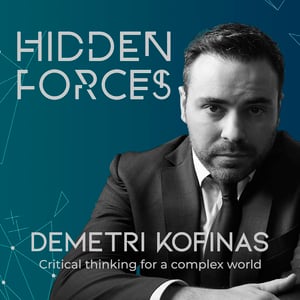
Hidden Forces
Demetri Kofinas
4.8 • 1.6K Ratings
🗓️ 16 April 2026
⏱️ 50 minutes
🧾️ Download transcript
Summary
In Episode 476 of Hidden Forces, Demetri Kofinas speaks with Marvin Barth, founder of Thematic Markets and former head of FX and EM macro research at Barclays, and Chief Economist for International Affairs at the US Treasury about the ongoing US-Israeli military campaign against Iran and its implications for the global economy, global security, and the future of American military, economic, and financial power.
The first hour begins with an update on the status of Operation Epic Fury, how the evolution of the conflict has aligned with Marvin's initial expectations, and the analytical framework he uses to assess US strategic objectives and the incentives that inform the decision-making of its principal agents—most notably the President himself. They draw historical analogies to previous Middle Eastern conflicts, assess risks to maritime security and global trade, and examine the evolving incentive structures of the US, Israel, the Gulf States, Saudi Arabia, and China. The conversation also explores the broader geopolitical implications of the conflict, including the fracturing of the post-war liberal order, Europe's precarious position, and the possibility of a far-reaching strategic realignment that could reshape America's alliances and its role as the world's dominant maritime and economic power.
The second hour opens with a psychological portrait of Donald Trump—his reliance on inductive reasoning, his strategic use of misdirection, his narcissism, and what Marvin describes as a genuine ambition to secure his place among history's greatest presidents. They discuss how the skills that made Trump successful in business and on the campaign trail may fall short of what is required to navigate international crises and lead America through this Fourth Turning, and how an unpopular war is eroding his political base and risks turning him into a lame duck president before he reaches the midpoint of his second term.
The episode concludes with a discussion of markets and the economy, including Europe's energy vulnerabilities, Marvin's bearish views on gold, and his innovation-cycle framework, which he believes explains why the US dollar remains near all-time highs on a real, effective basis despite widespread predictions of decline.
Subscribe to our premium content—including our premium feed, episode transcripts, and Intelligence Reports—by visiting HiddenForces.io/subscribe.
If you'd like to join the conversation and become a member of the Hidden Forces Genius community—with benefits like Q&A calls with guests, exclusive research and analysis, in-person events, and dinners—you can also sign up on our subscriber page at HiddenForces.io/subscribe.
If you enjoyed today's episode of Hidden Forces, please support the show by:
-
Subscribing on Apple Podcasts, YouTube, Spotify, Stitcher, SoundCloud, CastBox, or via our RSS Feed
-
Writing us a review on Apple Podcasts & Spotify
-
Join our mailing list at https://hiddenforces.io/newsletter/
Producer & Host: Demetri Kofinas
Editor & Engineer: Stylianos Nicolaou
Subscribe and support the podcast at https://hiddenforces.io.
Join the conversation on Facebook, Instagram, and Twitter at @hiddenforcespod
Follow Demetri on Twitter at @Kofinas
Episode Recorded on 04/14/2026
Transcript
Click on a timestamp to play from that location
| 0:00.0 | What's up, everybody? My name is Demetri Kaffinas, and you're listening to Hidden Forces, |
| 0:06.0 | a podcast that inspires investors, entrepreneurs, and everyday citizens, the challenge consensus |
| 0:12.3 | narratives, and learn how to think critically about the systems of power shaping our world. |
| 0:17.9 | My guest in this episode of Hidden Forces is Marvin Barth, founder of thematic markets, |
| 0:22.9 | an institutional research platform providing macro and geopolitical analysis to professional investors. |
| 0:28.3 | He previously served as head of foreign exchange and emerging market macro research at Barclays |
| 0:34.5 | and as chief economist for international affairs at the U.S. Treasury Department |
| 0:38.5 | during the second Bush administration. Marvin and I spend the first hour of our conversation |
| 0:43.4 | today discussing the ongoing U.S. and Israeli military campaign against Iran, where it stands, |
| 0:49.7 | how the evolution of the conflict has aligned with Marvin's initial expectations, |
| 0:53.6 | and the analytical framework he uses to assess U Marvin's initial expectations, and the analytical |
| 0:54.2 | framework he uses to assess U.S. strategic objectives and the incentives that inform the |
| 0:59.3 | decision-making of its key agents, most notably the President of the United States. |
| 1:04.8 | We draw historical analogies to previous Middle Eastern conflicts, assess the risks to further |
| 1:09.6 | disruptions in maritime security |
| 1:11.9 | and global trade, and assess the evolving incentive structures of the key players involved, |
| 1:17.2 | including the US, Israel, the Gulf states, Saudi Arabia, and China. |
| 1:22.4 | We also explore the broader geopolitical implications of the conflict, including the fracturing |
| 1:26.8 | of the post-war liberal order, the precarious situation in which Europe finds itself, the possibility of a far-reaching |
| 1:33.2 | strategic realignment that could reshape America's alliances, its role as the world's dominant |
| 1:38.5 | maritime power, and as the preeminent economic and military power in the international system. |
| 1:49.9 | The second hour begins with a psychological portrait of Donald Trump, his reliance on inductive reasoning, his strategic use of misdirection, his narcissism, and what Marvin describes as a |
... |
Please login to see the full transcript.
Disclaimer: The podcast and artwork embedded on this page are from Demetri Kofinas, and are the property of its owner and not affiliated with or endorsed by Tapesearch.
Generated transcripts are the property of Demetri Kofinas and are distributed freely under the Fair Use doctrine. Transcripts generated by Tapesearch are not guaranteed to be accurate.
Copyright © Tapesearch 2026.