
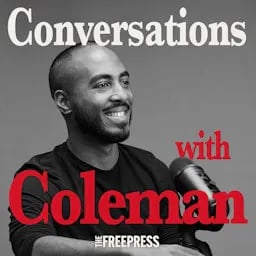
The Evolution of Altruism Michael McCullough [S2 Ep.3]
Conversations with Coleman
The Free Press
4.5 • 610 Ratings
🗓️ 5 February 2021
⏱️ 60 minutes
🧾️ Download transcript
Summary
Transcript
Click on a timestamp to play from that location
| 0:00.0 | The |
| 0:07.0 | The Welcome to another episode of Conversations with Coleman. |
| 0:33.3 | If you're hearing this, then you're on the public feed, which means you'll get episodes |
| 0:36.9 | a week after they come out, and you'll hear advertisements. You can gain access to the subscriber |
| 0:41.8 | feed by going to colemanhues.org and becoming a supporter. This means you'll have access to episodes |
| 0:46.6 | a week early, you'll never hear ads, and you'll get access to bonus Q&A episodes. You can also |
| 0:52.4 | support me by liking and subscribing on YouTube and sharing the show with friends |
| 0:56.2 | and family. |
| 0:57.2 | As always, thank you so much for your support. |
| 1:00.2 | Welcome to another episode of Conversations with Coleman. |
| 1:07.2 | My guest today is Michael McCullough. |
| 1:10.0 | Michael McCullough is a professor of psychology at the University of California, San Diego, |
| 1:14.7 | where he directs the Evolution and Human Behavior Laboratory. |
| 1:18.2 | He studies the functions of human behavior and emotion using the conceptual tools of evolutionary psychology and cognitive science. |
| 1:25.7 | He's conducted research on forgiveness, revenge, gratitude, |
| 1:29.4 | empathy, religion, and morality. He's the author of Beyond Revenge, the Evolution of the |
| 1:35.0 | Forgiveness Instinct, and the kindness of strangers, how a selfish ape invented a new moral code, |
| 1:40.9 | which is the focus of today's conversation. Michael and I talk about the field of evolutionary psychology and why it's considered |
| 1:47.9 | controversial. We talk about Richard Dawkins and the selfish gene revolution. We discuss |
| 1:53.8 | the evolutionary roots of altruism towards strangers. We talk about the criticism that evolutionary |
| 1:59.6 | psych is a collection of just-so stories rather than actual science. We talk about the criticism that evolutionary psych is a collection of just so stories rather than actual science. |
| 2:03.8 | We talk about the evolution of welfare spending over the past few centuries. |
... |
Please login to see the full transcript.
Disclaimer: The podcast and artwork embedded on this page are from The Free Press, and are the property of its owner and not affiliated with or endorsed by Tapesearch.
Generated transcripts are the property of The Free Press and are distributed freely under the Fair Use doctrine. Transcripts generated by Tapesearch are not guaranteed to be accurate.
Copyright © Tapesearch 2026.