
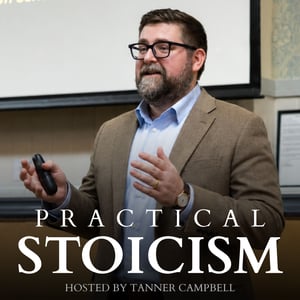
Stoicism vs. The Manosphere
Practical Stoicism
Tanner Campbell
4.7 • 723 Ratings
🗓️ 17 March 2026
⏱️ 18 minutes
🧾️ Download transcript
Summary
Join Prokoptôn, a private community of dedicated practicing Stoics working together to improve. Learn more at https://skool.com/prokopton
In this episode, I respond to a surge of listener questions about masculinity following a recent documentary on the so-called “manosphere.” The central question is simple: what does Stoicism actually say about what it means to be a man?
I begin by clarifying a core Stoic idea. Just as the Stoic aims toward the ideal of the Sage, a man should aim toward becoming a good man. These are not fixed endpoints but guiding horizons. The goal is not perfection, but progress toward moral excellence over the course of a lifetime.
From there, I address the common claims made by masculinity influencers. Wealth, physical strength, refusal to be censored, and dominance over women are often presented as defining traits of a “good man.” From a Stoic perspective, all of these fail. Wealth and strength are external. They do not determine character. Unfiltered speech is not virtue, but often a failure of judgment. And dominance over others is fundamentally unjust, especially when it involves suppressing another person’s rational agency.
So what, then, defines a good man?
The Stoic answer is straightforward: a good man fulfills his roles well. He takes seriously what is appropriate of him as a human being, as a member of a family, a community, and the broader world. He reasons through his responsibilities and works consistently to meet them. He is patient, just, self-controlled, and committed to improving both himself and the lives of those around him.
This leads to an important conclusion. The qualities that make a good man are the same qualities that make a good woman. Reason, virtue, and the capacity for moral development are not gendered traits. As Musonius Rufus argued, both men and women share the same capacity for virtue and should be trained accordingly.
I close by emphasizing that masculinity, properly understood, is not about status, power, or control. It is about living in accordance with reason and fulfilling one’s roles well. That is what it means to be a good man. And ultimately, that is what it means to be a good human being.
Listening on Spotify? Leave a comment! Share your thoughts.
I am a public philosopher, it is my only job. I am enabled to do this job, in large part, thanks to support from my listeners and readers. You can support my work, keep it independent and online, at https://stoicismpod.com/members
Looking for more Stoic content? Consider my 3x/week newsletter "Stoic Brekkie": https://stoicbrekkie.com
Learn more about your ad choices. Visit megaphone.fm/adchoices
Transcript
Click on a timestamp to play from that location
| 0:00.0 | Before we begin, if this podcast is sharpening your stoic practice, come sharpen it with others. |
| 0:06.1 | The Procopton community is now live on school. Come join your fellow Procopton's at |
| 0:12.1 | Stoicismpod.com forward slash school. |
| 0:16.6 | Welcome back, Procopton. Glad to have you here for another week. The number of emails I have received in the last 48 hours asking me to discuss the stoic view of masculinity in, I Can Only Assume, is the wake of the Lewis Thoreau documentary on Netflix, the one that's called Into the Manosphere, or some such silly name, has been in a word overwhelming. |
| 0:41.6 | I have never received this many single focus requests since beginning my work in this space. |
| 0:49.3 | So the other morning, before I did anything else, at 5 a.m., I watched the documentary. |
| 0:55.5 | And by 7 a.m. that same morning, I was sat on my couch, staring out the balcony, |
| 0:59.8 | wondering how in the world the world of men, and specifically the idea of what it means to be one, |
| 1:05.6 | could have ever been hijacked by such ludicrously self-centered and stupid individuals. |
| 1:13.5 | Also, I was wondering, what's my role in this war for the hearts and minds of young men? Do I have one? Can I even compete |
| 1:19.6 | against these seemingly rich, physically imposing, slut-shaming digital pimps? Or have they |
| 1:25.8 | already won? Is this the idea of masculinity for an |
| 1:29.8 | entire generation and earmuffs for the kiddos is unfucking it something that will take |
| 1:36.1 | three lifetimes? I don't know the answer to any of those questions, but I do know that my audience |
| 1:41.5 | expects me to show up and answer questions and provide advice. |
| 1:45.8 | And so that makes it my duty to absolutely answer their questions about masculinity and the stoic view of it. |
| 1:52.1 | And that is what's going to happen in today's episode. Before I start, I think we need to get on the same page about a few things. |
| 2:13.7 | And I think we should start with the idea of ideals. |
| 2:21.3 | In stoicism, the perfect stoic is the sage. |
| 2:28.1 | This is the stoic practitioner who has achieved perfect excellence of character. The most imperfect stoic isn't a stoic at all. It's the madman. Those are the two ends of the spectrum. The former is the unimprovable |
| 2:36.3 | visage of virtue, while the latter is completely habituated to the opposite end of that spectrum. |
| 2:42.9 | He or she is perfectly lacking in any indication of virtue and of virtue itself wholly. |
... |
Please login to see the full transcript.
Disclaimer: The podcast and artwork embedded on this page are from Tanner Campbell, and are the property of its owner and not affiliated with or endorsed by Tapesearch.
Generated transcripts are the property of Tanner Campbell and are distributed freely under the Fair Use doctrine. Transcripts generated by Tapesearch are not guaranteed to be accurate.
Copyright © Tapesearch 2026.