
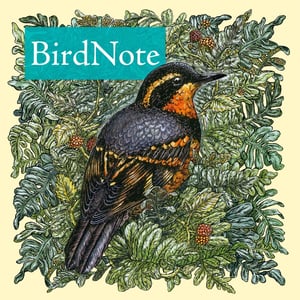
Starling Mimicry
BirdNote Daily
BirdNote
4.8 • 1.3K Ratings
🗓️ 10 November 2021
⏱️ 2 minutes
🧾️ Download transcript
Summary
Transcript
Click on a timestamp to play from that location
| 0:00.0 | This is bird note. |
| 0:04.0 | As you step outside in late fall for a breath of fresh air, |
| 0:08.0 | a searing cry of a red-tailed hawk pierces the air. |
| 0:12.0 | The distinctive scream is coming from a tree nearby, but when we scan the tree for the bulky form of a large hawk, we see only a small black bird. It tips its head back, opens its bill, and... |
| 0:27.6 | We've been fooled! It's a starling giving voice to the Hawks cry. In fact, the European Starling, |
| 0:37.0 | the continent's most abundant non-native bird, is an accomplished mimic. Starlings are especially astute imitators of bird sounds that have a whistled feel, |
| 0:48.0 | like this sound of a kill deer, |
| 0:51.0 | and this quail. |
| 0:55.0 | European Starlings regularly incorporate both into bouts of singing. |
| 1:02.0 | They can duplicate a car alarm or a phone ring too. |
| 1:08.0 | What adaptive benefit might Starling's gain from copying the sounds of other birds. A leading view argues that by mimicking, a male |
| 1:16.8 | starling adds to its song repertoire, making him just that much more attractive to the females than the next male on the branch. |
| 1:25.0 | So, the next time you hear a red tail scream, |
| 1:28.0 | double check its author, |
| 1:31.0 | especially if there are starlings nearby. |
| 1:36.4 | For Bird Note, I'm Michael Stein. |
Please login to see the full transcript.
Disclaimer: The podcast and artwork embedded on this page are from BirdNote, and are the property of its owner and not affiliated with or endorsed by Tapesearch.
Generated transcripts are the property of BirdNote and are distributed freely under the Fair Use doctrine. Transcripts generated by Tapesearch are not guaranteed to be accurate.
Copyright © Tapesearch 2026.