

Show 1441: How Exercise Can Help Cancer Patients Survive & Thrive
The People's Pharmacy
Joe and Terry Graedon
4.6 • 1.2K Ratings
🗓️ 15 August 2025
⏱️ 59 minutes
🧾️ Download transcript
Summary
Physical activity, aka “exercise,” is a cornerstone of good health, just like adequate sleep and a balanced diet. No one questions the benefits for people who are already healthy. But doctors may assume that cancer patients are too debilitated and demoralized to exercise. They may think physical activity wouldn’t be much help to patients who have just suffered through radiation or chemotherapy. Such assumptions are wrong and could be harmful, as a recent study shows. In actuality, structured exercise can help cancer patients survive and even thrive.
How You Can Listen:
You could listen through your local public radio station or get the live stream on Saturday, Aug. 16, 2025, at 7 am EDT on your computer or smart phone (wunc.org). Here is a link so you can find which stations carry our broadcast. If you can’t listen to the broadcast, you may wish to hear the podcast later. You can subscribe through your favorite podcast provider, download the mp3 using the link at the bottom of the page, or listen to the stream on this post starting on Aug. 18, 2025.
Does Exercise Belong in Cancer Treatment?
An exciting study published in The New England Journal of Medicine demonstrates that a personalized exercise program can be an important component of the treatment for colorectal cancer (New England Journal of Medicine, July 3, 2025). We spoke with the senior author, Dr. Christopher Booth, who explained that originally he and his colleagues wondered if exercise can help cancer patients feel less fatigued while undergoing chemo. Then they decided to design a trial that would go much further. They intended to answer two questions: can cancer patients exercise during treatment? And does that improve their likelihood of survival?
Increasing Physical Activity Can Help Cancer Patients Survive Longer:
The study, known as the CHALLENGE trial, hit a home run. The investigators recruited 889 people who had just had surgery and chemotherapy for their colorectal cancer. They randomly assigned half of them to get a health education booklet urging them to eat right and stay active. The other half got the booklet (usual care) PLUS a personalized exercise prescription designed to increase the amount of moderate to vigorous physical activity people did over the week.
How Did This Challenge Work?
The exercise prescriptions were devised by personal trainers who met with the “intervention” patients every two weeks for a year. Half of the meeting was devoted to motivational coaching and the other half to moving. Patients loved it. Increasing their fitness also improved their quality of life.
In addition, patients in the exercise intervention group had better immune function and lower inflammation and less insulin-like growth factor, which can contribute to tumor expansion. Both men and women participated in this trial. During the follow-up period, women who were active were less likely to develop breast cancer than those in the control group. Similarly, men in the intervention group had a lower chance of a prostate cancer diagnosis. The most exciting part of the story, however, is about their colorectal cancer treatment.
Not only did patients in the physically active group have longer overall survival, they also had longer disease-free survival. Remember, these two groups have the same type of cancer and got the same kind of treatment, except for the exercise prescription. The overall 8-year survival was 90.3% in the exercise group and 83.2% in the health education control group. That means the exercisers lowered their chance of dying during those eight years by 37%. The Number Needed to Treat (NNT) was 14 exercisers to prevent one death. That is a remarkable statistic.
How Did Cancer Patients Get Motivated to Move?
If you’ve ever started an exercise program only to drop it a few weeks later, you are not alone. Keeping ourselves motivated to stay active isn’t always easy unless you really love what you are doing. (Joe needs no extra motivation to show up for tennis.) Consequently, it is impressive that a very high proportion of the cancer patients in the CHALLENGE trial kept exercising. Part of that perseverance might be due to the motivational coaching.
No doubt another big part was the relationship with the personal trainer. Meeting with a person every two weeks for a year can help build friendships and creates a relationship in which accountability is a factor. After the first year, patients and trainers met every month for the next two years. Being able to increase physical activity was empowering for patients, giving them a sense of control that can otherwise be missing in a cancer patient’s life.
What Did Cancer Patients Do?
The exercise prescriptions were personalized, so people undertook a wide range of activities. Jogging and walking were popular, but some people swam, and others kayaked. There were patients who bicycled, and possibly some who rode horses. (Dr. Booth does not mention that.) The point was to find an activity you love and stick with it religiously, which they did. The most popular activity by far was also the simplest: walking. The idea was to walk at a pace so you looked like you were late for a meeting.
Is It Feasible to Help Cancer Patients Survive & Thrive?
One of the most exciting aspects of the CHALLENGE trial was to see that people responded to coaching. Personalized exercise prescriptions with accountability could be instituted into many cancer treatment programs. After all, if insurance pays for cardiac rehab, why shouldn’t it pay for cancer rehab? The cost of a personal trainer is about $3,000 to $5,000 over three years. That is a lot less than the next-level chemotherapy drug is likely to cost, and unlike chemo, the side effect is that the patient feels better. Not only is it feasible to help cancer patients survive through targeted exercise, it should be a part of most cancer treatment protocols,
In Summary:
Dr. Booth offered us this explanation of how the treatment works:
“Exercise is inducing physiologic, hormonal, inflammatory, immunologic changes in the body that are helping the body eradicate a proportion of these cancer cells. ‘
Learn More:
Dr. Booth is a medical oncologist. To complete this trial, he called on the expertise of a lot of colleagues, including exercise physiologists. Next week, we will speak with Claudio Battaglini, PhD, to get the exercise physiologist’s perspective on this important approach.
This Week’s Guest:
Christopher Booth, MD, is a medical oncologist and health services researcher at Queen’s University in Kingston, Ontario, Canada.
• Director, CCE Division, Queen’s Cancer Research Institute (QCRI)
• Medical Oncologist
• Clinician-Scientist, Cancer Centre of Southeastern Ontario
• Professor, Departments of Oncology and Medicine, Queen’s University
• Canada Research Chair in Population Cancer Care
https://scri.queensu.ca/faculty-staff/christopher-booth
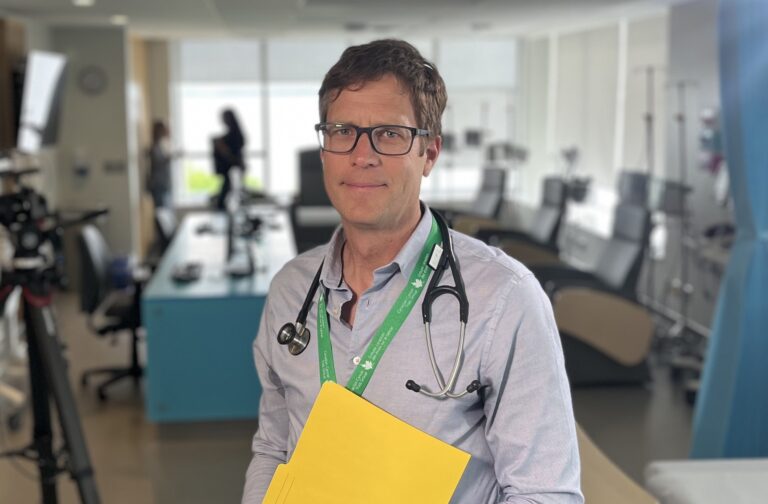
Christopher Booth, MD, Queen’s University
Listen to the Podcast:
The podcast of this program will be available Monday, August 18, 2025, after broadcast on August 16. You can stream the show from this site and download the podcast for free, or you can find it on your favorite platform.
Download the mp3, or listen to the podcast on Apple Podcasts or Spotify.
Transcript
Click on a timestamp to play from that location
| 0:00.0 | I'm Joe Graydon. |
| 0:01.5 | And I'm Terry Graydon. |
| 0:03.0 | Welcome to this podcast of the People's Pharmacy. |
| 0:06.1 | You can find previous podcasts and more information on a range of health topics at |
| 0:11.5 | People's Pharmacy.com. |
| 0:14.7 | Everyone knows exercise is good for our health. |
| 0:18.4 | New research suggests it's critical, especially for cancer patients. |
| 0:23.1 | This is the People's Pharmacy with Terry and Joe Graydon. |
| 0:34.3 | Colorectal cancer is the fourth leading cause of cancer-related death in the U.S. |
| 0:39.4 | How can exercise improve survival? |
| 0:42.9 | Exercise is inducing physiologic, hormonal, inflammatory, immunologic changes in the body |
| 0:48.4 | that are helping the body eradicate a proportion of these cancer cells. |
| 0:52.2 | Dr. Christopher Booth has conducted groundbreaking research |
| 0:55.6 | on incorporating a personalized physical activity program into the treatment of colorectal cancer. |
| 1:02.9 | Coming up on the people's pharmacy, how exercise can help cancer patients survive and thrive. |
| 1:14.0 | Doctors are expected to uphold the highest standards of ethical conduct. |
| 1:18.9 | In the Hippocratic Oath, doctors promised to put the benefit of patients first |
| 1:23.6 | and abstain from whatever is deleterious and mischievous. |
| 1:28.2 | A new study published in JAMA Network Open suggests that doctors who receive payments |
| 1:33.9 | from industry are more likely to be the target of patient complaints. |
| 1:38.6 | The researchers analyzed reports in the Patient Advocacy Reporting System Index and compared them to the physician's records of accepting non-researched payments, especially those above $5,000 a year. |
| 1:52.8 | There were nearly 72,000 physicians included in this analysis. More than two-thirds had received at least one payment, and 11% had accepted more than $5,000 in a year. |
... |
Please login to see the full transcript.
Disclaimer: The podcast and artwork embedded on this page are from Joe and Terry Graedon, and are the property of its owner and not affiliated with or endorsed by Tapesearch.
Generated transcripts are the property of Joe and Terry Graedon and are distributed freely under the Fair Use doctrine. Transcripts generated by Tapesearch are not guaranteed to be accurate.
Copyright © Tapesearch 2026.