

Show 1316: Protecting Your Digestive Tract
The People's Pharmacy
Joe and Terry Graedon
4.6 • 1.2K Ratings
🗓️ 22 September 2022
⏱️ 60 minutes
🧾️ Download transcript
Summary
This week on our nationally syndicated public radio show, we invite gastroenterologist Nicholas Shaheen into our studio to answer your questions about protecting your digestive tract. He is a nationally recognized expert in esophageal diseases and has helped write numerous treatment guidelines for gastrointestinal illnesses.
Detecting Digestive Tract Tumors:
Two of the most common cancers that affect Americans are colorectal cancer and esophageal cancer. Colorectal cancer, for example, is the third most common cancer diagnosis in the US. Approximately 4 percent of us will develop it at some point during our lifetimes. However, the death rate from this type of cancer has been declining, in part because screening via colonoscopy has been so effective. During this procedure, polyps that could become troublesome are found and removed.
Colorectal Cancer:
The only difficulty with colonoscopies is that they are unpopular. Preparation for the procedure requires cleaning the colon so that the doctor performing the procedure can see the walls clearly. Now there are new approaches that make it easier to prepare for a colonoscopy. In addition, there are other technologies such as FIT (fecal immunochemical test) that some people could use for cancer screening. How do they compare?
Esophageal Cancer:
At the other end of the digestive tract, esophageal cancer is far less common, but doctors have more trouble detecting it. Because it is relatively rare, most people don’t need to be screened for esophageal cancer. On the other hand, people with Barrett’s esophagus are at higher risk for this tumor. New technology has made it much easier for gastroenterologists to screen for esophageal cancer. They can also treat Barrett’s esophagus so that it doesn’t progress to cause problems.
New Ways to Treat Barrett’s Esophagus:
Dr. Shaheen has pioneered a number of ways to treat Barrett’s esophagus so that it is far less likely to develop into esophageal cancer. He will describe the research on radiofrequency ablation as well as the much newer cryoballoon ablation. This latest technique uses targeted cold to reverse the precancerous nature of the cells lining the esophagus (American Journal of Gastroenterology, Nov. 2020). When is this approach most helpful for protecting your digestive tract?
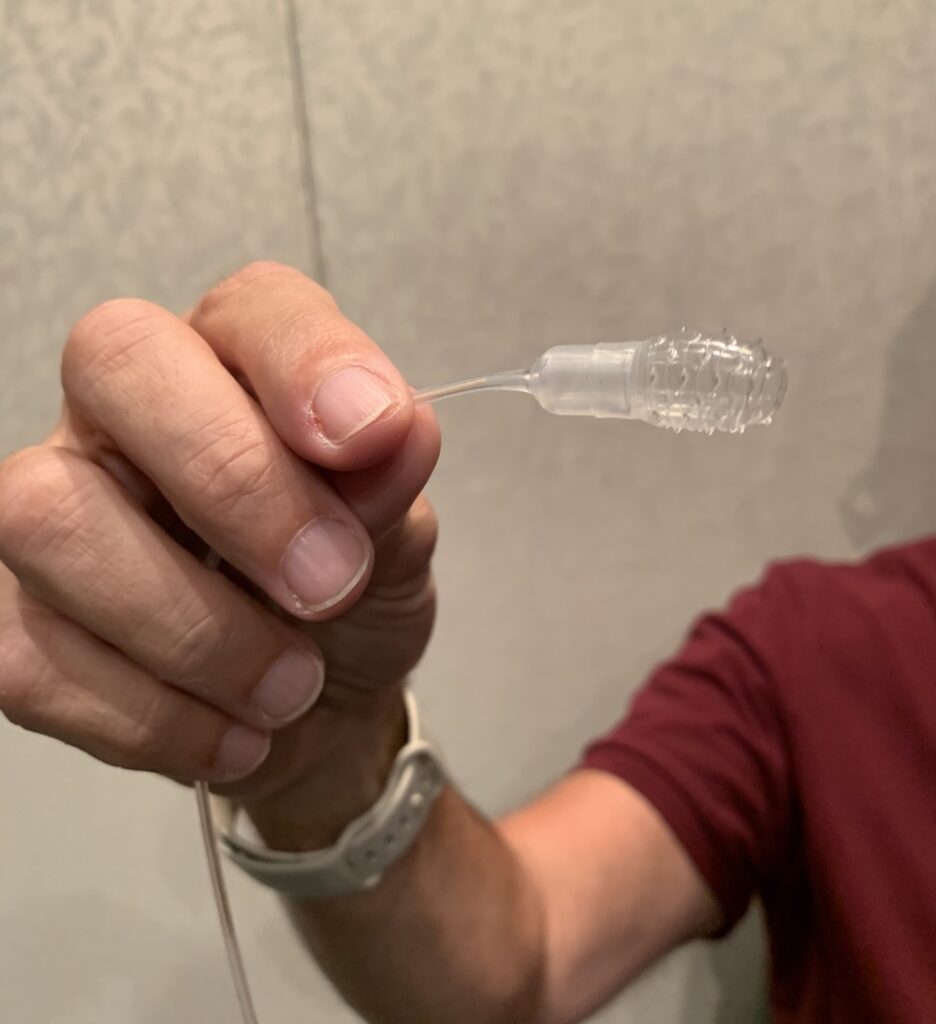
Are there ways to detect Barrett’s esophagus without endoscopy? The answer is yes. Gastroenterologists have identified DNA methylation markers. These can be retrieved from a small balloon swallowed by a potential patient (Science Translational Medicine, Jan. 17, 2018). In most case, patients prefer this approach over endoscopy (Digestive Diseases and Sciences, Jan. 2022).
Here is a picture of this new balloon technology, with the balloon expanded:
How Can You Overcome Heartburn?
One way of protecting your digestive tract is to reduce your experience of heartburn. Usually, this discomfort is caused by stomach acid splashing up into the esophagus where it can harm delicate tissue. While occasional heartburn is probably not dangerous, it is unpleasant. And frequent heartburn, also called reflux, may trigger Barrett’s esophagus. Are there ways to reduce your chance of heartburn? If you have been relying on a proton-pump inhibitor (PPI) such as omeprazole or esomeprazole for months, are there ways to discontinue the drug with minimal suffering?
What Are Your Concerns About Protecting Your Digestive Tract?
Having Dr. Shaheen in the studio during the show offers a unique opportunity for you to ask the questions that have been troubling you. Add your comment below or send us your question through email: radio@PeoplesPharmacy.com. You can also contact us through Facebook or Twitter. We’ll try to get to as many of your questions as we can. Between 7 and 8 am EDT on Sept. 24, 2022, you can call 888-472-3366 with your questions.
This Week’s Guest:
Nicholas J. Shaheen, MD, MPH, is the Bozymski-Heizer Distinguished Professor of Medicine at the University of North Carolina School of Medicine, and Chief of the Division of Gastroenterology and Hepatology at UNC. He also holds a position in the Department of Epidemiology at the Gillings School of Global Public Health of UNC. Dr. Shaheen is a recognized expert in esophageal diseases and endoscopy. He is author of multiple treatment guidelines for gastrointestinal illnesses.
Listen to the Podcast:
The podcast of this program will be available Monday, Sept. 26, 2022, after broadcast on September 24. You can stream the show from this site and download the podcast for free. The mp3 link is always found at the bottom of this page on Monday morning.
Transcript
Click on a timestamp to play from that location
| 0:00.0 | I'm Joe Gradyton and I'm Terry Grady. Welcome to this podcast of the People's Pharmacy. |
| 0:06.1 | You can find previous podcasts and more information on a range of health topics at people's pharmacy.com. |
| 0:15.0 | Are you taking good care of your digestive tract? |
| 0:18.0 | In addition to eating right, what screening do you need? |
| 0:22.0 | This is the people's Pharmacy with Terry and Joe Grayden. |
| 0:27.0 | A lot of people dread preparing for a colonoscopy. Drinking all that yucky |
| 0:38.9 | tasting stuff can be challenging. Running to the bathroom every few minutes is also unpleasant. |
| 0:45.0 | Are there new approaches to the prep that are more tolerable? |
| 0:49.0 | Are there other ways to detect and prevent cancer. |
| 0:53.0 | The upper end of the digestive tract is also vulnerable. |
| 0:56.0 | Chronic heartburn may lead to Barrett's esophagus. |
| 0:59.0 | How can people protect themselves from esophageal cancer? |
| 1:02.0 | Coming up on the people's pharmacy, Dr. Nicholas Shehine answers your questions about protecting |
| 1:08.4 | your digestive tract. In the people's pharmacy health headlines, a lot of people believe the COVID-19 |
| 1:20.4 | pandemic is over, but for millions of people the impact of this virus lingers. |
| 1:25.8 | A study published as a pre-print in Med Archive found that 21.5% of adults who were infected with the Omicron B. A 5 variant this past summer |
| 1:37.0 | are now suffering with long COVID. More than four weeks after their infection, |
| 1:42.1 | they reported unusual fatigue, shortness of breath, or trouble |
| 1:45.8 | concentrating. Young adults and Hispanics were especially likely to be infected. Unemployed people |
| 1:52.4 | and those with pre-existing conditions were most likely to |
| 1:55.6 | suffer the lasting symptoms of long COVID. The lead author notes that health care authorities |
| 2:01.3 | should start focusing more on long COVID as well as |
... |
Please login to see the full transcript.
Disclaimer: The podcast and artwork embedded on this page are from Joe and Terry Graedon, and are the property of its owner and not affiliated with or endorsed by Tapesearch.
Generated transcripts are the property of Joe and Terry Graedon and are distributed freely under the Fair Use doctrine. Transcripts generated by Tapesearch are not guaranteed to be accurate.
Copyright © Tapesearch 2026.