
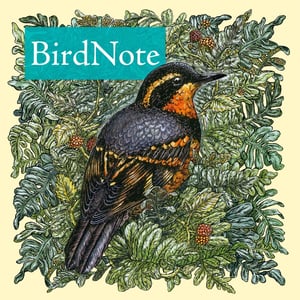
Robins and Earthworms: The Backstory
BirdNote Daily
BirdNote
4.8 • 1.3K Ratings
🗓️ 28 March 2023
⏱️ 2 minutes
🧾️ Download transcript
Summary
Transcript
Click on a timestamp to play from that location
| 0:00.0 | This is bird note. |
| 0:05.6 | A Robin tugging an earthworm from the ground is a symbol of spring, but that worm it's |
| 0:14.0 | eating hasn't always been here. |
| 0:16.7 | When glaciers push south into what is now the U.S., around 20,000 years ago, they scraped |
| 0:22.3 | off the soil layer and spelled the end of native earthworms, except in the southern |
| 0:27.7 | states. |
| 0:28.9 | So that earthworm plucked by the Robin is probably a relatively new arrival, most likely a species |
| 0:35.2 | Europeans conveyed to the Americas in plant soil or in the ballast of ships. |
| 0:40.5 | So if not earthworms, what were Robbins feeding their chicks before the Europeans arrived? |
| 0:46.1 | Well, probably some of the more than a hundred kinds of insects and other invertebrates, |
| 0:51.6 | as well as berries, that Robbins are known to eat. |
| 0:57.7 | Robbins prefer to forge in short grass to avoid potential predators, but after the last |
| 1:02.7 | ice sheets melted back, where was the short grass they liked? |
| 1:07.3 | One speculation is that prehistoric bison, horses, and mammoths grazed heavily in places |
| 1:13.6 | creating Robin-friendly landscapes. |
| 1:19.8 | Just as Robbins now share pastures with cows, perhaps 15,000 years ago, they hopped |
| 1:24.9 | among giant bison or woolly mammoths. |
| 1:31.0 | It's fun to picture, at least, for bird note, I'm Mary McCann. |
Please login to see the full transcript.
Disclaimer: The podcast and artwork embedded on this page are from BirdNote, and are the property of its owner and not affiliated with or endorsed by Tapesearch.
Generated transcripts are the property of BirdNote and are distributed freely under the Fair Use doctrine. Transcripts generated by Tapesearch are not guaranteed to be accurate.
Copyright © Tapesearch 2026.