
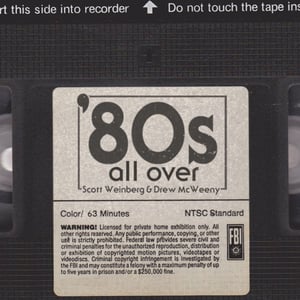
Patreon Bonus #6 - '79 All Over (Test Episode 1)
'80s All Over
Scott Weinberg and Drew McWeeny
4.7 • 805 Ratings
🗓️ 5 June 2017
⏱️ 42 minutes
🧾️ Download transcript
Summary
You can't just start a podcast fully-formed with your very first episode. Rather, I'm sure you can, it just won't stay that way very long, and it probably won't sound all that great. Usually you gotta put some training wheels on the bike and take a couple laps around the block before you show off to your friends. Before the "official" launch, Scott and Drew had to figure out their rhythm and get used to transforming their conversations into a show, and that meant practicing on the month of December, 1979, with films including Spielberg's infamous 1941, Peter Sellers' award-winning performance in Being There, and more.
Transcript
Click on a timestamp to play from that location
| 0:00.0 | Drew McQueen and Scott Weinberg were there in the 1980s as they happened and now they |
| 0:09.0 | have embarked on an epic mission to review every major release of the decade, month by |
| 0:13.7 | month, movie by movie. |
| 0:15.8 | They're going to dive in deep and soak in it and they're going to share every minute |
| 0:20.4 | of it with you. |
| 0:21.4 | They'll do their best to entertain you along the way. Get ready! It's the Ains all over. |
| 1:06.6 | Okay, hey, I'm Drew McQueenie and it is a pleasure to finally be doing this. This is something that Scott Weinberg and I have been talking about for a while now and I'm very excited because I think we're going to do something great that's going to take you from one end of maybe my favorite decade of film to the other. Scott. Scott. Well, I am the co-host of 80s all over and, you know, Drew and I have been good friends for many years and we see a lot of movies together and we like to compare notes on what we liked and disliked. You know, there's a lot of 80s nostalgia and I think when you look at online any day right now, Now they're celebrating anniversaries of movies that have never had anniversaries celebrated before. |
| 1:28.5 | But you end up seeing tributes like the same, whatever, 35, 40 titles. I think the 80s are interesting because they were so schizophrenic in a lot of ways. And you and I were kids. We were growing up different parts of the country back then. How old were you January 1st, 1980? I was eight. From the 80s, I was eight to 18. And I consider myself like a grade A perfectly aged 80s geek. The 70s almost felt like mom and dad working really hard. Like Hollywood was reinventing itself and they were really working hard to me. Challenging dark, unique new kinds of movies. And then the 80s were almost like, oh, we have kids. Let's have a party now. And I think you see the tail end of the 70s still. You see movies where it's still clearly the 70s to this filmmaker while somebody else is already on to whatever the 80s is starting to become. And it's kind of that collision that makes especially the first half of the 80s really interesting. And then it starts to change into something very different. I think if we go month by month and we go film by film and we're going to see that interesting sort of shift from one film culture to another, occur over the course of this podcast. And you had mentioned this to me a couple of days ago, what I hope we can do is talk about things we liked back then in comparison to how the movie world is today and not approach films with blindingly rose-colored glasses. For all the fluff and maybe forgettable spectacle that went through the 80s, we had a kind of renaissance. We had a new carpenter almost every year. We had a new Cronenberg almost every year. We watched the rise of Rob Reiner. We saw the evolution of Steven Spielberg and that's the decade that instilled in me a movie love that precluded video games. I stopped playing my Atari mostly My grandmother would record movies off HBO and give the VHS to my mom and knew that that was my thing. And if there was a move towering in Ferno was on two nights in a row, guess what? That's what we were doing. So we're going to begin this month. We're going to do our spotlight films. And the month that we're doing is December 1979. So you're at the very end of the decade. And one of the biggest releases of the month by any definition. I remember the comic adaptation of this |
| 3:45.9 | before I remember seeing the film. It was as hyped as a movie could get in 1979. And yet for years, this was synonymous with disasters with just giant bombs that people hated. Scott, I know you're very fond of the movie, so I'm gonna let you kick this off. What's your first pick for our first episode? I have long been a fan of Steven Spielberg's 1941. I am well aware of its reputation as both a box office, critical, and audience bomb. And while I completely acknowledge all the problems that people have with the film, that it's too loud and it's plotless and Maybe a barely connected series of sketches and the sketches maybe our kind of deficient of punchlines I get all those complaints. I really I really do But every time 1941 was on TV we watched it It was usually over two nights like a Monday night in a Tuesday night because it's a kind of a long film Yeah, six and a half hours I think oh stop The what the theatrical cut I don't have it right in front of me that's embarrassing the cut that exists on television Especially the tonight cut their stuff that wasn't in the theatrical release. Yeah, there's extra scenes There's alternate takes to replace stuff that they couldn't show on TV. So, the version you know, it's not even quite the Spielberg director's cut, which also existed on Lazardisc at one point. You kind of fell in love with that weird middle ground that exists and it really doesn't for film fans now, the TV cut. Yeah. The TV cuts were often not controlled by the filmmaker at all. It was the studio and it was the TV division and they just put anything they found into that thing to make it fit for the TV time slot. 1941 for the record according to box office mojo cost 35 million and gross about 92 million worldwide. Now, that is by no means a hit, |
| 5:46.0 | even if you accept the you have to make double your budget. |
| 5:48.9 | Well, there have been, there have been so many releases of this thing. Although, surprisingly, there's not a great, it's part of a blue-air box that you can get. But as a standalone, it still doesn't get its full respect. And here's the thing, I'm kind of with you on this. I find this script by Robert Zamekis and Bobby, |
| 6:03.5 | it was really interesting. |
| 6:04.5 | And nobody was doing farce at that point. |
| 6:08.1 | Farce is very, very hard. |
| 6:09.4 | And. you on this. I find this script by Robert Zamekisimbabi, you know, really interesting. And nobody was doing farce at that point. Farce is very, very hard. And what I love most is the energy and the choreography of it. There's a fight riot sequence at a dance that breaks out that is one of the most beautifully choreographed in terms of camera and performer sequences that Spielberg's ever done. And it is him just Just playing you can just feel how giddy he is that this many extras and this biggest set and this many cameras And this much chaos and he's having a blast doing this stuff There are so many set pieces in the movie without having much of a plot There are there's a Japanese sub spotted off the coast of a California town and everyone goes apeshit and it plays very much like a 1942 screwball comedy on such a loud, some would say over loud, expensive scale. I can guarantee that all three of them, Zameka scale and Spielberg were all fans of it to mad, mad, mad, mad, mad, mad, mad, mad, mad, mad, mad, mad, mad, mad, world. world yeah I think I got them all in there. |
| 7:05.2 | There's a lot of funny bits and funny moments in the movie thanks mainly to the actors. Wendy Jo's perber is really funny in this movie. Always. Yeah, her lighting season. Eddie Deezon on the Ferris wheel is. Boy, oh boy, boy, a Ferris wheel. I love Ferris wheel. Hey, are we gonna get the light this all night? Just to the end of the show. |
| 7:25.6 | Wait a minute, we don't have to pay for this, do we? |
| 7:27.6 | Yes, I remember we're working for the government now. |
| 7:29.6 | It's that performance of his is very Hamilton together. It's great 1941 is a fascinating anomaly in Spielberg's filmography to me He said it was a torture to make He still seems to have some kind of fondness for it in interviews and archival footage. It depends on which interview though. This is the truth about Steven Spielberg and this is something we'll get into as we go through the rest of this decade. He feels about his movies, however the public tells him to feel about his movies. If a movie is reviled at a particular moment, he'll take the public side on that. And then if they come back around so will he. And 1941 is the best example of that where for years, I don't think you were allowed to even mention it to him. And then once the Lazardist came out and Laurent Bozerot did a phenomenal job in putting together a huge Lazardist condition of this movie with behind the scenes stuff and with footage from the TV cut and all sorts of different things and commentaries. It's tremendous. It's really one of the best laser disks that's ever done. It sort of rehabbed the film's image. And I remember at that point suddenly Spielberg liked the movie again and started giving interviews where no, he admitted that there were things he really liked about it and that he was proud of. Considering what a enormously gifted and un-deniably influential storyteller he is now, I still think the public's opinion of his films carries huge weight with him. It still holds up as just maniacal silliness. Part of your is just stunned that this much effort was put into something so frothy and goofy. Uh, we're discounting the, the participation of John Millius. I think Millius had the initial idea. As I understand it, it was him that said, you know, there was this real incident where people were panicked about Pearl Harbor and everybody was convinced the Japanese were on their way to America and everybody on the coast of California went insane for a little while. Right. And I think Millius was the one that found that story and sort of broke it. |
| 9:27.8 | But it's the mechus gale. |
| 9:28.8 | The screenplay that everybody loved and it was legendary. Like that was one of those scripts where everybody had read it. Everybody was talking about it when Spielberg signed on to make it. It was because it was a hot shit script and everybody wanted to make that movie. Doesn't make any sense to me because I am one of the film's biggest fans and even I would say it's not in the screenplay |
| 9:47.4 | At least not based on the film. It's based on meant maniacal moments and pinpoint funny actors. I think then that's maybe why Spielberg didn't go back to full on comedy because that script was beloved. Everybody who read it said this is going to be a huge hit. This is hilarious. This is great. And Spielberg signed on to make it and then it came out and laid there. One of the craziest parts about this is the following year, airplane came out and had that great opening parody of jaws. Spielberg did it first. Spielberg made fun of himself before anybody else got a shot with the opening of 1941. And it's because it's Spielberg, it's about as precise a parody as you're ever going to see in a movie. Yeah, it's always funny to note that they are very similar jokes, but Spielberg did do it first. So that's ultimately, even as a fan, I would not put it near the upper echelon of Spielberg's best. But if you're going through his body of work, |
... |
Please login to see the full transcript.
Disclaimer: The podcast and artwork embedded on this page are from Scott Weinberg and Drew McWeeny, and are the property of its owner and not affiliated with or endorsed by Tapesearch.
Generated transcripts are the property of Scott Weinberg and Drew McWeeny and are distributed freely under the Fair Use doctrine. Transcripts generated by Tapesearch are not guaranteed to be accurate.
Copyright © Tapesearch 2026.