
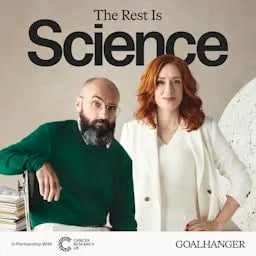
Michael Discovered A New Way To Make Twins
The Rest Is Science
Goalhanger
4.5 • 1K Ratings
🗓️ 31 May 2026
⏱️ 47 minutes
🧾️ Download transcript
Summary
Transcript
Click on a timestamp to play from that location
| 0:00.0 | Welcome to the rest of science. I'm Hannah Fry. And I'm Michael Stevens. Today, I want to tell you about something I've discovered. Go on. A new way to make twins. |
| 0:10.9 | Is it ethical? Oh, it's ethical. It's not easy. Okay. There's two ways to make twins. Yeah. And the first way is the normal way. |
| 0:21.6 | You and your partner just really hope that that zygote splits into two babies. |
| 0:26.6 | Genetically identical. |
| 0:27.8 | Genetically identical individuals. |
| 0:30.0 | The second way is for you and your partner to have about 70 trillion children. |
| 0:35.2 | Okay. |
| 0:35.8 | That sounds like quite a lot of work. |
| 0:37.7 | It's not that bad. |
| 0:39.2 | All it requires is birthing 70,000 children a second. |
| 0:43.7 | What for your entire fertile life? |
| 0:46.5 | Well, I mean, for your entire fertile life. |
| 0:49.4 | Not mine, my partners, luckily. |
| 0:51.5 | You're not going to get much else done. |
| 0:56.0 | No, no, but wouldn't it be cool? |
| 0:58.4 | I'll talk about how this works in a moment. |
| 1:05.9 | This episode is brought to you by Cancer Research UK. |
| 1:07.3 | Here's something strange. |
| 1:15.7 | Your DNA contains more ancient viral fragments than genes. The genes that build our cells make up only 2% of our DNA. And for years, that is what scientists focused on. |
| 1:23.2 | They treated the rest, the ancient viruses and stuff, as junk. But now we know that that hidden |
| 1:28.8 | majority, sometimes called the dark genome, influences how our biology works and how does |
| 1:35.2 | disease like cancer behave. It's a reminder that progress rarely comes as a single breakthrough. |
... |
Transcript will be available on the free plan in 24 days. Upgrade to see the full transcript now.
Disclaimer: The podcast and artwork embedded on this page are from Goalhanger, and are the property of its owner and not affiliated with or endorsed by Tapesearch.
Generated transcripts are the property of Goalhanger and are distributed freely under the Fair Use doctrine. Transcripts generated by Tapesearch are not guaranteed to be accurate.
Copyright © Tapesearch 2026.