
May 1981
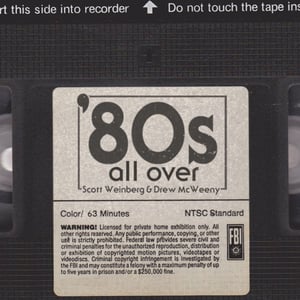
'80s All Over
Scott Weinberg and Drew McWeeny
4.7 • 805 Ratings
🗓️ 1 May 2017
⏱️ 91 minutes
🧾️ Download transcript
Summary
Oh, my god, there were roughly 11,000 movies released in May of 1981, and we managed to discuss every single one of them.
You want John Waters? We've got John Waters. You want Hal Ashby? We've got Hal Ashby. We've got Charles Bronson and Lee Marvin together. We've got a terrible Lone Ranger movie. We've got Stewart Rafill at his Stewart Rafillest. Sean Connery's in outer space! And Richard Pryor shows up in a really terrible comedy featuring kids and the Klan! All that plus five -- yes FIVE -- slasher films. What are you waiting for?!
Transcript
Click on a timestamp to play from that location
| 0:00.0 | There are a few decades in film history that have been as scrutinized as the 1980s, but to really understand the decade and its movies, it's going to take a couple of someone's who were there for it the first time around. Drew McLean and Scott Weinberg are ready to review every major film of the decade, one month at a time. The look at what worked then, what endoers now, and how it felt to be there when it all went down. Turn back the calendar with us. It's the 80s all over. Billie Jean King became the first prominent sportsman to come out and she announced relationship with Marilyn Marilyn Barnett. 26-year-old Bobby Sands died of a result of his 66-day hunger strike. SC-TV Network 90 debuted on NBC to the light of a generation comedy fans and Andrew Lloyd Weber's cats debuted London to the delight of a generation of tourists. By far though, the most important story of the month was the premiere of the Harlem Globe Trotters on Gilligan's Island, perhaps the finest crossover between a basketball team and a sitcom movie of all time. Even so, there were films released in May of 1981. Let's talk about them today. Yeah. Oh, dude. It is a wild month. It's crazy. It's really crazy. When I sent you this list, your first response was, Drew, that's not, we're not doing the rest of 1981 in one episode. Now before we get going this week, I wanted to once again thank all of you who have taken the time to pledge support on the Patreon page. For those of you who have not yet signed up, you are missing out. Let me tell you because we have got bonus content that we put up there that I think is really coming together beautifully. |
| 2:29.1 | We've done two interviews. yet signed up. You are missing out. Let me tell you because we have got bonus content |
| 2:25.1 | that we put up there that I think is really coming together beautifully. We've done two interviews. Each one in an hour, you can listen to Nancy Allen talk about her early 80s work. You can listen to Leah Thompson talk about how are the duck and back to the future. And now we've just put up our first commentary for John Carpenter's The Fogged and we would love for the rest of you to come to www.patrion.com slash 80s all over. Check it out. We'll probably do a bonus episode later of the movie podcast that we recommend because we really do want to share some love. But we're really thrilled that movie geeks have taken to the show so far. And we just want to continue to be great. So let's get started with May of 1981. This is one of the most jam-packed months we've ever had and I really have no idea why. I don't know what it was about May of 1981 but it was wall to wall and as a result there's a little bit of everything. For example our first movie which was released on May 1st is called King of the of the Mountain. This is the very first film ever from Polygram films, which if you don't know Polygram, you probably have seen the logo in front of at least one movie you love like American World of London. It was the first company where John Peters and Peter Goober worked together and that partnership helped define a huge portion of the rest of the 80s and the 90s. They were huge studio forces of course. This was a movie that was based on a magazine article about racing, street racing on Mulholland Drive. And like a lot of their films began that way. Flash Dance was that kind of a film where they found a real article about something trendy that was going on and then would turn it into a film that was meant to kind of play off of that trending capitalize on it. I think it's important for two reasons. First for the Peter's Goober, for the beginning of what they did as a production team. And also because this is where the reinvention of Dennis Hopper began. You know, he had been the director of Easy Rider and this huge independent force and he had burned down that goodwill with the last movie. It's jaw dropping. It is somebody torching their career in front of a camera and he had basically vanished. His big, big comeback of course was, I guess, my science project and then Hoosiers, but he plays like the cautionary tale to the other kids. He's the guy who used to be Harry Hamlin Who is now he's the street racer whose friends are moving on and they're getting other jobs and they're starting to put their lives together And he doesn't want to he just wants to race It's not bad But it spends a lot of time off the car racing stuff and focused more on there the three friends are trying to break into the music business and then one of them doesn't want to betray his art and the second one is very pragmatic about mute money and the third kind of plays it's not a bad movie but I mean I can imagine like people who live in LA would be fascinated to see this movie just like somebody who lives in New York would be fascinated to see like an able for our movie from 1981. I'm sure that honestly I think the best stuff in it is the first like just during the opening credits where you're just doing the aerial photography of Mulhull and Drive and you're looking at some of the craziest turns and corners and stretches of road and if you race Mulhull and and it happens there's a lot of people to do that and it's still something something that goes on, you're an asshole. That is a terrifying road and it's terrifying to be on it |
| 5:49.2 | when somebody's using... and it happens, there's a lot of people to do that and it's still something that goes on. You're an asshole. |
| 5:45.0 | That is a terrifying road |
| 5:47.0 | and it's terrifying to be on it when somebody's using it that way. And I think that there is something you can maybe do that would be really like exciting and visceral. This isn't that film. This is a pretty conventional down the middle. It's a 1981, fast and the furious part one in LA. It's kind of dull, but I was still kind of into it because I had like never even heard of it until like two weeks ago |
| 6:08.1 | That and that's weird. There's a 1981, fast and the furious part one in LA. It's kind of dull, but I was still kind of into it because I had never even heard of it until two weeks ago, and that's weird. There's a lot of films from this era that I haven't seen, but an American film that got a major release that I had never heard of was uncommon. Well, saying you'd never heard of that one, I'd never heard of the next one. You're kidding! No, never heard of it. He likes to take you by surprise. He likes to leave a very special calling card. It was the best blood I have ever tasted. He's giving you a very special invitation. Harsers who are fans will of course remember as one of the co-founders of a British production company called Amicus. Hammer gets a lot of the press because they were awesome but but Amicus was also great. And one of the things that Amicus was really good at was horror anthologies. And some of the best ones, of course, are Tales from the Crypt, Volt of Horror and my personal favorite, 1972's Asylum, which is great. After Amicus closed up shop, Milton Zubowski went on and tried to produce some films on his own without the Amicus shingle. This was one of his efforts. He went back to the anthology well and really kind of half-assed it. The copy I saw, this is startlingly pretty, just in terms of the condition that it's in. It looks like this movie was played once, ever. If you take the three stories that are the focus of the film, two of them are pretty deadly dull, but third one is kind of effectively creepy. The wraparound story. In the Amicus films, the wraparound story was generally some kind of a morality tale about, you know, these people stuck in a chamber and we're now we're going to watch the stories of how they ended up in purgatory and why they deserve to be there blah blah blah and that generally works, you know in the monster club the rap round story is just us visiting a ridiculously ugly Rock club where really band music is being played we get to see the entire song soundtrack for this movie's weird Trojus the only band that you might recognize from these segments are you be 40 but But even then then the music is just terrible And they show you every single note of every single song So the rap route is pretty much painful. Horror fans will of course appreciate the expensive price and Donald Pleasant and John Caradine do show up and so that does lend some you know old school class and credibility to the stories. But it's a shame, |
| 8:45.0 | it's because I got really excited |
| 8:46.9 | when I realized I'd never seen it |
| 8:48.3 | because it isn't anthology movie |
| 8:49.9 | because it's got Vincent Price. |
| 8:51.7 | It seemed like the kind of thing where, |
| 8:53.4 | oh my God, I might be set up here |
| 8:54.8 | for a really lovely discovery. |
| 8:56.1 | And like you said, the stories, the individual stories, |
| 8:59.4 | they're all based on the work of our Chetwin Haynes. |
| 9:02.4 | And if these are faithful adaptations, there's a reason I don't know him. If they're not, he should sue somebody because they've done terrible damage to his name. Yeah, I mean, I would call the wrap around stuff truly painful, but the stories are serviceable, certainly not great, but in the grand scheme of the Amicus style anthology monster club is unfortunately lesser fair. Speaking of lesser fair. There's this thing that happens sometimes some of these movies part of the trick in pinning the date down is that they come out different times at different places. This is a 1978 film that took this long to make it to America and there's a reason. Even though this thing stars Kim Novak, Marlene D. Trick and final film of parents, and young David Bowie. |
| 9:45.3 | It is an awful movie, and it's confusing |
| 9:47.6 | because I think Bowie could be very good on film. And I think it an interesting sense of picking collaborators. If you look at the Man of Feld Earth, the film he made before this, it's not just a terrific performance. It's an unbelievable movie that I think Bowie recognized the vision rogue ad, and was like, yes, I can do this. He took a lot of chances at David Bowie. Some of them were Nicholas Rogues, Manfilter Earth, and others were of course just a jiggle o. I don't get this movie at all, dude. A bowie apparently hated it and he called it, quote, all his Elvis movies rolled into one. Oh, 100% true. And I think part of it was that at some point and had promised him he could work with Marlena Dietrich. And if you're at all interested in Hollywood history, there would be some charge to doing that, just wants just to work with her. |
| 10:45.1 | And none of their scenes are together. I'm fairly sure they were never on set at the same time. If he took the film to work with her, he got screwed. David Bowie stars as a post-war, war one veteran who becomes a high class jiggle-o. Not exactly sure if it's going for melodrama, but it doesn't have any sort of social commentary, kind of insight about you know returning home from war and well and it's |
| 11:07.7 | set during the rise of insight about, you know, |
| 11:05.6 | returning home from war and... Well, and it's set during the rise of the Nazis. So you're seeing like fascism start to fall into place around him. And you would think that a movie, especially, this is when Bowie was working in Berlin, and I think he had a connection to the city, and you know, some of his best art came out of this period. Here's this movie where you're talking about, literally a guy who's selling himself and who is a sex worker at a moment where |
... |
Please login to see the full transcript.
Disclaimer: The podcast and artwork embedded on this page are from Scott Weinberg and Drew McWeeny, and are the property of its owner and not affiliated with or endorsed by Tapesearch.
Generated transcripts are the property of Scott Weinberg and Drew McWeeny and are distributed freely under the Fair Use doctrine. Transcripts generated by Tapesearch are not guaranteed to be accurate.
Copyright © Tapesearch 2026.