
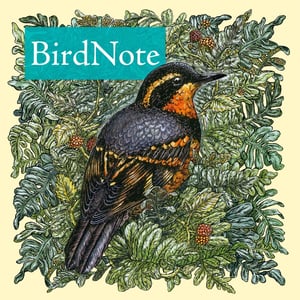
Listening in on Birds
BirdNote Daily
BirdNote
4.8 • 1.3K Ratings
🗓️ 13 October 2022
⏱️ 2 minutes
🧾️ Download transcript
Summary
Transcript
Click on a timestamp to play from that location
| 0:00.0 | This is Bird Note. |
| 0:05.7 | Collecting data on wild birds is crucial for their conservation. |
| 0:09.9 | But it requires huge amounts of effort. |
| 0:13.0 | Researchers may spend many hours in the field |
| 0:15.4 | recording all the birds they see and hear |
| 0:18.2 | or following the lives of specific individuals. |
| 0:22.0 | This takes a lot of training, time, and money. |
| 0:25.6 | One way to help streamline this process |
| 0:27.7 | is with Gizmo's called Autonomous Recording Units, or ARUs. |
| 0:32.6 | For days or months, these recording devices |
| 0:35.2 | eavesdrop on the environment around them, |
| 0:37.4 | including the songs and calls of the local birds. |
| 0:41.0 | HMS Site 103, start time now. |
| 0:46.7 | Recently, researchers tracked the lifespans |
| 0:49.4 | of male savanna sparrows over six years |
| 0:52.2 | using only recordings that captured |
| 0:54.2 | individual's uniquely identifiable songs. |
| 1:00.3 | Identifying the songs picked up on recordings |
| 1:02.3 | can be almost as time-consuming as in-person fieldwork. |
| 1:05.9 | But new AI tools are quickly making it |
| 1:08.1 | easier to analyze the audio. |
| 1:10.4 | This could open up new possibilities |
... |
Please login to see the full transcript.
Disclaimer: The podcast and artwork embedded on this page are from BirdNote, and are the property of its owner and not affiliated with or endorsed by Tapesearch.
Generated transcripts are the property of BirdNote and are distributed freely under the Fair Use doctrine. Transcripts generated by Tapesearch are not guaranteed to be accurate.
Copyright © Tapesearch 2026.