
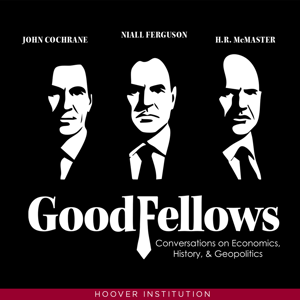
Iran, Tariffs, Epstein | GoodFellows | Hoover Institution
GoodFellows: Conversations on Economics, History & Geopolitics
Hoover Institution
4.6 • 717 Ratings
🗓️ 25 February 2026
⏱️ 58 minutes
🧾️ Download transcript
Summary
Transcript
Click on a timestamp to play from that location
| 0:00.0 | And if at times we disagree, |
| 0:02.0 | our disagreements come from our profound sense of concern about a Europe |
| 0:07.0 | with which we are connected, |
| 0:09.0 | not just economically, not just militarily, |
| 0:13.0 | we are connected spiritually and we are connected culturally. |
| 0:17.0 | We want Europe to be strong. |
| 0:19.0 | We believe that Europe must survive, |
| 0:22.6 | because the two great wars of the last century |
| 0:25.6 | served for us as history's constant reminder |
| 0:29.6 | that ultimately our destiny is |
| 0:32.6 | and will always be intertwined with yours. |
| 0:48.3 | It's Tuesday, February 24th, 2026, and welcome back to Goodfellows, |
| 0:52.7 | a Hoover Institution broadcast examining matters of history, economics, and geopolitics. |
| 1:11.4 | I'm Bill Waylon. I'm a distinguished policy fellow here at the Hoover Institution. I'll be the moderator of this show today. Looking forward to a spirited conversation featuring three of my colleagues whom we jokingly refer to as the Goodfellows. I'm referring, of course, to the historian, Sir Neil Fulguson, the economist John Cochran, and former presidential national security advisory, Lieutenant General H.R. McMaster, Neil John, and H.R. are all Hoover's senior fellows. |
| 1:15.6 | Gentlemen, good to see you, and I have three items for you to discuss today. |
| 1:19.6 | John, I want us to discuss what's next in the way of tariffs and trade wars now that the U.S. Supreme Court has struck a blow to the Trump administration's tariff strategy. |
| 2:01.0 | Neil, I want to get your and the panel's thoughts on the significance of the Epstein scandal now that it's led to the arrest of a member of the House of Windsor and a former British ambassador to the U.S. and might also topple your prime minister. But first, HR, I turn to you and let's talk about Iran. And let's keep in mind we're a bit of an awkward position here. We're recording about nine hours before President Trump gives a stated union address. We're also recording five days into the 10-day window to the president set on whether or not to strike Iran. So HR, let me ask you, since you once served in the White House for Donald Trump, if you were back at your old job as NSA, what would you advise him at this point? |
| 2:19.2 | Well, I think what I would advise him is, first of all, hey, let's have clear objectives here. What is it do you really want to achieve? I think what he wants to achieve, first of all, is to, you know, to restore deterrence in terms of the Iranian regime's, you know, willingness to commit mass murder, mass atrocities. They murdered over 30,000 of their own people. |
| 2:19.2 | Maybe another objective would be to reduce willingness to commit mass murder, mass atrocities. They murdered over 30,000 of their own people. |
| 2:24.8 | Maybe another objective would be to reduce further their capacity to do harm more broadly in the region. |
| 2:25.4 | That would bring into play the missile program, the Islamic Revolution Guards Corps Navy, |
| 2:32.5 | for example, would be kind of targets associated with that. |
... |
Please login to see the full transcript.
Disclaimer: The podcast and artwork embedded on this page are from Hoover Institution, and are the property of its owner and not affiliated with or endorsed by Tapesearch.
Generated transcripts are the property of Hoover Institution and are distributed freely under the Fair Use doctrine. Transcripts generated by Tapesearch are not guaranteed to be accurate.
Copyright © Tapesearch 2026.