
Episode # 12: Let's Talk about your Brain and Anxiety
Your Anxiety Toolkit - Practical Skills for Anxiety, Panic & Depression
Kimberley Quinlan, LMFT | Anxiety & OCD Specialist
4.9 • 882 Ratings
🗓️ 11 March 2017
⏱️ 18 minutes
🧾️ Download transcript
Summary
Let's talk about your Brain and Anxiety
When your physical symptoms of anxiety are high, you may feel like nothing works. You may have moments when you feel like you can't come back to your rational brain. When we are all wound up on anxiety, fear can run the show. You know what I am talking about, right? Despite there being some great tools out there, but one of the most difficult parts of having severe anxiety or panic is the comprehending what IS real danger and what IS NOT. Last month we talked about R.A.I.N, which is an acronym that helps us use some of the most important mindfulness tools. There is also non-judgment, acceptance, willingness, bringing our attention to the present moment. These are all wonderful tools. For me personally, if I can understand the mechanism behind what is happening, I can handle it better. That is why understanding what was happening in my brain was SO helpful. Today we are going to delve deeper into understanding our brain and what happens when we experience high anxiety. The problem with the anxious brain is that it often sets of an alarm, making us feel like our lives are at risk, danger is ahead, when really there is no danger at all. This is a mistake our brain makes, particularly when we have an anxiety disorder like Obsessive Compulsive Disorder, Generalized Anxiety Disorder, Panic Disorder, Social Anxiety or Specific Phobias. Sometimes just understanding a little bit about what our brain is doing can help us with awareness and then allow us to implement the tools better.A Simple way to Understand YOUR Brain and Anxiety
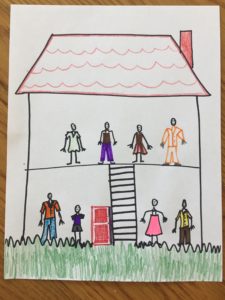 I want you to think of the brain like a house. This house is a two-story house, with a stairway that leads us to from upstairs to downstairs, or vice versa. Dan Siegel and Tina Payne wrote a wonderful book called, The Whole Brain Child that coined this concept, but I have shifted them a little to specifically address the management of anxiety. **Please note that scientifically, this is not perfect. It would take hours for me to explain the intricacies of the brain and all the areas that provide different functions. For the purpose of getting a basic understanding, we will use this simple metaphor. The Upstairs of the brain is where we do most of our Executive Functioning. What this means is, in the upstairs brain lives the "Thinkers". Functions of the upstairs brain allows us to
 - Regulate our body (speed up or slow down)
- Tune in to someone else or something else.
- Balance our Emotions and use Empathy and compassion
- Have response flexibility (slows down the time between impulses or urges and an action). Basically, this means that we don't respond based on pure emotion.
- Calm our fear: There are inhibitory peptides called gabba that tame our fear and help us interpret the stimuli in a rational, appropriate way. This occurs in the Prefrontal Cortex at the front of the brain.
- Creative Cassidy
- Problem Solving Pete
- Patty the Planner
- Reasonable Renee
- Calming Catarina
- Kind Kelly
- Flexible Felix
- Bodily mechanisms that are automatic (Breathing, Digestions and Blinking). It is really quite incredible that our whole body can function without us needing to do anything at all.
- Fight, flight and freeze mechanisms. This is the most important, for today's discussion. The downstairs is the Emotional hub of the brain. We need to be thankful for this part of our brain, as it keeps us safe from real danger. This downstairs area of the brain is what keeps us from touching the hot plate on the stove or not walking out onto a busy highway.
- Fearful Frannie
- Panicky Pete (Fight flight or freeze)
- Sad Sandra
- Furious Frank
- Bossy Benjamin
What happens when we have an Anxiety Disorder?
In some cases, as mentioned above, our brains interpret that there is danger and sends out these messages when there is, in fact, little or no danger at all. This is VERY common in anxiety disorders. We could say that our downstairs made a mistake and set off the alarms, signaling to the whole body that is must prepare for fight or flight. When I am using the metaphor of the two-story house, I often call this "lockdown". Sometimes, just as our brains do where there is a REAL danger, when our brains mistakenly set off the alarm bells, it "locks down" the downstairs brain and won't allow us to access our upstairs brain in a reasonable way. Problem Solving Pete and Rational Renee have no way of communicating with Panicky Patty and this keeps us from questioning if this danger is, in fact, a danger. There is great benefit from knowing this information and being able to notice and observe when your brain is sending you into "lockdown". Just understanding and observing this can allow us to reset. In fact, identifying that we are in lockdown and that our downstairs brain is being activated instantaneously opens up the stairway a little and allows reasonable Renee to begin doing her work. It is Reasonable Renee who allows us to say "OK, I am in lockdown right now". Isn't that SO cool?! Dan Siegel uses the quote, "you have to name it to tame it" and I cannot agree more when it comes to anxiety. When you (or your little ones) can name what is happening in their brain, it helps them to feel in control and then are able to tame their heightened sense of danger. Now, don't get me wrong, knowing this information will not make anxiety go away completely. But, the more we can identify when our downstairs is in lockdown mode, the more likely we are to use our mindfulness and Cognitive Behavioral Therapy tools. Another tool is to practice using you upstairs brain when you aren't in automatic lockdown. By exposing yourself to the very things that set off the downstairs brain in to lockdown (when there is, in fact, no danger at all), you can re-train your brain to reassess the danger appropriately. You will use your upstairs brain to regulate your downstairs brain when it wants to send you into lockdown. It is important to know that the upstairs part of the brain isn't fully built until sometime in a child 20's. This doesn't mean that this tool isn't helpful to those who are children or adolescents. In fact, it is even more important for those who are younger. Understanding your brain can help develop the use of the upstairs brain and can benefit then in many, many ways. The goal is to have an upstairs and downstairs brain that communicate and work together.Discussing Anxiety and the Brain with your Kids
If you are working with young children, try to make it fun. If your child is in lock down, have Bossy Benjamin tell Panicky Pete to "scram!!!!". You could say, "You don't belong here Panicky Pete!" You might also ask the lovely Calming Catarina to help with breathing and doing a fun activity that engages your child. For little kids (and us big Adult kids), you might ask Reasonable Renee to keep and eye on Worried Wanda. Worried Wanda often spends too much time worrying about the future and all the bad things that might happen. Reasonable Renee can help remind Worried Wanda that her imagination has gone a little wild. Reasonable Renee might also sit down and come up with some activities that your child can do when Worried Wanda talks too loud and starts to become a bother. Ideas might include arts and crafts, take a walk, build a lego castle, do a jigsaw puzzle. The trick is to get hat upstairs AND downstairs brain engaged and communicating together! Play around with some of these ideas and please let me know if you have any great ideas or questions.Transcript
Click on a timestamp to play from that location
| 0:00.0 | Hello, my name is Kimberly Quinlan and this is your anxiety toolkit. |
| 0:20.4 | Well, welcome. |
| 0:21.4 | I am a little bit late this month. |
| 0:23.8 | Time got away from me. |
| 0:26.1 | So you know when your anxiety gets so high that you feel like nothing is working? |
| 0:31.5 | I'm like you can't come back to your irrational brain |
| 0:34.3 | and that you're all wound up on anxiety and fear is really running the show. |
| 0:40.1 | You know what I'm talking about, right? |
| 0:41.7 | This experience where you've lost control at this point. |
| 0:46.1 | Now there are some great tools out there. |
| 0:48.6 | Last month we talked about rain, which is an acronym that helps us to use some of the most |
| 0:53.9 | important mindfulness tools. |
| 0:56.4 | But there is also non-judgment, there is acceptance, there is willingness, there's it |
| 1:02.6 | bringing our attention to the present moment. These are all wonderful tools. For me, |
| 1:09.6 | if I can understand the mechanism behind what is happening, I can usually |
| 1:14.9 | handle the situation much better. And sometimes for those of us who have anxiety, understanding |
| 1:21.6 | what is happening in our brain can be super helpful. Today we are going to delve deeper into understanding our brain and what |
| 1:30.1 | happens when we experience high anxiety and panic. Now one of the most difficult parts of having |
| 1:36.9 | severe anxiety or panic is comprehending what is and what is not real danger. |
| 1:45.0 | The problem with our anxious brain is that it often sets off an alarm, |
| 1:50.0 | making us feel like our lives are at risk and that there is danger ahead, |
| 1:55.0 | when really there is no danger at all. |
... |
Please login to see the full transcript.
Disclaimer: The podcast and artwork embedded on this page are from Kimberley Quinlan, LMFT | Anxiety & OCD Specialist, and are the property of its owner and not affiliated with or endorsed by Tapesearch.
Generated transcripts are the property of Kimberley Quinlan, LMFT | Anxiety & OCD Specialist and are distributed freely under the Fair Use doctrine. Transcripts generated by Tapesearch are not guaranteed to be accurate.
Copyright © Tapesearch 2026.