

Elizabeth Gibson - Self Care and Integration: An Excerpt from the Navigating Psychedelics Masterclass
Psychedelics Today
Psychedelics Today, LLC
4.6 • 598 Ratings
🗓️ 5 March 2019
⏱️ 34 minutes
🧾️ Download transcript
Summary
This is an exclusive interview with Elizabeth Gibson from Dreamshadow, a segment from the Psychedelics Today, Navigating Psychedelics Masterclass, Lessons on Self Care and Integration.
3 Key Points:
- A common mistake people make is thinking all of the work happens in the session, when really only a portion of the work happens in the session, and the rest happens afterward during integration.
- It's important not to isolate yourself after this work, it's important to search out people who will be understanding of your experience.
- Elizabeth compares journeywork to planting a seed. You can't grow a whole plant in one session, you simply plant the seed. You determine how it grows by how you water and cultivate it (integrate it), it's a process that can't be rushed.

Support the show
- Patreon
- Leave us a review on iTunes
- Share us with your friends – favorite podcast, etc
- Join our Facebook group - Psychedelics Today group – Find the others and create community.
Navigating Psychedelics
Trip Journal Integration Workbook
Show Notes
Integration
- Integration is one of the most important aspects of work with extraordinary experiences
- "How do you take material that's come up and bring it into your everyday life? How do you realize the benefit of the intense work that you've done?" - Elizabeth
Elizabeth's Background
- Elizabeth has been facilitating Breathwork for 23 years
- She was a part of MDMA trials in the 80's when it was legal
- Elizabeth helped edit the MDMA Assisted Psychotherapy Manual
Integrating the Experience
- A common mistake that people make is thinking all of the work is in the session itself, but really that's only half of the work. The other half of the work happens after leaving the session, the integration.
- Integration is about being more present with ourselves in every moment, not just yearning to get back to the state of the session
- The long term subtle changes that happen over time are the most important
- Stan Grof says that aerobic activity like swimming, running, etc is a way of connecting with energy and feelings that operate at deeper levels
- Elizabeth says she likes drawing immediately after an experience to work with it symbolically, and then journaling a day or two later once she is able to verbalize her experience
- "Just do it before you think too much about it"
Community Benefits
- It's important not to isolate yourself after this work
- "The principle of community is really important. We can't do this work completely on our own." - Elizabeth
- We are all the descendants of successful tribes
- It's important to search out people who will be understanding of your experience
- If there is somatic stuff happening in the body, it is a good idea to do some body work, such as deep tissue massage
- On the other side, if we are holding the space for others who went through a session, it's important for us to make ourselves available for them
- Just to talk and to be heard is so important on its own
- Email follow up is tricky because a person can pour their heart out or be very vague or not get deep in their email
- The email follow up method is also tricky because of difficult response time and interpretation of responses
- Facebook groups can be a helpful way of finding the others and creating community to be able to reach out to understanding individuals
- Elizabeth says it's like the analogy of seeds being planted, you decide how you want it to grow and how you cultivate it
- Acting too quickly after an experience isn't always the best idea, its best to keep it slow
Journeywork Tips
- Safe setting
- Access to people who will be able to support you afterwards
Links
About Elizabeth
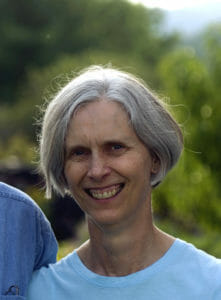
Elizabeth Gibson, M.S., holds a bachelor's degree in literature and a master's degree in biology from The University of Tulsa. She has completed Herbert Benson's Clinical Training in Mind/Body Medicine at Harvard Medical School. Previously she worked as a consultant at Arthur D. Little, Inc., and Radian Corporation in the areas of environmental protection and food research. She is a writer, editor and homemaker with interests in environmental literacy, yoga, music and gardening. Elizabeth is the editor of Stanislav Grof 's The Ultimate Journey: Consciousness and the Mystery of Death and a contributor to the teaching manual MDMA-Assisted Psychotherapy for the Treatment of Posttraumatic Stress Disorder, both published by the Multidisciplinary Association for Psychedelic Studies. For the past 12 years, she has been responsible for local news for the Town of Pawlet, and from 2008 – 2014 she was the editor of the weekly environment section for the Rutland Herald and Montpelier Times Argus newspapers in Vermont.
Transcript
Click on a timestamp to play from that location
| 0:00.0 | Hello and welcome back to psychedelics today. This is Joe Moore coming at you from Bracken |
| 0:24.2 | Newt, Colorado, beautifully high in the mountains. Amazing sunny day here, almost 40 degrees Fahrenheit. |
| 0:30.9 | Great stuff. So today on the show, we do something a little different. We actually have a |
| 0:36.3 | master class from navigating psychedelics that we're |
| 0:39.5 | going to play here for you. It is with our breathwork teacher Elizabeth Gibson from Dream Shadow. |
| 0:45.9 | And we get into a lot of stuff. We talk a little bit about an MDMA session she had way back |
| 0:52.8 | that was that was really helpful for her and talk about breath work. |
| 0:57.9 | And I think you all might find it interesting because it's, you know, where Kyle and I come |
| 1:03.0 | from. |
| 1:04.0 | If you listen to the show and you're curious about our background, this is a good glimpse into |
| 1:08.2 | that in the relationship we have with Elizabeth. |
| 1:10.7 | So I think you'll, I think you'll like it. |
| 1:13.4 | If you like the show, you'll like this. |
| 1:14.7 | And what we're doing is releasing a sample of what exists in our navigating psychedelics |
| 1:21.3 | course. |
| 1:22.1 | So you can get a better taste for it and see if it's something you might be into. |
| 1:26.8 | This is really a foundational course. |
| 1:28.8 | Anybody from a physician to a therapist to a college student would benefit from this. It's, |
| 1:35.8 | you know, it's not necessarily geared towards clinical people, but clinical people find it very |
| 1:41.5 | helpful. We have a number of folks who are professionals that have taken it and have really appreciated |
| 1:46.0 | it. |
| 1:46.6 | Again, we've mentioned this in the show before, but money back guarantee, 100% 30-day money-back |
... |
Please login to see the full transcript.
Disclaimer: The podcast and artwork embedded on this page are from Psychedelics Today, LLC, and are the property of its owner and not affiliated with or endorsed by Tapesearch.
Generated transcripts are the property of Psychedelics Today, LLC and are distributed freely under the Fair Use doctrine. Transcripts generated by Tapesearch are not guaranteed to be accurate.
Copyright © Tapesearch 2026.