
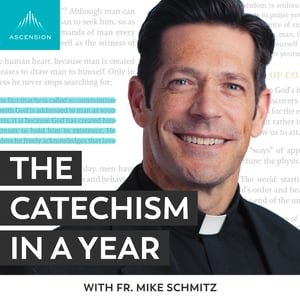
Day 291: The Political Community and the Church (2025)
The Catechism in a Year (with Fr. Mike Schmitz)
Ascension
4.9 • 11.6K Ratings
🗓️ 18 October 2025
⏱️ 17 minutes
🧾️ Download transcript
Summary
We take a look at what the Catechism teaches about the Church in relation to political communities. Every institution has their own vision of what it means to be human, which shapes their policies. Because the Church knows the truth, that every person is made in the image and likeness of God, the Church must weigh in to ensure that the dignity of the human person is at the forefront of political decisions and policies. Today’s readings are Catechism paragraphs 2244-2257.
This episode has been found to be in conformity with the Catechism by the Institute on the Catechism, under the Subcommittee on the Catechism, USCCB.
For the complete reading plan, visit ascensionpress.com/ciy
Please note: The Catechism of the Catholic Church contains adult themes that may not be suitable for children - parental discretion is advised.
Transcript
Click on a timestamp to play from that location
| 0:00.0 | Hi, my name is Father Mike Schmitz, and you're listening to the Catechism in a Year podcast, |
| 0:09.5 | where we encounter God's plan of sheer goodness for us, revealed in scripture, and passed down |
| 0:13.5 | through the tradition of the Catholic faith. The Catechism in New Year is brought to you by |
| 0:16.8 | Ascension. In 365 days, we'll read through the Catechism of the Catholic Church, discovering our identity and God's family as we journey together toward our heavenly home. This is day 291. We're reading paragraphs 2244 to 2257. As always, I'm using the Ascension edition of the Catechism, which includes the Foundations of Faith Approach, but you can follow along with any recent version of the Catechism with the Catholic Church. You can also download your own catechism in a year reading plan by visiting ascensionpress.com slash CIY. And lastly, you can click follow or subscribe on your podcast app for daily updates and daily notifications. Today, day 291, we're coming to the end of commandment number four. This is the last little section. We have three quick paragraphs and then a bunch of little nuggets. So we're going to talk all about that. Today in paragraphs 2244 to 2257, we're looking at the political community and the church. And so, yes, of course, we know we talked yesterday about the duties of citizens. And so there's plenty of duties of citizens. We have the duties of civil authorities we |
| 1:11.4 | talked about the day before. But today we're looking at this. How do we see the church in relation |
| 1:15.5 | to political communities? How do we see political communities? What are their limits? And what should |
| 1:20.8 | be their guiding points? We only have three paragraphs on this. And yet these three paragraphs are |
| 1:24.9 | quite powerful, I believe. Once again, we affirm and assert the right to |
| 1:30.0 | exist of every institution because every institution has, is inspired, at least implicitly, it says in |
| 1:35.7 | 2244, by a vision of man and his destiny. That's every, every organization, every institution |
| 1:41.6 | has a vision of what it is to be human and what it is and what is the goal of being human. |
| 1:47.0 | And we recognize that when an institution lacks a true and authentic, a comprehensive view of what it is to be human and of the destiny of that human being or of humanity itself, there's always going to be a lack. |
| 2:02.6 | There's always going to be a distortion. And so because of that, we pay attention to those things. |
| 2:07.6 | And secondly, we also recognize that because of that, the church can never fully endorse any one |
| 2:13.3 | particular view of the human person. That is not comprehensive and that is not completely adequate |
| 2:18.2 | when it comes to reality. Also, the church does have a say in the sense that the church has the |
| 2:24.8 | right to weigh in on matters of political consequence, right? The church does get to weigh in on this |
| 2:31.7 | because the church has a lot to offer. The church has a |
| 2:34.1 | truth to offer. The church has a vision of the human person that is adequate and that is comprehensive. |
| 2:39.3 | And so because of that, church must weigh in, but also the church must weigh in as church, |
| 2:44.3 | not as another political entity. Does that make sense? Hopefully all those words made sense, |
| 2:48.7 | but as we get today in paragraphs 2244 to |
... |
Please login to see the full transcript.
Disclaimer: The podcast and artwork embedded on this page are from Ascension, and are the property of its owner and not affiliated with or endorsed by Tapesearch.
Generated transcripts are the property of Ascension and are distributed freely under the Fair Use doctrine. Transcripts generated by Tapesearch are not guaranteed to be accurate.
Copyright © Tapesearch 2026.