
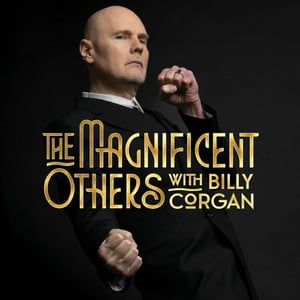
David J (Bauhaus/Love and Rockets) | The Magnificent Others with Billy Corgan
The Magnificent Others with Billy Corgan
Billy Corgan
4.6 • 731 Ratings
🗓️ 13 May 2026
⏱️ 98 minutes
🧾️ Download transcript
Summary
Billy Corgan sits down with David J of Bauhaus /Love and Rockets, one of the quiet architects of alternative music. David shares stories about growing up in working-class England, discovering reggae and punk, the accidental genesis of "Bela Lugosi's Dead," and Bauhaus' mission to dismantle the conventions of traditional rock.
Billy reflects on hearing Bauhaus for the first time and how the band permanently reshaped his understanding of music and artistic freedom. David recalls the surreal night Iggy Pop appeared front row at Danceteria, reveals what it truly took to reunite with Peter Murphy after years of estrangement, and reflects candidly on releasing more than 20+ solo albums for a niche-but-devoted audience, driven less by ambition than by an unstoppable need to create.
Check out David's album: "Tracks From The Attic Revisited" here: https://www.independentprojectrecords.com/david-j
See Privacy Policy at https://art19.com/privacy and California Privacy Notice at https://art19.com/privacy#do-not-sell-my-info.
Transcript
Click on a timestamp to play from that location
| 0:00.0 | A guitar is not necessarily something that you strum, you know, you can hit it with a stick. Whatever it takes to get, the right sound out of the thing. To fanboy for a second, to me, Bauhaus was one of the greatest bands ever. What a big thing for us was not doing the obvious and not being rock. I'm always impressed by how confident your musical life has been to let things be simple or imperfect or just be what they are. When we started, we got a lot of resistance and we really relished kicking against that. Did you guys have an intellectual kind of conversation at the beginning? You are named for an art movement. Yeah. No. I love it. |
| 1:08.6 | David nice to see you. Thank you for being here today. You honor me with your presence. Thank you, Billy. Um, where can we begin? Okay. Uh, I'm fascinated because of the music that came out of the UK in the 60s, 70s, 80s, this kind of post-war gloom. You weren't necessarily born right after the war, but you were born in 57. What was the environment that you grew up in? If you were to just kind of give me a postcard view of it? Yeah, well, I come from a town called Northampton. It's right in the middle of England. It's the |
| 1:25.6 | Midlands. It's the centre. Further is from the sea in England actually. And it's a small market town. The industry is making shoes, boots and shoes. Okay. So there's factories for that. And there's a brewery there, the Colesburg brewery, and there's a town centre, market square. It was a pretty rough place growing up there. Kind of industrial, the typical industrial kind of. It had an element of that, very working class, just really, just a kind of hard place and pretty tough and rough and ready. Somali by beautiful countryside, which was, you had to escape, you know, go into the countryside, which was near. But the town centre was very, very working class and it was a rough place and |
| 2:28.4 | we got a lot of stick when I first formed a house with the other guys. Yeah, I had a feeling |
| 2:35.8 | forming a heart band. Yeah, we were very much outsiders. I bet. You know, what did your parents do? |
| 2:43.2 | My parents worked, they had a news agent and tobacco in the shop. Okay. Little shop on the corner. And that did quite well. That shop mainly due to my mum's kind of business acumen. And they built that up quite well. So I, as a result of that, my brother and I, we went to a public school for two years, which in England a public school is the opposite to here, so like a private school. Ah. So, and that was quite formative in a way. I was gonna say, yeah. Different. It was certainly like the level of education was a lot higher. Yeah. But it was pretty draconian in its, like, you know, Tom Brown school days to a degree, corporate punishment and all that. Oh, okay. And that was another kind of tough place. So only last two years and then went back to were just what they call the secondary modern school, just a regular place. So only last two years and then went back to a, just what they call the secondary modern school, just a regular school. And I found out I was two years ahead of everybody. Oh, I see. But soon slip back, because I wanted to hang out with the cool kids. Yeah. So every musician has their apocryphal, you know, the moment when the music sort of flashed in their brain, like, I didn't do that. What was your sort of... That would be well. The very first thing was reggae. So which has always been present in your music. Yeah, yeah. It's kind of dub, dub feel. Yeah, but I'm sort of like prior to dub. Desmond Decker. Yeah, exactly Desmond Decker, the Toots and the Maytays, things like that. And a lot of the early records that were produced by Lee Scratch Perry and that had a big impression on me. So this is like 1970. OK. So I was like 13. Yeah. My mates and I used to sneak into the skinhead disco. We were too young to get in but we would sneak in. And that's where the first place where I heard music really loud in the dark. And in the edgy company of the skins, you know. Yeah. Who would be quite amused by us. |
| 5:06.1 | Is a nippers and they would like, play us with beer and get us drunk. It's just like nascent punk times or... No, because it was... What were the skinheads listening to? Tobrega exclusively. Really? Oh, I didn't know that. That's all they play there. This part of English culture just kind of lost to the Americans, you know? |
| 5:24.6 | Yeah, and the reason that there was a lot of that music in England was because of the mass immigration from the West Indies and Jamaica. Basic colonialism, right? Well, they were calling it, what they call an ease at some point. Yeah, but it was the other way, you know, and those people coming in. No, I'm not saying, but it was the connection of the cultures to colonialism that sort of so-and-so agrees. That's an emotion. Yeah. Again, this is my American teacher. Yeah. And they were kind of, the natives were kind of escaping that to go back to the source of the imperialism. But they set up their own culture there in England, and it was very prevalent and made a big impression musically. What was the attraction to the skinheads, if you remember? Like, did they like that it was, was it sitting as more pure? It was what was there? Because the skinheads tend to have some kind of sociopolitical logic to what they're into. Yeah, I think it was an identification with the archetype of the rude boy. Okay. And the clothes, they liked the clothes and that was influential on the dress sense of the skinheads, and then morphed into the suede heads. And I was an early, I was a suede head because I'd never got that skinned haircut. So when they all started to grow out of their hair, it was recognized that I was already there. It's fascinating too, because I know you had your dips in the Motown, but like basically Motown and Stacks had such an influence on reggae. So going back through what you were influenced by, it's like an interesting loop there. Yeah. Yeah. So that was the first music that made a big impression on me. And then shortly after that, I mean, what really blew it all apart was Mark Buller and T-Rex. Yeah. So this is like 71, 72. And I was totally captivated by all that. I joined the only fan club I've ever joined was the T-Rex fan club. What did you get for a join of the fan club? Well, I would wait with baited ref from my monthly package that would come through a newsletter, a photo of Mark, with a printed signature. No, I wish. Occasionally a flexi disk, which is quite a treat. No, I think they go for big bucks now. I bet. But yeah, I was a paid up member. And then again, shortly after that, Bowie, of course. Yeah. Well, David Bowie was quite fascinated with Mark Bowie too. He said, I'll take some of that. Yeah, sure. As you know, not everybody wants to play the bass. It tends to be the red-headed stepchild of the musicians. So what was it about the bass? Was it the Doug Reggae part of it all? Well, this is prior to Doug, but it was certainly the Reggae. Yeah. Okay. And I identified that sound and that instrument has been very integral to me. The music that I loved and nobody else wanted to play the bass, you know. My first band I was in at school, there were five league guitarists. And then it was, and I was, I was one of them aspiring, you know, and failing. and then it was suggested by one of us that, well, well, somebody has to be the bass player. And I just stepped forward. Yeah. You know, maybe it will be the other guy step back. And I was, but no, it was gravitated to it. Yeah, because I love the bass, but you know, as an 18 year old guitar player, what a nothing to do at the bass, you know? Sure. Yeah, because I love the bass, but you know, as an 18-year-old guitar player, what nothing to do at the bass, you know, is the guitar, you know? Yeah, of course. Certain types. Tony Viscati, was he the T-Rex bassist, essentially? Well, he played on some of the records, Bill Curry, a regular guy. But I mean, Tony V just going to you, yes, very good |
| 9:25.8 | basically. But when you talk about the reggae influence on your playing, it's like suddenly, because when I first heard you playing, I couldn't understand what it was coming from. Because I only thought within the guys of what we would now call alternative music. Right. You know, where it's like, you think of like Steve Severer or something, it's very like aggressive and, you know, maybe playing higher, hooky. |
| 9:45.5 | Yes, sure. |
| 9:46.4 | But you were coming from this totally other quadrant of logic. like you think of Steve Severer or something, it's very like aggressive and maybe playing higher hooky. |
| 9:45.5 | Yeah, sure. |
| 9:46.5 | But you were coming from this totally other quadrant of logic. |
| 9:50.1 | Uh, yeah, although I did have elements of what you're talking about. |
| 9:54.5 | Yeah, but I'm saying that part of your playing was a mystery to me. |
| 9:58.8 | Right. |
| 9:59.8 | Yes. |
| 10:00.8 | And that is coming from Dubb. |
| 10:01.8 | Yeah. |
| 10:02.8 | Because I mean, basically, um, well, a key component to Belgrade goes, just, that is, this has got a Dub factor there. It makes total sense when you put it in that frame. With the echo as well. Yeah. Yeah. So we were all into reggae, especially myself and Daniel, we're very much into Dub. So yeah, that also explains some of the love and rocket stuff even. Yeah, it's always been there. Yeah, sure. So I'm not asking you to repeat the origin story of the band, but I'm curious you know, having a musical brother, you know, and you know, the famous brother pairings, the kinks and the the the galagers and stuff like that. Was it was it always the intention you guys were going to work together or was it? Did that sort of my brother and I yeah. Well, how I'll tell you how that started. And I told this story to Tony Fisconte mentioning him. Oh, very. And he loved it. So the first time I ever recorded anything, and that was on a real to real tape recorder that belonged to my parents, because I had the two-rex singles. So we would play those sort of quite low volume. And I would sing over the top and wall ball, you know, to tend to sound a bit like Mark Bowling. And Kevin would play, he would be Mickey Finn and he would be playing... Carguss? Well, he'd turn Plowparts literally as he's Congress, in lieu of Congress. And we would make these, I kinda wish I had those before. You know, and I was a record store day, you know? It's in this day and age. It's a release. |
| 11:46.0 | Yeah. |
| 11:47.5 | So that was the start of it, really. |
... |
Transcript will be available on the free plan in 3 days. Upgrade to see the full transcript now.
Disclaimer: The podcast and artwork embedded on this page are from Billy Corgan, and are the property of its owner and not affiliated with or endorsed by Tapesearch.
Generated transcripts are the property of Billy Corgan and are distributed freely under the Fair Use doctrine. Transcripts generated by Tapesearch are not guaranteed to be accurate.
Copyright © Tapesearch 2026.