
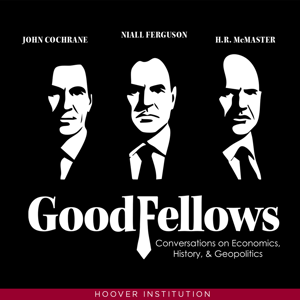
Cyber Rattling & Socialism: Anne Neuberger on Future Wars, Mayor Mamdani, and a Big Deal at the BBC | GoodFellows | Hoover Institution
GoodFellows: Conversations on Economics, History & Geopolitics
Hoover Institution
4.6 • 717 Ratings
🗓️ 14 November 2025
⏱️ 62 minutes
🧾️ Download transcript
Summary
Transcript
Click on a timestamp to play from that location
| 0:00.0 | We will prove that there is no problem too large for government to solve and no concern too small for it to care about. |
| 0:11.2 | It's Wednesday, November 12th, 2025, and welcome back to Goodfellows, a Hoover Institution broadcast examining history, economics, and geopolitics. |
| 0:19.4 | I'm Bill Whalen. I'll be your moderator today, joined by |
| 0:22.1 | our full fleet of Goodfellows. That means that we today have in the House, the historian, |
| 0:26.9 | Sir Neil Bergeson, the economist John Cochran, and former Presidential National Security Advisor, |
| 0:32.0 | Lieutenant General H.R. McMaster, Neil John, and H.R. are all Hoover Institution's senior |
| 0:37.3 | fellows. Gentlemen, two segments today, in the second part of our show, we're going to do a little game we call Big Deal, little deal, no deal at all. I'm going to give you a bunch of items in the news and you tell me their relative significance. But first, we're going to kick off the show with the segment on war, not current wars necessarily, but wars of tomorrow. Wars of the future. |
| 0:55.7 | And joining us for this conversation, making her debut on Goodfellas I might add is Ann Newberger. |
| 1:01.1 | Anne Newberger was recently named the William C. Edwards Distinguished Visiting Fellow here at the Hoover |
| 1:05.3 | Institution. She joins us after serving as a national security advisor for cyber and emerging technology |
| 1:10.3 | in the Biden White House, her field of expertise being national policy around cyber warfare, cybersecurity, and emerging technologies. That includes components of AI policy. And Newberger also worked at the NSA and the Pentagon. And it's great to meet you. Great to have you on this show. And I got to say, when I that somebody worked at the NSA, I'd love to find out what you did, but you'd probably have to kill me |
| 1:30.2 | after you told me, right? |
| 1:32.8 | Thanks so much. It's wonderful to be here with you. And in short, at NSA, I was the deputy |
| 1:37.4 | head of global operations. I served as their first chief risk officer after Snowden and stood |
| 1:42.1 | up their cybersecurity director as we saw geopolitics |
| 1:45.6 | and cyber threats fundamentally changed and recognizing that the NSA and intelligence community |
| 1:50.3 | response had to change along with it. So I think that summarizes it and you seem to be alive and |
| 1:54.8 | well, Bill. Thank you very much. So Ann, let's talk about the wars of tomorrow, the future of war. |
| 1:59.8 | If we look back, I'm going to play amateur historian for a second, Sir Neil and HR. |
| 2:03.3 | If you look back to the 20th century in World Wars, World War II, the less than the winning side did a better job of mastering technology. The Allies were better at radar, the Allies were better at air warfare, long-range bombers. If you look at World War I, Neil Ferguson's The Pity of War, I recommend to those who want to read about the war. |
| 2:20.5 | Both sides tragically, range bombers. If you look at World War I, Neil Ferguson's The Pity of War, I recommend to those |
| 2:19.0 | who want to read about the war, both sides tragically in taking technology, but using 20th century |
... |
Please login to see the full transcript.
Disclaimer: The podcast and artwork embedded on this page are from Hoover Institution, and are the property of its owner and not affiliated with or endorsed by Tapesearch.
Generated transcripts are the property of Hoover Institution and are distributed freely under the Fair Use doctrine. Transcripts generated by Tapesearch are not guaranteed to be accurate.
Copyright © Tapesearch 2026.