
Changing the Narrative, with Nikole Hannah-Jones
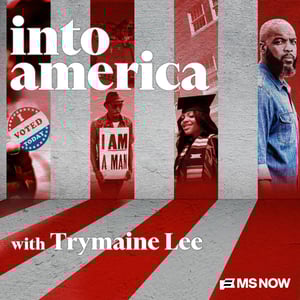
Into America
Trymaine Lee, MS NOW
4.6 • 3.4K Ratings
🗓️ 18 November 2021
⏱️ 30 minutes
🧾️ Download transcript
Summary
Transcript
Click on a timestamp to play from that location
| 0:00.0 | To the more than 30 million descendants of American slavery. |
| 0:10.0 | August 1619. |
| 0:20.0 | A ship arrives near Point Comfort, a coastal port in the English colony of Virginia, |
| 0:28.0 | which was founded 12 years earlier. |
| 0:34.0 | You're listening to the newly released audiobook version of the 1619 project. |
| 0:41.0 | The White Lion carries some 20 to 30 captive Africans |
| 0:46.0 | who are traded to the Virginia colonists for provisions, making them the first enslaved Africans in the English colonies that will become the United States. |
| 0:58.0 | Two years ago, in August of 2019, the New York Times published the 1619 project. |
| 1:05.0 | The aim was to show us just how deeply the U.S. legacy of Chattel's slavery history was and still is, V defining feature of this nation. |
| 1:15.0 | The project was the brainchild of New York Times magazine journalists and my dear friend Nicole Hanna-Jones. |
| 1:23.0 | We are often taught in school that Lincoln freed the slaves, but we are not prodded to contemplate what it means to achieve freedom without a home to live in, without food to eat, a bed to sleep on, clothes for your children, or money to buy any of it. |
| 1:42.0 | But even as the federal government decided that black people were undeserving of any restitution, it was bestowing millions of acres in the West on white Americans under the Homestead Act, |
| 1:54.0 | while also enticing white foreigners to immigrate with the offer of free land. |
| 2:02.0 | When it was released, the 1619 project took up an entire issue of the Times magazine. More than two dozen black journalists, writers, and thinkers contributed to this initiative, myself included. |
| 2:15.0 | Today, black Americans, far removed from slavery and Jim Crow, continued to be handed the economic misfortune of their forebears. |
| 2:25.0 | This is why, as of 2017, white households were twice as likely as black households to receive an inheritance. |
| 2:33.0 | And when white people inherit money, it's typically three times the amount black beneficiaries get. Those inheritances help drive the racial wealth gap. |
| 2:44.0 | The life of the 1619 project has gone far beyond one magazine. This week, Nicole published the book version of 1619, along with an audio book, and a children's book, called Born on the Water. |
| 2:59.0 | I've been a fellow at Harvard this fall, teaching at the Kennedy School's Institute of Politics. My classes center around storytelling, race, and American mythology. |
| 3:11.0 | And I knew Nicole would be the perfect fit. So I brought her up to Harvard to talk with students about the enduring legacy of 1619. |
| 3:20.0 | It asked the question, how would we think differently about America and how would we be able to better understand America if we thought about our origins not in 1776 with this group of white men, the claring they wanted to find a nation so that they could be free. |
| 3:38.0 | But instead, thought about 1619, which is the introduction of African slavery. |
... |
Please login to see the full transcript.
Disclaimer: The podcast and artwork embedded on this page are from Trymaine Lee, MS NOW, and are the property of its owner and not affiliated with or endorsed by Tapesearch.
Generated transcripts are the property of Trymaine Lee, MS NOW and are distributed freely under the Fair Use doctrine. Transcripts generated by Tapesearch are not guaranteed to be accurate.
Copyright © Tapesearch 2026.