
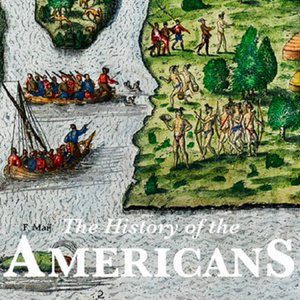
#39 Set Fair For Roanoke Part 1
The History of the Americans
Jack Henneman
4.9 • 632 Ratings
🗓️ 23 September 2021
⏱️ 34 minutes
🧾️ Download transcript
Summary
In the spring of 1584, Sir Walter Ralegh (the spelling he used), now the chief organizer and promoter of English settlement in North America, dispatched two ships to the Outer Banks of North Carolina on a mission of reconnaissance. They explored Hattaras Island and Roanoke Island, and the area between Pamlico Sound in the south and the mouth of the Chesapeake in the north. They brought home to England two Indians, Manteo and Wanchese, who would go on to speak English and would have a huge impact on the two subsequent attempts to settle English people in the area.
#VastEarlyAmerica
Website: The History of the Americans
https://subscribebyemail.com/thehistoryoftheamericans.com/?feed=podcast
Selected references for this episode
James Horn, A Kingdom Strange: The Brief and Tragic History of the Lost Colony of Roanoke
David Beers Quinn, Set Fair for Roanoke: Voyages and Colonies, 1584-1606
Transcript
Click on a timestamp to play from that location
| 0:00.0 | Welcome to the History of the Americans podcast, episode 39. |
| 0:10.3 | I'm your host, Jack Heneman, and I'm recording this episode, as usual, very early in the morning, |
| 0:17.2 | on September 23rd, 2021, in Austin, Texas. |
| 0:22.8 | The title of this episode, Set Fair for Roanoke Part 1, is a tip of the hat to David Beers Quinn, |
| 0:31.5 | an Irish historian who devoted his long career to the study of early English settlement in North America. |
| 0:38.3 | Professor Quinn died in 2002 at age 93, but his book, Set Fair for Roanoke, is one of the |
| 0:45.7 | premier sources on the three colonies that settled on an island just inside of North Carolina's |
| 0:51.3 | outer banks in the mid-1580s. |
| 1:01.0 | The new website, still at the History of theAmericans.com, is getting good reviews so far. |
| 1:08.0 | I put up a couple of blog posts that do not launch podcast episodes, and you can read them by going there and clicking on Jack's blog. I'm going to use the blog to post |
| 1:12.6 | random interesting stuff and to publish corrections of podcast episodes that have already gone |
| 1:17.5 | live. You'll see a post there called Erata, the Road to the Roanoke colonies, for example, |
| 1:24.8 | which corrects a couple of errors in last week's episode. I haven't yet |
| 1:28.9 | gone back to write blog post correcting errors in old episodes that have gone up previously, and I |
| 1:36.5 | don't know that I ever will, but at least we have a mechanism to clean stuff up going forward |
| 1:40.8 | with a handy place to go when I have to correct the record. |
| 1:45.5 | Speaking of last week's episode, if you have not already listened to it, you might enjoy |
| 1:50.0 | this one more if you do. Of course, when you go to last week's episode, you'll hear me suggest |
| 1:55.4 | that you listen to a couple of others first. It all ties together. It's late 1583. The Catholic world had rolled out the new |
| 2:05.4 | Gregorian calendar at the beginning of the year, which jumped 10 days to account for miscalculations |
| 2:11.4 | in the old Julian calendar. The new calendar was not adopted immediately everywhere, and the English still used the old one. |
| 2:20.2 | Professional scholars will show various dates during this period with a slash to reflect different |
... |
Please login to see the full transcript.
Disclaimer: The podcast and artwork embedded on this page are from Jack Henneman, and are the property of its owner and not affiliated with or endorsed by Tapesearch.
Generated transcripts are the property of Jack Henneman and are distributed freely under the Fair Use doctrine. Transcripts generated by Tapesearch are not guaranteed to be accurate.
Copyright © Tapesearch 2026.