
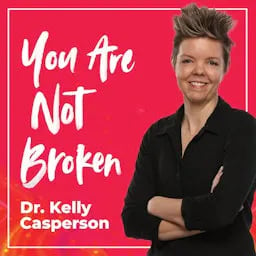
345. Ethics and Informed Consent in Hormone Care
You Are Not Broken
Kelly Casperson, MD
4.8 • 1.1K Ratings
🗓️ 16 November 2025
⏱️ 64 minutes
🧾️ Download transcript
Summary
Transcript
Click on a timestamp to play from that location
| 0:00.0 | Welcome to the You Are Not Broken Podcast. |
| 0:06.0 | I'm your host, Dr. Kelly Casperson, a board-certified jurologist, thought leader, and conversation starter on midlife living, hormones, and sexuality. |
| 0:16.0 | Enjoy the show. |
| 0:18.0 | Hey everybody, welcome back to the You Are Not Broken podcast. Today I have Jennifer Lanoff, who's a board-certified women's health nurse practitioner and attorney, and we're going to hear all about that journey. But we're not just talking about hot flashes and hormones today. We're going to talk about ethics, access, and advocacy with the brilliant Jennifer Lanoff. Thank you so much for joining us today. Yes, I'm so happy to be here. |
| 0:39.2 | Okay, first your story. Not many lawyers go back to take care of humans. What happened? Well, it's only funny, well, it's funny for a lot of reasons, but I have resisted for so many times doing anything lawyerly. because, you know, everyone went back to school is like, |
| 0:53.9 | oh, you can be a great med mal lawyer. |
| 0:55.7 | Oh, you can start, you know, you're going to really know it. |
| 0:57.5 | And I just have been like, nope, I want to see patients. I want nothing to do with this. So I was a public defender for 25 years-ish, including, you know, sort of during law school, representing the poorest of the poor, we're hanging out of the jail, working on prison conditions for kids and adults, |
| 1:14.1 | trying murder cases during 9-11. I was like the only person trying a case because I was nine months pregnant and the entire courthouse was empty, but the judge was worried that I would go into labor, so we had to finish our trial. It was crazy. But I, you know, I did it for a long time and it's a lot of |
| 1:27.9 | fighting with people. And I, it's also hard, hard work. Although I have to say this is hard work too, but in a different way, it just tugs at your heartstrings. My son is a investigator that now at the Public Defender Service in D.C. And he sees it, right? Because there's no happy ending, right? The clients are just as much victims as the victims. So it's a hard job and I couldn't really figure out what I wanted to do next and I've always loved reproductive health. So given that I was old, I decided that I would, you know, I interviewed everyone. I said, should I go to med school? Should I do this? Should I do that? And every doctor I talked to said, do not go to med school. It's a waste. It's a 20. I mean, no offense to the people who went to med school older, but it is a 20-year-old game for sure. Not just length of years, but it's grueling physically. Yeah. And I also realized, like, I didn't want to do, I don't need to do surgery. I didn't't. So then I thought, oh, I'll become a midwife and I'll just do like some very low stress, you know, because GW has this great or they used to have this great midwifery program. You could deliver in the hospital if it became complicated. The doctors would come in. And so I thought, you know, this is easy. And so, well, not easy, but then I went to school. I went to |
| 2:34.4 | Hopkins, drove back and forth to Baltimore every day, because I live in D.C. And then I just was on that path. And then I did my first rotation when I started Georgetown, the master's program, at a home birth clinic. And I, I hope I'm not insulting anyone, but I was basically like, oh my god, I don't like pregnant people. |
| 2:51.6 | Way to be honest with yourself, though, ahead of time. |
| 2:54.4 | Well, it was just funny because my whole path was midwife, midwife, midwife, midwife, and I had been dulying, and I had been doing all this stuff. But I was, you know, measuring bellies every day. And I realized that I always looked forward to the Wednesday, which was the day they only did GYN, because those were the most interesting days. And, you know, of course, at that clinic, I already knew Rachel Rubin. So I'd sort of, you know, I had been involved with NAMs. So she's, Rachel's my neighbor. So I have known her forever. And I had already sort of started down this path. So I knew some stuff. And then, you know, of course, they were like, we don't mention the E word in our meetings with our patients, which is estrogen. And so I really spent a lot of time trying to educate that, you know, that group of clinicians about hormones and all of that. But yeah, then I realized that. And then so as luck would have it, Jim Simon was willing to take me on as a student or, you know, for a clinical rotation. And so I worked with him for a year and with his amazing PA, Lucy Trine, who is a quiet genius. I mean, she's amazing with all of this stuff. So, and then I just, I fell into it. So, you know, it's hard to say I think I really wanted to do direct patient care. I didn't want to go, like, work for Planned Parenthood or National Women's Law Center. I wanted to actually help patients. You know, if there's Armageddon, being a lawyer is not that helpful. So I thought, you know, I'm just going to learn, I'm going to learn some skills. So I guess that's my story. I don't, there are probably other versions of it that I say, but it's very unique. I mean, there's some combo MDJD programs, but people don't really practice law, right? Like, the fact they're like, no, no, no, that was your career. And then you pivoted is very unique. I still sometimes identify myself as Jennifer Lano from the Public Defender Service. I just, it's so part of my. It like comes out and you're like, hold on. One of the other things I did when I was lawyer was, I was on, I worked through the board of professional responsibility. So we heard a lot of attorney ethics cases. So that always sort of interested me sort of defining what's ethical. And you know, the med-mouth stuff, I always thought about that because I always felt so, you know, I was in lower side. I saw these poor clinicians who had tried to make |
| 4:51.3 | good judgment decisions and then were getting sued. So I've sort of always been interested in that |
| 4:56.1 | whole world. But I have put it off until this year when I feel like I'm, I feel like we have to |
| 5:01.2 | start talking about it some more. I think that's the magic of anybody who brings in, like, very disparate pieces of themselves, |
| 5:10.1 | and then they have, like, a superpower that you're like, |
| 5:14.0 | I didn't go in this to have a unique lens on advocacy, ethics, and, like, menopause, |
| 5:19.5 | but you do now, because you have that background and that, like, deep, deep, and like menopause, but you do now because you have that background and that |
| 5:23.7 | like deep, deep understanding that if you just went into medicine and went straight into medicine, |
| 5:29.6 | you wouldn't have that. You don't even have the language, really? Like, to me, I'm like, |
| 5:33.0 | Jen, can you define ethics for us? Like, it sounds stupid, but like we better start there. |
... |
Please login to see the full transcript.
Disclaimer: The podcast and artwork embedded on this page are from Kelly Casperson, MD, and are the property of its owner and not affiliated with or endorsed by Tapesearch.
Generated transcripts are the property of Kelly Casperson, MD and are distributed freely under the Fair Use doctrine. Transcripts generated by Tapesearch are not guaranteed to be accurate.
Copyright © Tapesearch 2026.