
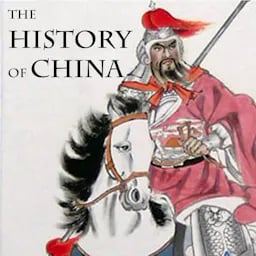
#302 - Qing 37: Palace of Mirrors
The History of China
Chris Stewart
4.6 • 1.2K Ratings
🗓️ 15 August 2025
⏱️ 40 minutes
🧾️ Download transcript
Summary
Transcript
Click on a timestamp to play from that location
| 0:00.0 | You're listening to an Airwave Media podcast. |
| 0:09.8 | Hello and welcome to the history of China. |
| 0:17.1 | Episode 302, Palace of Mirrors |
| 0:21.0 | Today we begin in a new chapter of our exploration of Qing China under the Qianlong Emperor, |
| 0:28.9 | a ruler who, by the second half of his reign, was not merely defending a dynasty or overseeing a government. |
| 0:35.0 | He was designing his legacy with eternity as his intended audience. |
| 0:40.6 | In the aftermath of the major conquests that had marked the first two decades of his rule, |
| 0:45.6 | including the extermination of the Jungar Confederation in Central Asia, Tianlong turned his attention |
| 0:51.0 | more inward. His vision of Empire had never been solely military. |
| 0:57.1 | Even in the midst of his grand campaigns, he'd been planning something far more ambitious |
| 1:02.3 | to establish an all-encompassing architecture of power, one that fused ideology, culture, ritual, |
| 1:09.5 | administration, and memory into a single, coherent image |
| 1:13.4 | of Qing supremacy. By the 1770s, Chen Long's empire was the largest centralized polity |
| 1:20.9 | on earth, as population, already spiraling to over 300 million, surpassed that of all of Europe combined. |
| 1:29.3 | Its court was the most elaborately bureaucratized in Chinese history, and at its helm |
| 1:33.8 | set an emperor who believed that he had achieved and must now immortalize a moral order |
| 1:39.7 | unmatched in human history. What would come to pass over the course of his later decades of rule |
| 1:46.5 | was not simply the continuation of good governance. Rather, it was something closer to a campaign |
| 1:53.1 | of symbolic consolidation, a bid to define what China was, who it belonged to, how it remembered its own past, and what it would permit |
| 2:03.7 | going into the future. We'll now explore the beginnings of this project, a campaign not |
| 2:09.6 | of swords and soldiers, but of scholars and scrolls, and maybe even more dangerous for exactly |
| 2:16.5 | that reason. |
... |
Please login to see the full transcript.
Disclaimer: The podcast and artwork embedded on this page are from Chris Stewart, and are the property of its owner and not affiliated with or endorsed by Tapesearch.
Generated transcripts are the property of Chris Stewart and are distributed freely under the Fair Use doctrine. Transcripts generated by Tapesearch are not guaranteed to be accurate.
Copyright © Tapesearch 2026.