
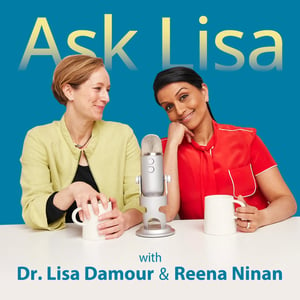
3: How to Deal with Conflict While Stuck at Home
Ask Lisa: The Psychology of Raising Tweens & Teens
Dr. Lisa Damour/Reena Ninan
4.7 • 822 Ratings
🗓️ 28 August 2020
⏱️ 28 minutes
🧾️ Download transcript
Summary
Transcript
Click on a timestamp to play from that location
| 0:00.0 | This is Ask Lisa, a podcast to help people understand the psychology of parenting, now in the midst of a pandemic. |
| 0:12.2 | Psychologist Dr. Lisa DeMore, author of two New York Times best-selling parenting books, takes your questions. |
| 0:19.7 | And I'm co-host Rina Ninan a journalist and |
| 0:22.3 | mom of two some of what we talk about comes from raising children ourselves most |
| 0:27.4 | of the time I'll be getting answers to your parenting questions so send your |
| 0:31.6 | questions to ask Lisa at dr. Lisa demour. this episode, we're going to cover dealing with conflict. |
| 0:45.8 | So, Lisa, I noticed back in March in Wuhan as they opened up, divorce rates skyrocketed. I saw that too. Did you see that? Like, |
| 0:56.5 | people coming out of COVID suddenly realized they didn't like their spouse as much as they did at |
| 1:02.3 | the beginning of this. They like them better when they go places. It is hard, though, right? |
| 1:08.8 | We're not meant to spend this much time alone together with our children or our partners. |
| 1:13.5 | No, I mean, it really is one of those things. Like, we all want more family time, but this is a lot of family time. There is no question about it. No question about it. |
| 1:23.4 | So how do you deal with this? Because, I mean, I think there are a lot of people who are even co-parenting, who might not even be living in the same house, but are forced to interact more closely than ever before. |
| 1:34.2 | And then you've got relationships of people who have been together a long time, not doing so well in the start of COVID and have just deteriorated. |
| 1:46.0 | What's your advice for dealing with people who are trying to cope with their children, whether they're young adults or elementary |
| 1:51.4 | age kids, and partners, spouses, boyfriends, girlfriends, people realize a lot about the other |
| 1:58.8 | person in the midst of quarantine. |
| 2:03.8 | All right, so let's think of this in two categories. |
| 2:07.2 | One is where the conditions of living in a pandemic become fault finders, right? |
| 2:15.1 | Where, you know, if there was a crack, the pressure on that crack |
| 2:18.7 | really causes it to, you know, open wide open. So maybe a relationship that was not in such |
| 2:24.3 | good shape before, either between adults or between parents and children, the strain of living |
| 2:30.7 | through this pandemic is definitely making whatever wasn't working well before, |
... |
Please login to see the full transcript.
Disclaimer: The podcast and artwork embedded on this page are from Dr. Lisa Damour/Reena Ninan, and are the property of its owner and not affiliated with or endorsed by Tapesearch.
Generated transcripts are the property of Dr. Lisa Damour/Reena Ninan and are distributed freely under the Fair Use doctrine. Transcripts generated by Tapesearch are not guaranteed to be accurate.
Copyright © Tapesearch 2026.