

3,Herodotus, Lydia
Storynory - Audio Stories For Kids
Storynory Ltd
4.2 • 3.1K Ratings
🗓️ 19 December 2017
⏱️ 8 minutes
🧾️ Download transcript
Summary
Written and presented by Bertie
Dedicated to Charlie Taylor in Sydney
The images come from Wikimedia Commons. for licences see here and here.


This Bertie, and I’m here with the next part of the histories of Herodotus
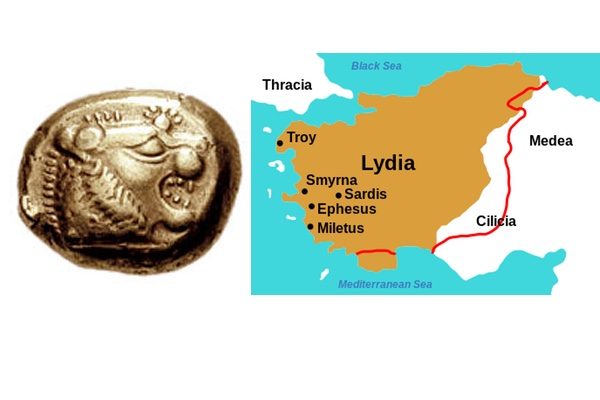
This story starts in a country that doesn’t exist any more. In its time it was as important as Babylon or Egypt and it was famous for its wealth, particularly the gold that came from its rivers. In fact, Herodotus says it was the first place to use gold and silver coins, and to open shops. This country was called Lydia, and it was part of what we now call Turkey.
Herodotus tells us that the first kings of Lydia were the family of Heracles. As you probably know Heracles was the Greek strongman and hero who had to complete 12 impossible tasks. We have that tale on Storynory, filed under myths.
Well one of these Lydian Kings, supposedly something like the great, great, great grandchild of Heracles was called Candaules. Some people say that his name meant ‘the dog strangler.’ But you will be pleased to know that I haven’t found any stories about him strangling dogs.
Candaules’ best friend was his bodyguard called Gyges, and one time this Gyges caught sight of the Queen of Lydia in the nude. The queen was embarrassed and very angry, and she gave Gyges a choice - she would either order him to be executed - or he could kill king Candaules and marry her. So he duly murdered Candaules and became king in his place.
That’s the story of how Gyges became king of Lydia as told by Herodotus - more or less - but I’m going to quickly give you another version which is more like a fairytale.
According to Plato, the Greek Philosopher, Gyges was actually a shepherd who found a magic ring that made him invisible when he put it on. He used this power of invisibility to help him murder king Candaules and to marry his wife, and to take his place as king.
Plato asks a question that’s a bit like this. Supposing you had a magic ring - and could use it to make yourself invisible. You could get away with doing anything you liked - even if it was bad. For instance you could walk into a shop, completely invisible, and just steal anything you wanted. Would you be tempted? In other words do we only behave well because we are afraid of being caught and punished? Or are some people, just good anyway?
Well that’s just something to think about, especially when we hear stories about powerful people, such as kings and queens and the rules whom the Greeks called tyrants, who could actually get away with doing bad stuff. Would they use their power for good or evil? It's one of the big questions in history.
Gyges murdered Candaules - and made himself King of Lydia, about 718 years before the birth of Christ. And the people of Lydia were not happy about this because they thought that if the gods punished Gyges for his crimes, they might also punish all the people of Lydia too. Gyges had to prove that the gods wanted him to be king. And this is when Lydia began its expensive custom of consulting the Greek oracles.
So what was an oracle? Well it was usually a priestess who claimed that she could ask the gods questions about anything - including the future - and get answers. Lots of people believed in the power of oracles and were willing to pay good amounts of gold for their services.
The richest and most famous oracle was in a place called Delphi on the slopes of mount Parnassus in central Greece. The high priestess of Delphi was called the Pythia and she was said to be in touch with Apollo, god of the sun and music.
Gyges sent a messenger to Delphi to receive the wisdom of the Pythia. She replied that Gyges’s family would be firm rulers of Lydia for five generations - but then the family of Heracles would get their revenge. So Gyges was secure. Herodotus says nobody paid any attention to the warning about the distant future - until it came true.
Gyges rewarded the Oracle with many precious gifts, including six great golden bowls which Herodotus saw when he visited Delphi almost 200 years later - but by that time the empire of Lydia no longer existed.
But the family of Gyges did rule for five generations and there are more stories to tell you about them - and about how they consulted the oracle of Delphi.
But there is one prediction that I made, that I have to admit that I got wrong. Last time I said that the next story was going to be about a king who thought that was so rich that he thought he must be the happiest person alive. As it turns out, it’s going to take a little longer to get round to telling his story - but we will get there fairly soon.
And I am delighted to dedicate this story from Herodotus to Charlie Taylor who is seven years old and lives in Sydney, Australia. His mother, Jenny, tells us that they listen to both our version of Herodotus and to the original Histories on Audible.
And I would like to thank Charlie and Jenny for becoming our latest supporters on Patreon. It means the world to us, to receive help from our listeners.
Transcript
Click on a timestamp to play from that location
| 0:00.0 | Hello, this is Bertie, and I'm here with the next part of the histories of Herodotus. |
| 0:05.9 | And this story is dedicated to Charlie Taylor. This story starts in a country that doesn't exist |
| 0:13.7 | anymore. In its time, it was as important as ancient Egypt or Babylon, and it was famous for its wealth, particularly |
| 0:23.3 | the gold that came from its rivers. |
| 0:26.7 | In fact, Herodotus says it was the first place to use gold and silver coins, and to open |
| 0:33.6 | shops. |
| 0:34.8 | This country was called Lydia, and it was located in the part of the world |
| 0:40.2 | we now called Turkey, which is where Europe ends and Asia begins. Herodotus tells us that |
| 0:47.6 | the first kings of Lydia were the family of Heracles. As you probably know, Heracles was the Greek strongman and hero who had |
| 0:57.6 | to complete 12 impossible tasks. We have that tale on Storinori, filed under myths. Well, one of these |
| 1:08.5 | Lydian kings, supposedly something like the great, great, great, great, grandchild of Heracles was called Kandallis. |
| 1:18.9 | Some people say that his name meant the dog strangler. |
| 1:23.7 | But you will be pleased to know that I haven't found any stories about Kandauly's strangling dogs. |
| 1:32.0 | Kandali's best friend was his bodyguard called Gaijis. |
| 1:36.2 | And one time this Gai Gis caught sight of the Queen of Lydia in the nude. |
| 1:42.4 | The Queen was embarrassed and angry and she gave Gaiji's a choice. |
| 1:49.0 | Either she would order him to be executed or he could murder King Kandallis and marry her. |
| 1:59.0 | It was one of those choices that wasn't really much of a choice, so he duly killed King Kandali's and marry her. It was one of those choices that wasn't really much of a choice. |
| 2:03.1 | So he duly killed King Kandallis, married the queen and became king in Kandali's place. |
| 2:11.1 | And that's the story of how Gaijis became King of Lydia, as told by Herodotus, more or less. |
| 2:19.0 | But I'm going to quickly give you another version of this story, and this version is more like a fairy tale. |
| 2:29.0 | According to Plato, the Greek philosopher, Gai'es was actually a shepherd who found a magic |
... |
Please login to see the full transcript.
Disclaimer: The podcast and artwork embedded on this page are from Storynory Ltd, and are the property of its owner and not affiliated with or endorsed by Tapesearch.
Generated transcripts are the property of Storynory Ltd and are distributed freely under the Fair Use doctrine. Transcripts generated by Tapesearch are not guaranteed to be accurate.
Copyright © Tapesearch 2026.