

263: OCD in Kids, Featuring Dr. Taylor Chesney
Feeling Good Podcast | TEAM-CBT - The New Mood Therapy
David Burns, MD
4.6 • 901 Ratings
🗓️ 11 October 2021
⏱️ 75 minutes
🧾️ Download transcript
Summary
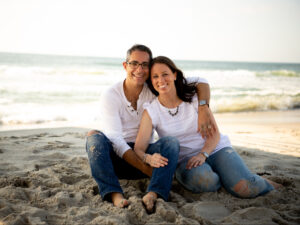
Photo features Taylor and her husband, Gregg, who is an ER / ICU physician in NYC.
263: OCD in Kids, Featuring Dr. Taylor Chesney
Rhonda starts this podcast by reading two incredible endorsements from fans like you. Thanks so much for the many kind and thoughtful emails we receive daily!
Today's podcast features Dr. Taylor Chesney, the founder and director of the Feeling Good Institute of New York City. Taylor was a member of my Tuesday training group at Stanford for several years during her doctoral training in psychology. Then she and her husband, Gregg, who is an ICU / intensive care unit doctor, returned home to NYC where she opened her clinical practice.
We have featured Taylor on a number of two previous podcasts: Corona Cast 4 (published 4-09-202) and Corona Cast 6 (published 4-30-2020). We always benefit greatly from Taylor's wisdom, warmth, and superb teaching. Taylor specializes in TEAM-CBT for children and teens, and tells us today about the upsurge in OCD (Obsessive-Compulsive Disorder) in young people, and how she approaches this problem using TEAM-CBT along with some family therapy.
Taylor describes OCD as a pattern of intrusive thoughts, fears, and images that trigger feelings of anxiety. In addition, the patient engages in a series of repetitious, supposititious behaviors in an effort to avoid the fear. Sometimes the parents may get caught up in the child's fears as well and engage in the compulsive rituals as well.
The fears Taylor sees in children are similar to the fears reported by adults with OCD, such as the fear of contamination, and the compulsive habit of repeated handwashing, and more. But especially common in kids are fears that loved ones, like parents, won't come home or will be hurt.
Common OCD rituals in children include wanting things to be a certain way; for example, organizing your desk meticulously, arranging your pencils, and so forth. The patient often feels that he or she can't stop or something terrible will happen.
Another common fear is getting sick, and needing repeated reassurance that the food the child is eating is safe.
David asked about the Hidden Emotion Model that is common and often helpful in adults with OCD, or any anxiety disorder. For example, if a child fears that a parent will be hurt, might this suggest that the child has repressed angry feelings toward the parent?
Taylor confirmed that this dynamic was, in fact, common in children as well as adults with OCD. She emphasized the need for an alliance with the parents as a part of the treatment team. This might include urging the child to express his or her anger, wants, and so forth.
Taylor speculated that the increase she's seen in OCD may be the result of the COVID pandemic, and the uncertainty we all feel. Children have a great need for love, empathy, structure, and certainty, and OCD is just one pattern that the increase in anxiety can take.
At the start of treatment, Taylor does an initial intake session with the parents, followed by two sessions with the child, and in both cases attempts to empathize and form an alliance via the Five Secrets of Effective Communication. She also wants to find out who the "patient" really is. Who is asking for help? Is it the child? Or the parents?
She also wants to know who will do the work of the therapy. If the child doesn't see the OCD symptoms as a problem, she will work with the parents.
Sometimes there's a mismatch as to what the problem is. The parents might want the child to get help with procrastination on schoolwork or household chores, but the child might want help with shyness and relationships with other kids.
She describes how she uses TEAM to show the child that his or her symptoms reflect his or her core values, but that they can turn down the intensity of the fears using the Magic Dial. She emphasized a role for psychoeducation in the treatment as well, explaining the evolutionary and protective role of anxiety. It's just that sometimes the volume gets turned up to unnecessary levels.
She said that the parents are a huge part of the treatment, since the problem "lives in the house," and the parents may fear what might happen if the child does not engage in the rituals.
And, of course, Exposure and Response Prevention are important keys to successful treatment, just as they are in adults.
Taylor described a compelling example of a teenager with an intense fear of vomiting in the middle of the night, who had resorted to a variety of rituals including avoiding dinner, secretly sleeping in his bathroom just in case. and more. Together, she guided him in the creation of a hierarchy of exposures as well as Positive Reframing of his symptoms. He successfully completed his treated in just six sessions.
Taylor offers a 12-week introductory course on TEAM-CBT with children and adolescents, and is a superb and highly esteemed teacher. For more information, you can contact Taylor@FeelingGoodInstitute.com or look for her on the website of the www,FeelingGoodInstitute.com
Rhonda and David
Transcript
Click on a timestamp to play from that location
| 0:00.0 | Hello and welcome to the Feeling Good podcast, where you can learn powerful techniques |
| 0:11.6 | to change the way you feel. I am your host, Dr. Ronda Borovsky, and joining me here in the |
| 0:16.8 | Murrieta studio is Dr. David Burns. Dr. Burns is a pioneer in the development of |
| 0:22.3 | cognitive behavioral therapy and the creator of the new team therapy. He's the author of Feeling |
| 0:27.4 | Good, which has sold over 5 million copies in the United States and has been translated into over 30 |
| 0:33.2 | languages. His latest book, Feeling Great, contains powerful new techniques that make rapid recovery |
| 0:39.3 | possible for many people struggling with depression and anxiety. Dr. Burns is currently an emeritus |
| 0:45.2 | adjunct professor of clinical psychiatry at Stanford University School of Medicine. Hello, |
| 0:51.5 | Rhonda. Hello, David. |
| 0:57.5 | And welcome listeners to episode 263. |
| 1:03.4 | We have a really special guest today, Taylor Chesney, who's the director of the Feeling Good Institute in New York. |
| 1:08.0 | I know David wants to say something about Taylor, too, as we introduce her. |
| 1:10.0 | Taylor who? |
| 1:15.5 | Taylor is a brilliant and beloved colleague. |
| 1:22.5 | Spent at least two years in the Tuesday group at Stanford. Well, after completing your doctoral degree and clinical psychology and went on many Sunday hikes. |
| 1:33.3 | So we've shared a lot of times together. We've done personal work together. |
| 1:42.3 | And one of my favorite people in the world. |
| 1:45.9 | And then Taylor and her husband, Greg, who's an emergency room and intensive care unit doctor in New York, moved home to New York. |
| 1:54.8 | And Taylor, you started the feeling good therapy center in New York City. And so we've missed you a lot. We're grateful for the |
| 2:07.6 | time we did have together. And it's always fun to reconnect. Some of you may remember that part of |
| 2:14.7 | our training is doing personal work. So you have the experience with |
| 2:19.7 | team and both Taylor and Rhonda, as you know, have done personal work that was featured on |
... |
Please login to see the full transcript.
Disclaimer: The podcast and artwork embedded on this page are from David Burns, MD, and are the property of its owner and not affiliated with or endorsed by Tapesearch.
Generated transcripts are the property of David Burns, MD and are distributed freely under the Fair Use doctrine. Transcripts generated by Tapesearch are not guaranteed to be accurate.
Copyright © Tapesearch 2026.