
#175 Louis Jolliet and Jacques Marquette Explore the “Mesippi”
The History of the Americans
Jack Henneman
4.9 • 632 Ratings
🗓️ 3 February 2025
⏱️ 42 minutes
🧾️ Download transcript
Summary
In the summer of 1673, two now famous Frenchmen and five others who are all but nameless traveled by canoe from the Upper Peninsula of Michigan at the Straits of Mackinac to central Arkansas on the western bank of the Mississippi River, and then back again. Louis Jolliet was a new sort of Frenchman, a natural born North American, having come into this world in Quebec in 1645, now a fur trader and voyageur. Jacques Marquette was the more usual sort, having been born in France in 1637. By the time of the expedition Marquette was a Jesuit priest, long known to the nations of North America as a “Black Robe.”
The episode begins with an overview of New France in the years between Samuel de Champlain’s death in 1635 and 1661, when it languished because the Five Nations of the Iroquois had it entirely bottled up. The expedition was a marker of New France’s rapid expansion after King Louis XIV began to rule in his own right that year.
Along the way, our heroes become the first Europeans to visit Iowa (Go Hawks!), see some extraordinary painted monsters, learn the importance of the calumet, and find a short portage in the eastern continental divide at a place soon to be called Chicago.
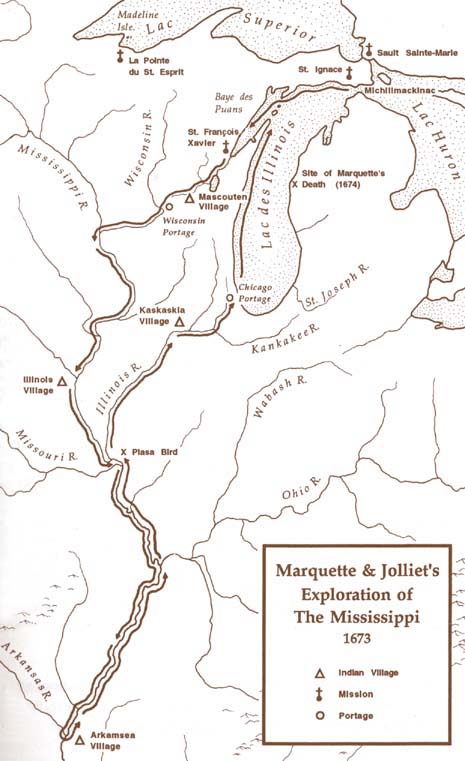
Map of the route (visible in the shownotes for the episode on the website), credit Illinois State Museum
X/Twitter – @TheHistoryOfTh2 – https://x.com/TheHistoryOfTh2
Facebook – The History of the Americans Podcast – https://www.facebook.com/HistoryOfTheAmericans
Selected references for this episode (Commission earned for Amazon purchases through the episode notes on our website)
Mark Walczynski, Jolliet and Marquette: A New History of the 1673 Expedition
Francis Borgia Steck, The Jolliet-Marquette Expedition, 1673 (pdf)
Piasa “monsters” (Wikipedia)
Carignan-Salières Regiment (Wikipedia)
Beaver Wars (Wikipedia)
Transcript
Click on a timestamp to play from that location
| 0:00.0 | Welcome to the History of the Americans podcast, episode 175. |
| 0:11.4 | I'm your host, Jack Heneman, and I'm recording this episode on February 1st, 2025 in Austin, Texas. |
| 0:19.9 | We are telling the history of the lands now encompassed by the United States |
| 0:23.9 | from the beginning without intentional presentism. In the summer of 1673, at the same time that |
| 0:32.8 | Keese the devil was raiding the Chesapeake and reconquering New York and New Jersey, two now famous |
| 0:39.2 | Frenchmen and five others, who were all but nameless, traveled by canoe from the Upper |
| 0:45.0 | Peninsula of Michigan at the Straits of Mackinac to Central Arkansas on the western bank of the |
| 0:50.9 | Mississippi River, and then back again. Louis Joliette was a new sort of |
| 0:56.6 | Frenchman, a natural-born North American, having come into this world in Quebec in 1645, now a |
| 1:05.0 | fur trader and entrepreneur. Jacques Marquette was the more usual sort, having been born in France in 1637. |
| 1:14.4 | By the time of the expedition, Marquette was a Jesuit priest, long known to the nations of North America as a black robe. |
| 1:23.9 | Joliette, the Canadian, pronounced Joliet in French, but we're going to go with a pronunciation most familiar to Americans, and Marquette, the Frenchman, are famous because so many things have been named after them, including John Belushi's greatest character, Joliet Jake Blues. |
| 1:46.9 | There's no way to tell the history of the Americans without them. At the same time, the journey itself was fairly uneventful as these things went. |
| 1:53.5 | There were no particularly violent encounters, gruesome deaths, or tragic missed opportunities. |
| 2:00.4 | There was, however, one very important discovery, |
| 2:03.8 | a mere portage across a couple of thousand yards of swamp at a place that would come to be known |
| 2:10.3 | as Chicago. That portage was important because it marked the eastern continental divide. |
| 2:20.2 | On the eastern end of that comically short distance, the waters flow into the Great Lakes and eventually out the St. Lawrence River |
| 2:27.1 | into the North Atlantic. On the western side, they flow into the Mississippi River, and ultimately the Gulf of Mexico. |
| 2:36.7 | Oh, excuse me, the Gulf of America, so hard to keep up. |
| 2:43.8 | Anywho, in the world, when the highways were water and boats carried everything heavier than a man could bear on his back, that portage |
| 2:53.0 | was a big deal. The voyage of Joliette and Marquette was important for another reason. |
... |
Please login to see the full transcript.
Disclaimer: The podcast and artwork embedded on this page are from Jack Henneman, and are the property of its owner and not affiliated with or endorsed by Tapesearch.
Generated transcripts are the property of Jack Henneman and are distributed freely under the Fair Use doctrine. Transcripts generated by Tapesearch are not guaranteed to be accurate.
Copyright © Tapesearch 2026.