
#162 Spanish Florida and the “Republic of Indians”
The History of the Americans
Jack Henneman
4.9 • 632 Ratings
🗓️ 7 September 2024
⏱️ 29 minutes
🧾️ Download transcript
Summary
While the English were consolidating their territory on most of the eastern seaboard of North America in the 1600s, Spanish Florida plugged along with its sole city at St. Augustine, with little European population growth. That simple fact obscures remarkable changes in the civil society of the future Sunshine State. From the 1570s, after the Jesuits had given up, until the 1720s, a small band of Franciscan friars, at no time numbering more than around fifty, built a network of wood and thatched missions throughout the region. They converted tens of thousands of Florida Indians to Catholicism, many practicing with such diligence that a visiting Frenchman wrote that the Apalachee were “scarcely distinguishable [in their practices] from Europeans who had been Christians for centuries.”
The relationship between the Franciscans in Florida and the indigenous peoples was not only different than anywhere in English or Dutch North America, it was different from everywhere else in the Spanish New World, including New Mexico at the same time, and California and Texas in the following century. As a result, the relationship between the Spanish and the Indians of Florida was symbiotic, one of shared religion, trade, and mutual support rather than conquest.
Unfortunately, it would all fall apart when the English Carolinians marched south looking for people to enslave.
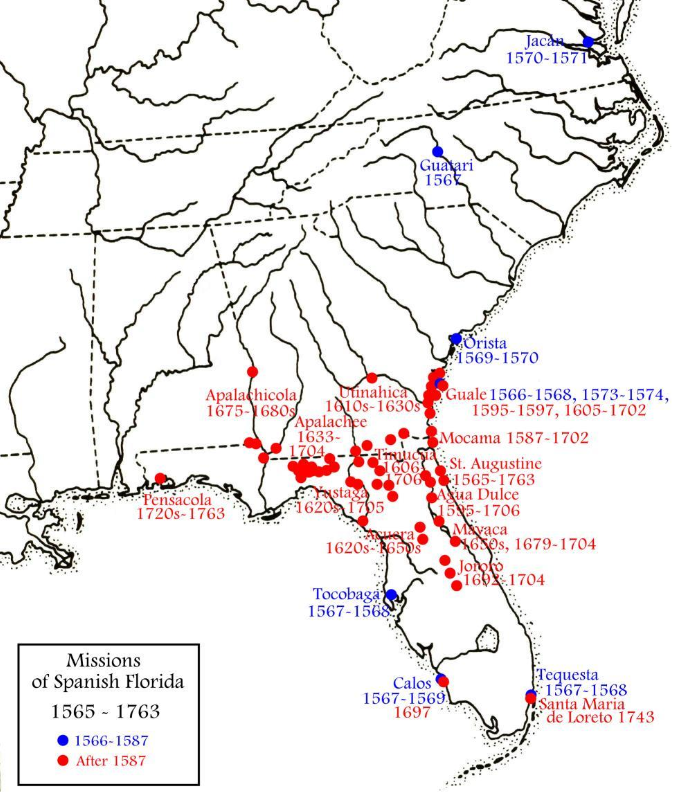
Map of Spanish Missions in Florida 1560s – 1720s:
X/Twitter: @TheHistoryOfTh2
Facebook: The History of the Americans Podcast
Selected references for this episode (Commission earned for Amazon purchases through the website)
Michael Gannon (ed), The History of Florida
Transcript
Click on a timestamp to play from that location
| 0:00.0 | Welcome to the History of the Americans podcast, episode 162. |
| 0:11.4 | I'm your host, Jack Heneman, and I'm recording this episode on September 6, 2024 in Austin, Texas. |
| 0:19.3 | We are telling the history of the lands now encompassed by the United |
| 0:22.5 | States from the beginning without intentional presentism. Last time we talked about Spanish, Florida, |
| 0:30.0 | and particularly St. Augustine in the 1600s. And it would behoove you to listen to that |
| 0:35.3 | episode before this one. That's not a painful |
| 0:38.8 | prerequisite as these things go, since there's a lot of interesting unpleasantness in that episode, |
| 0:45.7 | unless, of course, you are one to avoid unpleasantness. In which case, I would set your |
| 0:51.3 | time machine dial for someplace other than 17th century La Florida. |
| 0:57.3 | This episode is about the complex and interesting civil society of that very time and place, |
| 1:03.4 | which is usually ignored in surveys of American history and the usual teaching of the history |
| 1:09.8 | of the Americans. |
| 1:13.6 | Floridians may have a different experience. I'd be interested in hearing from Sunshine State listeners if they know if the history |
| 1:19.6 | of Spanish Florida is taught in the schools there, like Cabezza de Vaca is taught in Texas. |
| 1:25.2 | Anywho, the usual omission of Spanish Florida is unfortunate, because it's |
| 1:30.4 | bound up with the entire history of not just Florida, our third largest state, but the wider |
| 1:36.9 | southeastern United States, which, by the way, makes up the southeastern conference, our most |
| 1:42.6 | footballist region. The eminent historian of |
| 1:47.3 | early Florida, Amy Bushnell Turner, wrote 1996, quote, to many Spaniards, Florida must have seemed |
| 1:56.5 | a native utopia. In this maritime periphery of strategic rather than economic importance, |
| 2:03.6 | the goals of peaceful evangelism were largely met. Indians were not enslaved. Their lands were not |
| 2:11.3 | alienated. Their lives were not shortened in mines or workhouses. Territorial expansion observed the forms of the conquest |
... |
Please login to see the full transcript.
Disclaimer: The podcast and artwork embedded on this page are from Jack Henneman, and are the property of its owner and not affiliated with or endorsed by Tapesearch.
Generated transcripts are the property of Jack Henneman and are distributed freely under the Fair Use doctrine. Transcripts generated by Tapesearch are not guaranteed to be accurate.
Copyright © Tapesearch 2026.